


Immigrant-Led News Outlets Step Into the Breach, Delivering Trusted Information When Communities Need It Most
When Allan Marrero, an asylum seeker from the Cayman Islands, walked free after five months in immigration detention, he did not simply return to his family’s embrace—he made sure a journalist was there to witness it. Eileen Grench, a reporter for Documented, an independent nonprofit news outlet, had become a trusted chronicler of his ordeal, which began when he was detained after an interview with federal officials for a marriage-based green card. But Grench did not merely document the legal battle; she also illuminated Marrero’s humanity, focusing on the love story he shares with his husband, their resilience, and their determination to maintain joy in the face of uncertainty. “Most folks in these situations aren’t just victims; they’re fighting and being resilient and maintain the beautiful things about their life, too,” Grench said. The Marreros’ faith in Grench and Documented yielded full access and rich reporting that resonated broadly; New York City Mayor Zohran Mamdani even shared Grench’s story on Twitter upon Allan’s release. “To see their story kind of lifted up on to that city stage was really gratifying,” Grench said. Her work is part of a growing wave of immigrant-serving newsrooms across the United States that are meeting a critical need at a time when legacy and mainstream publications are cutting back, lacking resources, or simply losing touch with immigrant communities. These independent outlets are using social media, chat apps, and other nontraditional tools to connect directly with immigrants and non-English speakers—particularly during recent Immigration and Customs Enforcement (ICE) surges—and they are leaving a deep mark. “The impacts are phenomenal for relatively new media outlets, and part of it is because they’re operating on such a hyper-local level,” said Angie Chuang, a journalism professor at the University of Colorado Boulder. “Immigrant communities know what they need. They might not be able to access it or make it happen, but they can articulate their own needs. What these outlets are doing is just understanding how amplifying the community’s voices can help them.”
Last year, Documented and the Spanish-language news service Conecta Arizona launched the Immigrant News Coalition(INC) with the Listening Post Collective, the Bay Area’s El Tímpano, and the Minneapolis-based Sahan Journal to share strategies and resources for serving immigrant communities—and to secure their own survival. Their work has since been strengthened by a $1.5 million award from the Press Forward Foundation to “test and spread effective revenue models for immigrant-serving newsrooms” and additional support from Democracy Fund. Through listening tours and research, the outlets discovered that members of immigrant communities in the US don’t always read news by visiting websites or reading push notifications, especially when English isn’t their first language. Instead, they rely on platforms that may be rife with inaccurate information, such as WhatsApp, which over half of Latinos in the US use. To meet people where they are, Documented runs a WhatsApp group in Spanish, a WeChat group for Chinese immigrants, and a TikTok account in Haitian Creole to combat misinformation about ICE raids and fear-based scams. “Misinformation thrives when there is a vacuum of good information, and immigrant communities are so vulnerable because of the lack of alternatives,” said Madeleine Bair, the founder of El Tímpano. “We’re not translating news into other languages. We’re creating news first and foremost for immigrant communities, and that looks very different than news created for non-immigrant communities.”
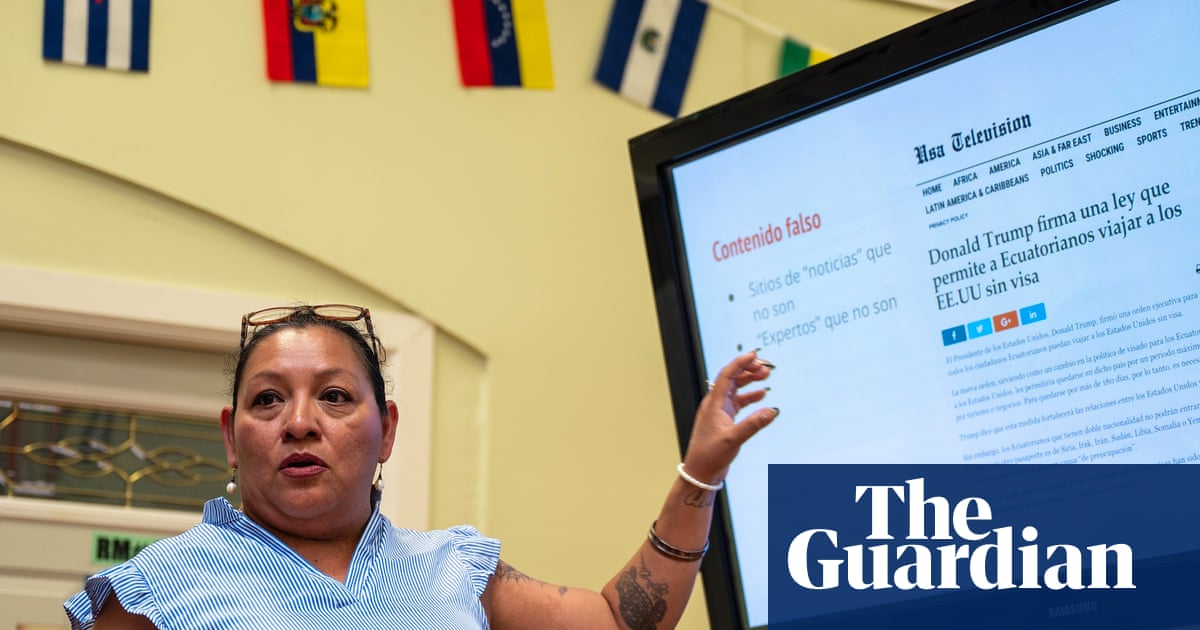
Emmy-winning journalist Maritza Félix started Conecta Arizona’s WhatsApp group, La Hora del Cafecito—or Coffee Time—during the pandemic to provide timely, accurate news for immigrant communities in Spanish. The online gathering space, which has thousands of members across platforms, features a weekly Q&A with expert guests, including immigration attorneys, education policy experts, and labor rights specialists. But as ICE raids have increased, members are increasingly shifting away from the public group chat and into one-on-one direct messages with staff. “They’re afraid of being a screenshot, or having their message forwarded to someone,” Félix said. “Listening to our community taught us that what works today might not work next week. We are listening to what they say and their silences at the same time.” Having a genuine dialogue with the local Bay Area immigrant community has also been crucial for El Tímpano, which means “eardrum” in Spanish. In addition to SMS messaging that reaches more than 7,000 Spanish-speaking immigrants, the outlet’s disinformation defense initiative, Comunidades Informadas, has trained more than400 Latino immigrants in the Bay Area to recognize and address disinformation and misinformation. “By equipping immigrants with an understanding of how disinformation works, it can empower them, so that when they see a rumor of an ICE raid, their immediate response isn’t to panic,” Bair said. “Instead, they can check with a source they trust or call their local rapid response hotline. We’ve received really positive responses to these workshops and to the information that we provide to combat that fear.” In May, the Alameda County Library partnered with El Tímpano for a Spanish-language disinformation defense workshop via Zoom for its staff members. Attendees found the content easy to understand, and it helped them articulate how to identify disinformation not only for community members, but also for their own family members. “After going through the workshop, I was like, ‘I can talk to this with my tia and my tios, and explain it to them in the way that I didn’t really have the language before,’” said Jaqueline Martinez, the library’s equity services coordinator.
For many of these outlets, the work and impact began long before the recent ICE surge. In 2019, Documented co-founders Mazin Sidahmed and Max Siegelbaum spoke with community organizations across New York that were concerned about workers’ wages being stolen. Joined later by reporter Lam Thuy Vo, they launched an investigation, seeking out New York state and federal wage data for four years. The result was Documented’s Wage Theft Monitor, which inspired New York state legislators to introduce three bills to prevent and punish wage theft. “The dual impact of protecting immigrant workers, but also helping the general public understand how pervasive this issue is, has been one of the most rewarding parts of seeing this project come to light,” Sidahmed said. Similarly, LA Taco, which is not part of the INC, originally built trust among Los Angeles immigrant communities through its coverage of food, culture, and cannabis. Then last June, as ICE raids swept through Los Angeles, LA Taco journalist Memo Torres began posting daily recaps of ICE activity on the publication’s Instagram account. By reporting verified information about raids during a time when misinformation ran rampant, Torres became one of LA’s most trusted journalists for immigrant communities, increasing LA Taco’s membership from 1,500 to77,000 and earning attention from state and federal government officials. “I was getting information from people, I started reaching out to rapid responders and building trust with them, and then got included in the network with them,” he said, recalling how he started the Daily Memo.
Over the summer, the Daily Memo wound down, while LA Taco’s political cartoons by Pulitzer Prize finalist Ivan Ehlers, called Sunday Taquitos, took off. In July, his humorous yet poignant illustration about Flock camera surveillance received more than7 million Instagram views and inspired fan-created versions in five different languages. The Ecuadorian American artist said the political cartoons are his short-form way of fighting misinformation and disinformation. “If I can get someone’s attention for five seconds, I can get people to look at important issues and say, ‘Hey, I didn’t know that was happening. Oh man, this is terrible,’” he said. “People will go in and do more research, read more about it, talk to their friends or share it, and that’ll start conversations.” Ehlers has also served as creative director for one of LA Taco’s zines, showcasing the outlet’s reporting on local protests and immigrant communities. Its release in early September was just one of many in-person events LA Taco has held this year to engage with its readers. “The bigger issue is building a community and building support systems and showing people that they’re not alone,” Ehlers said. “We have a lot of people who are willing to fight together, work together,and build something together.” In this way, these immigrant-serving outlets are not just delivering news—they are building infrastructures of trust, resilience, and solidarity that can withstand the relentless currents of misinformation, fear, and political upheaval, ensuring that voices too often relegated to the margins are heard loud and clear on the public stage.