


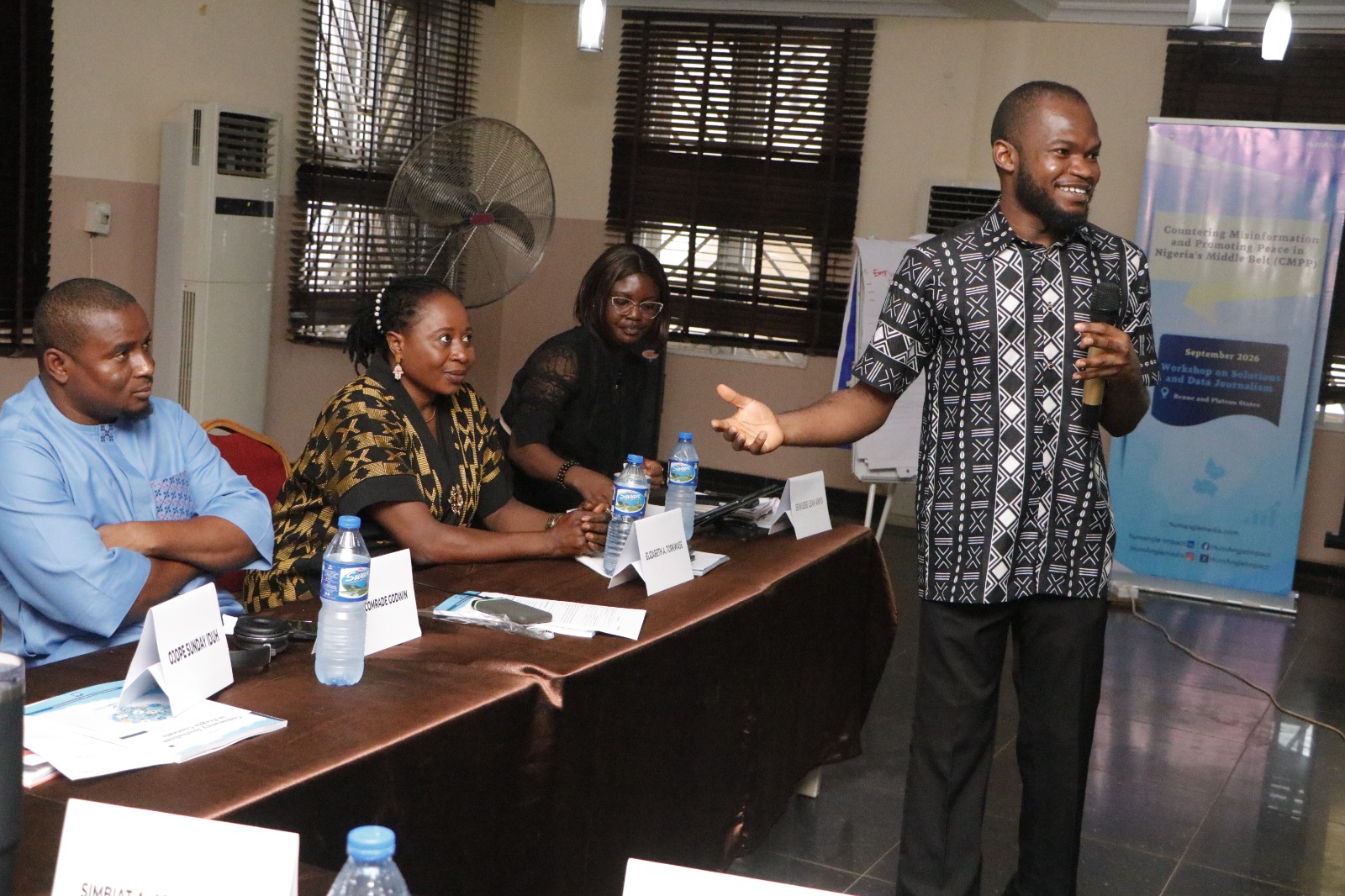
HumAngle Trains Benue Journalists on Solutions and Data Journalism to Counter Misinformation in Conflict-Affected Communities
HumAngle, a non-governmental organisation dedicated to strengthening conflict-sensitive reporting and promoting accurate information, has trained journalists in Benue State on solutions and data journalism as part of a broader effort to fortify reporting and counter the growing threat of misinformation in conflict-affected communities. The training was organised under the project titled “Countering Misinformation and Promoting Peace in Nigeria’s Middle Belt” (CMPP), with Benue and Plateau states selected as the focal states for the initiative. The project is sponsored by Journalism for Human Rights (JHR) and the Canadian High Commission, and it aims to place verification tools, data-driven reporting techniques, and solution journalism frameworks directly into the hands of reporters working in the North-Central region. According to the programme officer of HumAngle, Khadijat Oscar, the initiative is specifically designed to equip journalists with the practical skills needed to identify misleading information before it spreads, respond to false narratives with well-sourced reporting, and prevent the escalation of conflicts that are often triggered or worsened by inaccurate stories. The training comes at a critical time when the Middle Belt region continues to experience communal violence, farmer-herder clashes, and other security challenges that are frequently accompanied by dangerous rumours, hate speech, and manipulative content circulating on social media platforms. By focusing on solutions journalism, the project also seeks to encourage reporters to look beyond the immediate bloodshed and investigate the underlying causes, local peace efforts, and possible pathways to reconciliation that are often overshadowed by casualty figures and sensational headlines. Through a combination of practical exercises, scenario-based discussions, and expert-led sessions, the training aims to cultivate a new generation of journalists who are not only accurate and ethical but also deeply aware of the social impact of their reporting. The selection of Benue and Plateau as focal states is significant because these states have borne the brunt of perennial conflicts in the Middle Belt, making them fertile grounds for misinformation that can inflame tensions and destabilise entire communities. HumAngle’s involvement signals a growing recognition that journalism must be part of the solution in fragile environments, and that reporters need more than just traditional storytelling skills to operate effectively in such contexts. By embedding verification and data journalism into everyday reporting practice, the project hopes to reduce the spread of falsehoods while simultaneously elevating the quality and depth of conflict coverage in Nigerian media.
Speaking at the training, Khadijat Oscar explained that the project goes beyond journalists, as HumAngle also plans to engage state actors, community-based organisations, faith-based organisations, and religious leaders who have direct contact with people at the grassroots. She said this engagement is necessary because combating misinformation requires the collective efforts of different stakeholders, and no single group can effectively address the problem alone. Oscar noted that religious leaders and community-based organisations are often the most trusted voices in rural and semi-urban areas, and they can play a crucial role in correcting false information before it spreads widely. “We believe that it is not just journalists that have a role to play when it comes to countering misinformation. Faith leaders and community-based organisations also have important roles because they interact directly with people at the grassroots,” she said. This multi-stakeholder approach reflects a growing awareness in the media development sector that misinformation thrives in the absence of trusted local voices, and that interventions must therefore extend beyond newsrooms into the very communities where rumours and false narratives are born. Oscar added that the organisation hopes to bring together a diverse range of stakeholders in both states to discuss ways of countering misinformation and eventually develop a coordinated response framework that can help de-escalate situations triggered by false or misleading information. Such a framework, she clarified, would enable journalists, community leaders, religious figures, and government representatives to share information quickly, verify reports collaboratively, and present a united front against the deliberate spread of disinformation. The emphasis on coordination is particularly important in conflict settings where a single unverified story can spark reprisal attacks, force population displacements, or derail ongoing peace negotiations. By creating a platform for structured dialogue and joint action, HumAngle aims to bridge the gap between formal journalism and community-based information systems, ensuring that accurate reporting is reinforced at multiple levels of society. The involvement of state actors is equally significant, as government officials often possess official data and security information that can help debunk rumours, but they may lack the skills or platforms to communicate effectively with the public. Through the CMPP project, HumAngle intends to facilitate better communication between these official sources and the media, thereby creating a more transparent and accountable information ecosystem in the Middle Belt. Oscar’s remarks underscored a fundamental shift in how media development projects are being designed, moving away from one-off trainings and towards sustained, multi-layered interventions that recognise the complex social dynamics in which misinformation operates.
Oscar further stated that one of the major expectations of the training is to achieve a shift in the mindset of journalists regarding how they report conflict and other sensitive issues. She stressed the importance of accuracy in journalism, particularly when reporting from conflict-affected areas, and noted that journalists should not sacrifice accuracy for speed. In an era of instant news and viral breaking headlines, the pressure to publish quickly often leads to the dissemination of unverified information, which can have devastating consequences in fragile communities. Oscar emphasised that the mantra of the training was simple but critical: accuracy before speed. “It is not just about breaking the headlines; it is about telling the stories the way they should be told, considering the sensitivity of these conflict-affected areas,” she said. This call for deliberateness in newsroom practice challenges the fast-paced culture of modern journalism, but it is a necessary corrective in regions where every word can carry immense weight. The training also urged journalists to pay greater attention to the human consequences of conflict rather than focusing solely on casualty figures and statistics. Oscar argued that reducing people to mere numbers dehumanises victims and fails to capture the long-term suffering, trauma, and resilience of affected communities. “We want journalists to also look at the human side, the human costs of these conflicts. It is beyond just publishing numbers and putting the numbers out there,” she said. This perspective aligns with the broader principles of solutions journalism and human rights reporting, which prioritise the dignity of individuals and the systemic factors that enable violence. By focusing on human-centred narratives, journalists can produce stories that resonate emotionally with audiences, generate empathy, and provoke meaningful responses from policymakers and the public. The training therefore included exercises designed to help reporters identify compelling human stories within conflict zones, interview survivors and witnesses without causing further harm, and frame their reporting in ways that respect the privacy and safety of vulnerable people. Oscar’s emphasis on mindset shift suggests that the project is not simply about teaching technical skills, but about transforming the values and attitudes that underpin journalistic work in conflict settings. She expressed hope that the lessons from the training would long outlive the sessions themselves, and that participating journalists would become advocates for sensitive and accurate reporting within their own newsrooms. As more reporters adopt this approach, the overall quality of conflict coverage in Nigeria is likely to improve, and the capacity of false narratives to spark violence will be significantly reduced.
Beyond individual reporter skills, Oscar said the project is also designed to encourage stronger collaboration between journalists and community-based and faith-based organisations, arguing that such collaborations would help bridge existing gaps between the media and grassroots organisations and strengthen efforts to counter misinformation within affected communities. She noted that there has often been a disparity between professional journalists and these local organisations, with each side working in isolation from the other. “We want journalists to collaborate effectively with community-based and faith-based organisations within these communities because they can actually work together. It seems there has been a disparity, and that is another gap we hope to eliminate,” she said. This desire to dismantle the barriers between journalists and community leaders reflects a broader understanding that accurate information is not solely the province of trained media professionals. Local organisations often have deeper knowledge of the communities, stronger relationships with residents, and greater access to the informal networks through which rumours spread. By partnering with these organisations, journalists can gain valuable insights, verify information more efficiently, and ensure that their stories are grounded in the realities of daily life. At the same time, community-based and faith-based organisations can benefit from the fact-checking and verification skills of journalists, helping them avoid unintentionally amplifying false information in their sermons, community meetings, and public statements. This symbiotic relationship has the potential to create a robust information ecosystem in which falsehoods are quickly exposed and corrected before they can cause harm. Oscar’s comments also highlighted the importance of trust-building between the media and the communities they cover. In conflict-affected areas, journalists are often viewed with suspicion by local residents, who may fear that their words will be misreported or that they will be targeted by armed groups for speaking to the media. By working closely with trusted community leaders, journalists can overcome this resistance and gain access to stories and perspectives that would otherwise remain hidden. The training sessions provided practical guidance on how to initiate and sustain such collaborations, including strategies for building rapport with community gatekeepers, respecting local customs and sensitivities, and managing the ethical challenges that arise when reporting on vulnerable populations. This collaborative model is not only more effective for countering misinformation but also more ethical, as it treats community members as partners in the reporting process rather than mere sources of information. It also ensures that the stories being told are more representative of the full spectrum of experiences and opinions within a community, thereby reducing the risk of bias and stereotyping. The project’s emphasis on collaboration is a clear recognition that the fight against misinformation cannot be won in isolation, and that lasting change requires the active participation of all those who influence public discourse in conflict-prone regions.
The training featured a series of expert-led sessions designed to provide journalists with both theoretical frameworks and practical tools for their work. Earlier during the sessions, the Standards and Ethics Editor at HumAngle, Mr Johnstone Kpilaakaa, took journalists through a “Context Setting: Scenario Activity” as well as modules on “Neutrality, Sensitivity, and Preserving Journalistic Standards.” These sessions were intended to help participants understand the complex environments in which they operate and to reflect on the ethical dilemmas they may encounter when covering violent conflicts. The scenario activity, in particular, allowed journalists to role-play difficult situations and practice making decisions under pressure, such as whether to report information received from a single source, how to handle graphic images, and how to protect the identities of vulnerable sources. Kpilaakaa’s session on neutrality and sensitivity emphasised that journalists must strive to remain impartial in their reporting, but not indifferent to the suffering of those caught in conflict. The challenge, he explained, is to preserve the crucial distinction between being a neutral reporter and being a silent bystander to atrocities. This requires a delicate balancing act: journalists must verify facts, attribute assertions to sources, and avoid taking sides, while also ensuring that their reporting is compassionate and respectful towards victims. The module on preserving journalistic standards underscored the importance of adhering to core principles such as accuracy, fairness, transparency, and accountability, even when confronted with the chaos and pressure of conflict zones. Another key session, “Human Rights Journalism: Finding the Stories and Reporting them Ethically,” was facilitated by Fidelis Mbah, who focused on how journalists can uncover stories of human rights abuses without compromising the safety of survivors or the integrity of their reporting. This session explored issues such as informed consent, trauma-informed interviewing, the use of anonymous sources, and the responsible handling of graphic content. It also encouraged journalists to look beyond the immediate events of a conflict to examine broader human rights concerns, including displacement, food insecurity, gender-based violence, and restrictions on freedom of expression. Additionally, a session on “Verification in Low-resource Environments” was led by Hauwa Shaffii Nuhu, who shared techniques for fact-checking and verifying information when access to reliable sources is limited and digital tools may be unavailable. This training equipped journalists with methods for cross-referencing eyewitness accounts, checking official records, using satellite imagery and open-source intelligence, and identifying manipulated images and videos. The verification session was particularly relevant for journalists working in rural areas where internet connectivity is poor and where official sources are often silent or inaccessible. By providing these practical skills, the training ensured that participants left with more than just lofty ideals; they gained concrete tools that they could immediately apply to their daily reporting duties.
The choice of Benue and Plateau as the focal states for this project is both strategic and urgent, as these states have been epicentres of violence in Nigeria’s Middle Belt for years, with recurring clashes between farmers and herders, communal land disputes, and attacks by armed groups. These conflicts have resulted in thousands of deaths, massive displacement, and deep fractures within communities that have lived together for decades. In such an environment, misinformation can act as a dangerous accelerant, turning local disputes into broader ethnic and religious crises, and making it even more difficult for peace-building efforts to succeed. HumAngle’s project, therefore, is not just a training exercise but a direct intervention in the information crisis that accompanies physical violence. The organisation hopes that by empowering journalists and their grassroots partners with the tools to counter misinformation, it can help break the cycle of rumour-driven violence and create conditions for sustainable peace. The project’s plans to develop a coordinated response framework are particularly ambitious, as they envision a network of journalists, community leaders, faith actors, and state officials who can act quickly and collectively when false information threatens to destabilise a community. Such a framework, if successfully implemented, could serve as a model for other conflict-affected regions in Nigeria and across Africa. HumAngle itself has emerged as a leading voice in conflict reporting and humanitarian journalism, known for its in-depth investigations and its commitment to amplifying the voices of affected communities. Its role in this project demonstrates that Nigerian media organisations are increasingly taking responsibility for the broader social consequences of their work, and are willing to invest in the professional development of the journalists who report from the frontlines. For the journalists who participated in the training, the experience was an opportunity to reflect on their own practice, learn from their peers, and recommit to the values of accuracy, sensitivity, and human dignity. As the project unfolds in the coming months, its impact will likely be measured not only in the quality of reporting but also in the number of rumours that are stopped from spreading, the misunderstandings that are prevented, and the lives that are saved as a result of more informed and empathetic journalism. In the end, the training in Benue State is a powerful reminder that truth is not just a professional obligation for journalists; it is a peace-building resource that can help communities navigate the darkest moments of conflict and emerge with their cohesion and humanity intact. The CMPP project represents a significant step towards a media environment in which information is treated with the care, precision, and accountability that it deserves, and where the fight against misinformation is recognised as a shared responsibility that involves journalists, religious leaders, state actors, and community members alike.