


From Scroll to Sale: The Evolving Dynamics of Digital Consumer Behavior in Saudi Arabia
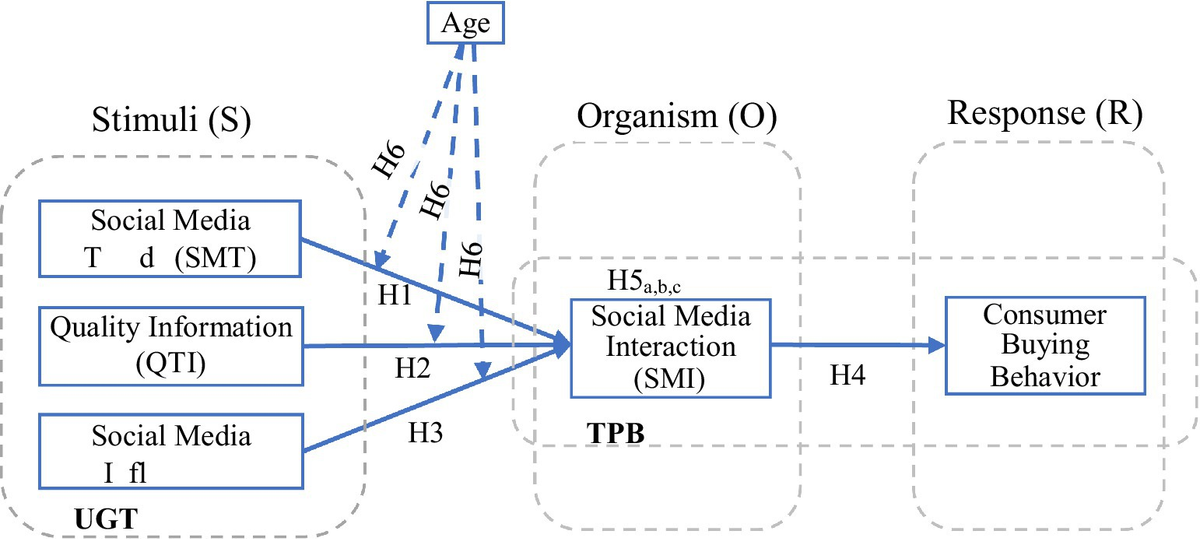
A recent study titled “From scroll to sale: how social media triggers and age shape digital consumer decisions through interaction” provides a critical look at how digital stimuli—specifically social media trends, information quality, and influencer cues—transform into tangible purchase actions. By surveying 359 Saudi social media users, the research leverages a robust theoretical framework combining the S-O-R (Stimulus-Organism-Response) model, Uses and Gratifications Theory (UGT), and the Theory of Planned Behavior (TPB). The findings offer a nuanced perspective on why traditional influencer-led marketing may be losing its potency in digitally mature markets.
The research identifies “Social Media Interaction” (SMI)—defined as the cognitive and emotional connection a user forms with content—as the central engine driving consumer buying behavior (CBB). The study confirms that when users engage with trending content or high-quality information, they are significantly more likely to make a purchase. This suggests that modern consumers prioritize the utility and social proof of content over passive consumption, framing SMI as a necessary bridge between merely seeing an ad and eventually buying a product.
One of the most striking findings is the “null” result concerning influencer cues (ICR). Despite the widespread reliance on influencers in modern marketing strategies, the study found no significant link between influencer content and consumer purchase behavior in the Saudi market. This absence of impact, coupled with the rising discourse on “influencer fatigue,” suggests that consumers may be becoming desensitized to celebrity or influencer endorsements, increasingly viewing them as purely commercial or lacking in authentic credibility.
Furthermore, the study investigated whether generational differences alter how users process these digital cues. Contrary to initial hypotheses that younger users might be more susceptible to social media trends than older cohorts, the researchers found no significant age-based moderation. This indicates that in highly digitalized societies like Saudi Arabia, tech-savviness is becoming a universal trait across demographics, rendering traditional age-based marketing segmentation less effective than strategies focused on shared behavioral motivations and content relevance.
For digital marketers and brands, the implications are profound. The research advocates for a shift away from influencer-centric strategies in favor of content that emphasizes transparency, accuracy, and communal trends. By prioritizing “quality of information”—such as objective product reviews and clear, helpful content—brands can foster the cognitive trust required to drive engagement. The study reinforces that interactive participation, such as polls and community-driven discussions, serves as a higher-value driver of purchase intent than celebrity affiliation in the current digital landscape.
Ultimately, the study serves as a call to action for marketers to recalibrate their digital strategies toward “interaction-led” commerce. As the digital market continues to mature, success lies in creating environments where consumers feel empowered through reliable information and authentic social interaction. With the research showing that social media interaction accounts for roughly 27.6% of the variance in consumer buying behavior, companies that foster meaningful engagement—rather than merely broadcasting influencer content—are better positioned to convert digital scrolls into final sales.