


**In an era where misinformation can spread faster than the facts it distorts, a recent social media post has resurrected a debunked claim about COVID-19 vaccines and pregnancy, presenting manipulated statistics as evidence of a hidden danger. The claim, amplified by political talk show host Katie Pavlich on the platform X, alleges that doctor-recommended COVID-19 shots functioned as “abortion shots” for pregnant women, citing staggering miscarriage rates of 81% and 82% from official data. These figures, however, are the result of a long-running and deliberate misrepresentation of early vaccine safety data, a misrepresentation that has been consistently refuted by medical researchers and public health experts who study the actual science of immunology and maternal health, rather than taking numbers out of context to manufacture a crisis where the data suggests none of the sort exists.
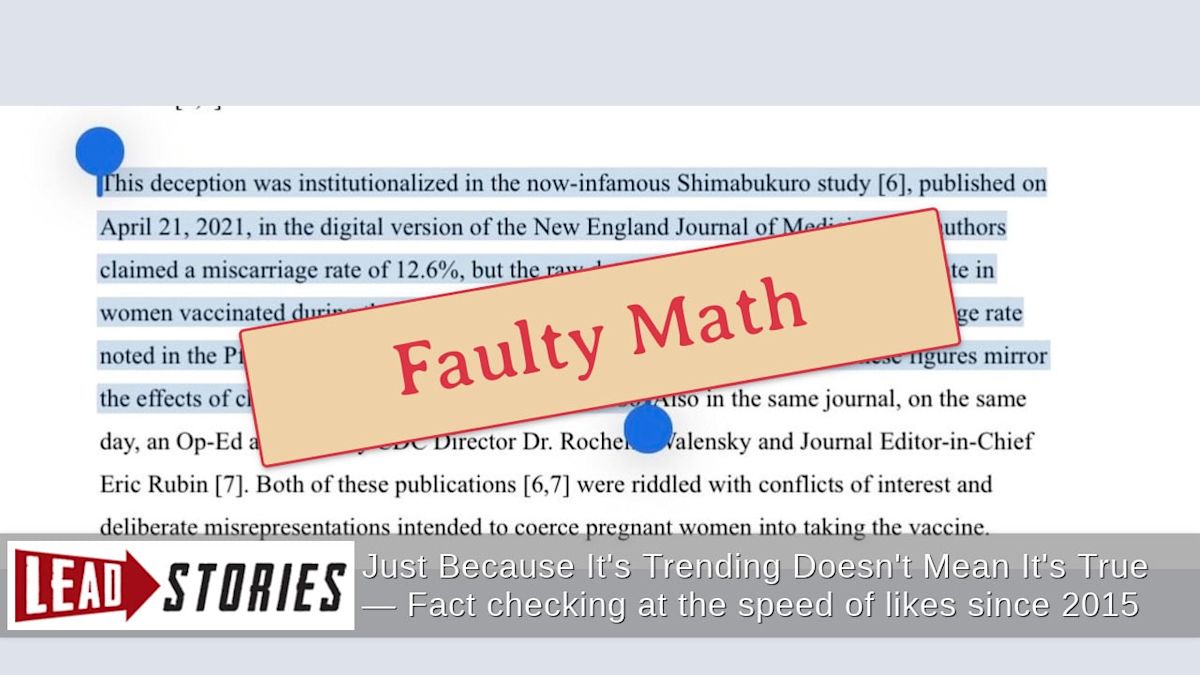
The genesis of these alarming figures can be traced back to a gross misreading of a pivotal study published in the New England Journal of Medicine in April 2021, known as the Shimabukuro study. Conducted during the initial rollout of the vaccine in early 2021, the research utilized surveillance data from the CDC to track the outcomes of pregnant individuals who received the mRNA vaccines. The study reported 104 spontaneous abortions out of 827 completed pregnancies, a rate of 12.6%. But critics seeking to discredit the vaccines achieved a bogus 82% rate by deploying a deeply flawed statistical maneuver: they simply subtracted the 700 women who had been vaccinated in the third trimester from the denominator. By arbitrarily excluding this massive and valid data set, they transformed a relatively low-risk population into a tiny, non-representative subset, thereby inflating the apparent risk to imply that doctors were seeing a silent miscarriage epidemic, a conclusion the study’s authors never made and the data never supported, as the inclusion of all gestational ages is crucial for an accurate assessment of pregnancy outcomes.
Further obfuscation comes from a separate analysis of Pfizer’s Post-Authorization Adverse Event Reports, data that was dredged up to lend a false sense of consistency to the 82% figure. This data set, however, was riddled with incomplete records regarding pregnancy outcomes, with outcomes pending or unreported for the vast majority of participants. When the numbers are actually calculated, the 28 reported losses out of 270 pregnancies yields a rate of about 10%, a figure that remains an undercount due to reporting bias but is nowhere near the 81% claimed. The 81% figure was reached by fruitlessly dividing the 28 known losses by the 32 pregnancies that had a defined outcome at the time of the report—a rudimentary arithmetic error since 28 divided by 32 actually equals 87.5%, not 81%. Regardless of the exact integer, this calculation is statistically invalid because it disregards the fundamental limitation that early-pregnancy losses are detected sooner than live births, creating a misleading snapshot when evaluating a cohort that hadn’t yet reached the point of delivery.
To understand the actual medical consensus, one must look to the large-scale meta-analyses that followed, which provide the context that early data lacked. A comprehensive meta-analysis published in early 2023 pooled data from 21 separate studies encompassing over 150,000 pregnant women, specifically asking whether COVID-19 vaccination was linked to miscarriage. The findings were resounding: a 9% miscarriage rate among vaccinated women, with no statistically significant association found between vaccination and adverse pregnancy outcomes. This 9% figure aligns perfectly with the established baseline risk of miscarriage in the general pregnant population, which some estimates place between 10% and 20% depending on the population and gestational age. When robust data from hundreds of thousands of pregnancies reveals a miscarriage rate consistent with that of the unvaccinated public, the claims of an 81% or 82% miscarriage rate don’t just appear false; they become an absurd statistical impossibility, as no country’s birth rates would survive such an outcome.
In conclusion, the claims regarding the 81% and 82% abortion rates represent a masterclass in misinformation, weaponizing incomplete data to sow doubt and distrust in life-saving medical interventions. The false inference stems from a deliberate failure to understand that early pregnancy losses are resolved more quickly than live births, leading to an overrepresentation of these cases in preliminary, incomplete datasets. The scientific evidence, rigorously vetted through peer review and meta-analysis, is unambiguous: there is no causal link between the COVID-19 vaccines and miscarriage. As Dr. Andrea Edlow, a maternal-fetal medicine specialist and researcher, has repeatedly pointed out, the virus itself poses a far greater risk to pregnant individuals. The data from the real world, encompassing millions of pregnancies, has consistently exonerated the vaccines, rendering these constantly recycled 81% and 82% figures not just misleading but a dangerous disservice to public health. As we move forward, critical thinking and a grounding in scientific literacy must serve as our defense against the relentless tide of misinformation.