


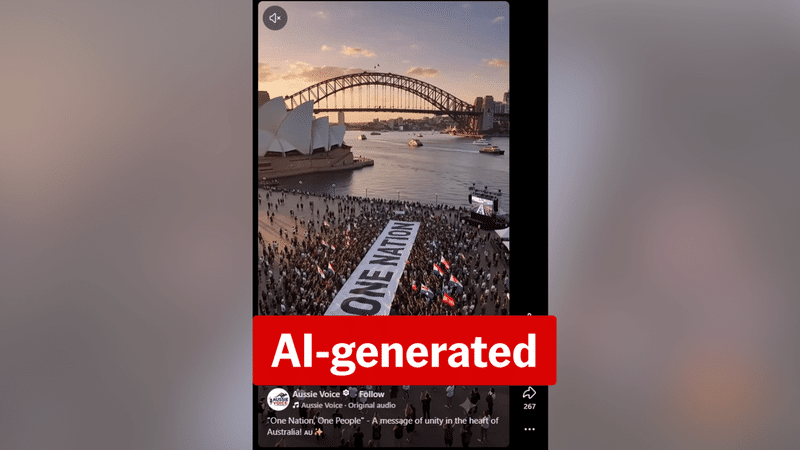
AI-Generated Fake Videos of One Nation Rallies Go Viral, Fact-Check Reveals
Widely shared social media videos that purport to show massive One Nation rallies across Australia are actually AI-generated fakes posted by a disinformation page, according to a new analysis from AAP FactCheck. The videos, which have amassed tens of thousands of views, display clear signs that they have been created using artificial intelligence, including misspelt signs and landscapes that do not match the real locations they claim to depict. The videos are being spread by a page called “Aussie Voice,” and some social media users have been genuinely convinced that they show real events. One video, accompanied by the caption “Thousands of proud Australians standing together for our country. Strong. United. Unstoppable,” purports to show helicopter footage of a One Nation rally taking place in a large open field. However, the clip contains a banner that appears to read “ONATION” rather than “ONE NATION,” a telltale linguistic error typical of AI image and video generators. Moreover, the footage carries a Veo watermark, which indicates that it was produced using Google’s Veo AI video-generation technology. The proliferation of such content raises serious concerns about the ease with which synthetic media can be created and circulated as authentic political events, especially in the lead-up to elections and during debates over national identity and immigration policy.
The second video identified by AAP FactCheck makes an even bolder claim, describing itself as “a bird’s-eye view of unity.” This clip again appears to show aerial footage taken from a helicopter, with dozens of people gathered around a giant banner that reads “ONEE NAATION.” The typographical errors, including the doubled vowels and missing spaces, are unmistakable markers of AI-generated imagery, as are the unnatural shapes and distortions in the crowd and the landscape. In the bottom-right corner of the video, the Gemini logo is clearly visible, confirming that the clip was created using Google’s Gemini AI tools. These watermarks and logos are embedded in AI-generated outputs and are intended to signal the synthetic nature of the content, yet they are often overlooked or ignored by viewers who share such videos with political enthusiasm. The fact that these obvious identifiers did not prevent thousands of people from believing and sharing the videos highlights the challenge of media literacy in the age of deepfakes and generative AI. The videos are strikingly realistic at first glance, especially in the movement of the helicopter and the seeming spontaneity of the crowds, but the textual errors and watermarks provide a clear path to verification for any careful observer.
Further videos in the same series claim to show helicopter footage of One Nation rallies in Sydney, with one caption reading, “One Nation, One People – A message of unity in the heart of Australia.” The video supposedly shows a rally taking place near the Sydney Opera House, but an examination of the foreshore shown in the clip reveals significant inconsistencies with the actual geography of the location. The proportions of the harbour, the shape of the shoreline, and the arrangement of buildings do not match satellite imagery or photographs of the real Sydney foreshore. As with the other clips, the Gemini logo is visible in the bottom-right corner, firmly establishing that the footage was artificially generated. Another video in the same series also purports to show a rally at the Opera House, with a similar caption and similar aerial framing. Yet again, the foreshore shown in the clip does not match the real location, and the Gemini logo is clearly present. More bizarrely, some people in the crowd are inexplicably waving the Spanish national flag and what appear to be Croatian or Paraguayan flags, a detail that makes no sense for an Australian political rally and further underscores the randomness of AI-generated content. As the video progresses, the text on a large One Nation banner gains an extra ‘a’ in the word ‘nation,’ shifting from “NAATION” to “NAAATION” or similar, demonstrating the instability and lack of coherence that characterises AI-generated text and graphics.
The page behind these misleading videos, “Aussie Voice,” appears to be a disinformation outlet rather than a genuine grassroots political organisation. One Nation and its leader, Senator Pauline Hanson, have long been popular targets for disinformation pages on social media, and AAP FactCheck has previously debunked dozens of posts targeting the Senator and the party. The relentless focus on One Nation appears to be driven by a desire to either inflate the party’s apparent support for certain political narratives or to make it look ridiculous, depending on the underlying intention of the anonymous page operators. In some cases, such pages aim to sow division and distrust in democratic processes by creating fantastical images of mass movements that do not exist; in others, they may be attempting to attract attention and engagement to monetise the page or spread political propaganda. The comments sections on the videos reveal a worrying trend, with several users expressing excitement and support for rallies they believe took place, while other users have pointed out the signs of AI generation and been attacked or dismissed by those who prefer to believe the videos are real. This dynamic illustrates a broader phenomenon in the misinformation ecosystem, where fact-checking and verification are often met with hostility, and where emotionally charged content—such as that showing patriotic crowds and nationalistic messaging—tends to rapidly overcome rational scepticism.
The rise of AI-generated video and image tools has transformed the landscape of political disinformation. Previously, doctoring a photograph or video required significant technical skill, but modern generative models such as Google’s Veo and Gemini, OpenAI’s Sora, and other similar tools allow anyone to produce realistic-looking synthetic footage in seconds. In the context of Australian politics, where compulsory voting and high engagement make voters a target for manipulation, the appearance of fake rally footage is particularly concerning. The technology is developing faster than platform moderation and legal frameworks can keep up, and the onus is increasingly on ordinary users to critically evaluate the media they encounter. Knowing how to spot the signs of AI generation—such as garbled text, impossible geometry, misplaced national symbols, and watermark logos—is now an essential skill for the digital age. However, there are also systemic responsibilities. Social media platforms that delay or fail to remove such content face ongoing criticism for amplifying false information, and there are growing calls for mandatory labelling of AI-generated content to prevent confusion and harm. In Australia, the electoral commission and various fact-checking organisations are monitoring the impact of synthetic media on electoral integrity, but a robust response requires a combination of regulation, platform accountability, and public education.
Ultimately, these particular videos serve as a vivid reminder of the need for careful verification before sharing content that appears to show political events or mass gatherings. The fact that the videos carry visible AI watermarks and contain obvious typographical errors did not stop them from being widely viewed and believed, which suggests that many people are still unprepared for the realities of synthetic media. Whenever an extraordinary political event is presented on social media, especially one that claims to show huge crowds or dramatic scenes, it is worth pausing and asking a few simple questions: Does the location match known landmarks? Are the signs and banners spelled correctly? Are the flags and symbols appropriate for the location and cause? Are there any watermarks or logos from AI tools? Crucially, does any independent news outlet or reliable eyewitness account confirm that the event actually occurred? In this case, no legitimate coverage of the alleged One Nation rallies exists, and all evidence points to the videos being fabricated from start to finish. AAP FactCheck remains a vital resource in this fight against misinformation, and as an accredited member of the International Fact-Checking Network, it continues to investigate and debunk false content on a daily basis. Australians are encouraged to follow AAP FactCheck on Facebook, Instagram, Threads, X, BlueSky, TikTok and YouTube to stay informed about the latest scams, fake news, and manipulation campaigns. The spread of fake rally videos is not merely an innocent joke; it undermines public trust in real political participation and distorts the national conversation. In a time when artificial intelligence can conjure convincing scenes of events that never happened, the responsibility of every citizen to verify, question, and think critically has never been more consequential.