


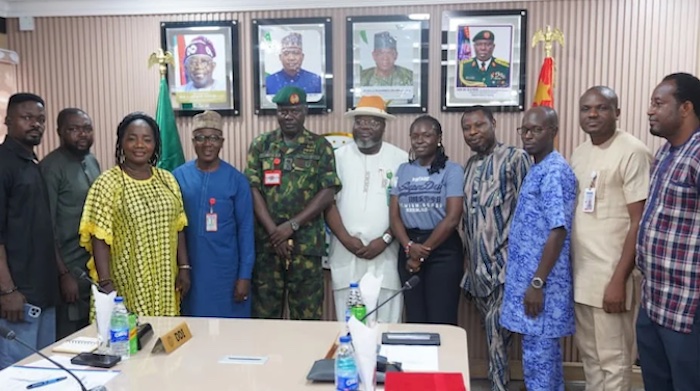
The Office of the National Security Adviser (ONSA), the Defence Headquarters (DHQ), and the Defence Correspondents Association of Nigeria (DECAN) have officially recommitted to a strategic partnership aimed at fostering accurate defence reporting and safeguarding national security. This renewed collaboration seeks to address the escalating challenges of fake news, misinformation, and disinformation, which have increasingly threatened to undermine public confidence in Nigeria’s security institutions. The agreement was cemented during formal courtesy visits by the newly elected DECAN leadership, led by President Chief Odita Sunday, to key stakeholders in the nation’s security architecture, including Dr. Chido Onumah, the Special Adviser on Strategic Communication to the National Security Adviser, and Major General Samaila Uba, the Director of Defence Information.
During the engagements in Abuja, Chief Odita Sunday emphasized that the relationship between the media and the armed forces serves as a critical bridge for public understanding. He defined the role of defence correspondents as a complementary force to the military’s battlefield efforts, noting that by informing and educating the public through balanced reporting, journalists effectively shape the national narrative. Seeking to institutionalize this cooperation, Odita formally requested enhanced access to official information, more consistent operational briefings, and specialized training programs designed to bolster the expertise of those covering the complex security beat. Moreover, he revealed plans for a new quarterly publication, The Defence Correspondent, scheduled to launch in October 2026, which will serve as a repository for documenting the achievements and operational activities of Nigeria’s defence institutions.
Representing the Office of the National Security Adviser, Dr. Chido Onumah praised the association for its professionalism and underscored the indispensable nature of the media in a democratic security framework. Acknowledging the requests raised by the DECAN delegation, Onumah pledged to present these concerns to the National Security Adviser, Mallam Nuhu Ribadu, for urgent consideration. He placed a high premium on capacity building, asserting that continuous training is essential for journalists to navigate the nuances of the security sector with greater responsibility. Dr. Onumah reaffirmed that the ONSA remains committed to working alongside the media to ensure that information dissemination aligns with national security interests, promising a more transparent and responsive communication channel moving forward.
At the Defence Headquarters, Director of Defence Information, Major General Samaila Uba, echoed these sentiments, welcoming the new DECAN leadership and stressing the importance of the media as a tactical partner. He noted that in an era dominated by social media manipulation and the emergence of artificial intelligence as a conduit for malicious propaganda, the burden of truth rests heavily on the press. Major General Uba urged journalists to serve as a firewall against adversaries who exploit false narratives to spread fear or erode public trust in the state. By prioritizing verification through official channels, he argued, the media plays a patriotic role in neutralizing threats that seek to sabotage the reputation of the nation’s armed forces.
A significant portion of the discourse at the Defence Headquarters centered on the ethical responsibilities of the press in a volatile environment. Major General Uba issued a stern caution regarding the publication of classified military information, warning that even well-meaning reporting could inadvertently endanger active operations or provide tactical advantages to terrorist groups. He emphasized that responsible journalism must strike a delicate balance between public interest and operational security. This directive highlights the military’s expectation that while collaboration is encouraged, the safety of soldiers and the integrity of national security operations remain the paramount concerns that should guide the pens and platforms of all defence correspondents.
The meeting concluded on a spirit of mutual appreciation, with Major General Uba conveying the gratitude of the Chief of Defence Staff for the professional coverage provided by journalists on the front lines and domestic assignments. Both parties agreed that the road ahead requires sustained transparency, rigorous verification, and a shared commitment to national unity. As the stakeholders look toward future milestones—including the launch of DECAN’s new publication and the potential rollout of improved training and media infrastructure—the alliance stands as a testament to the idea that secure nations are built not only on the strength of their weapons but on the integrity and accuracy of the information provided to the citizenry.