


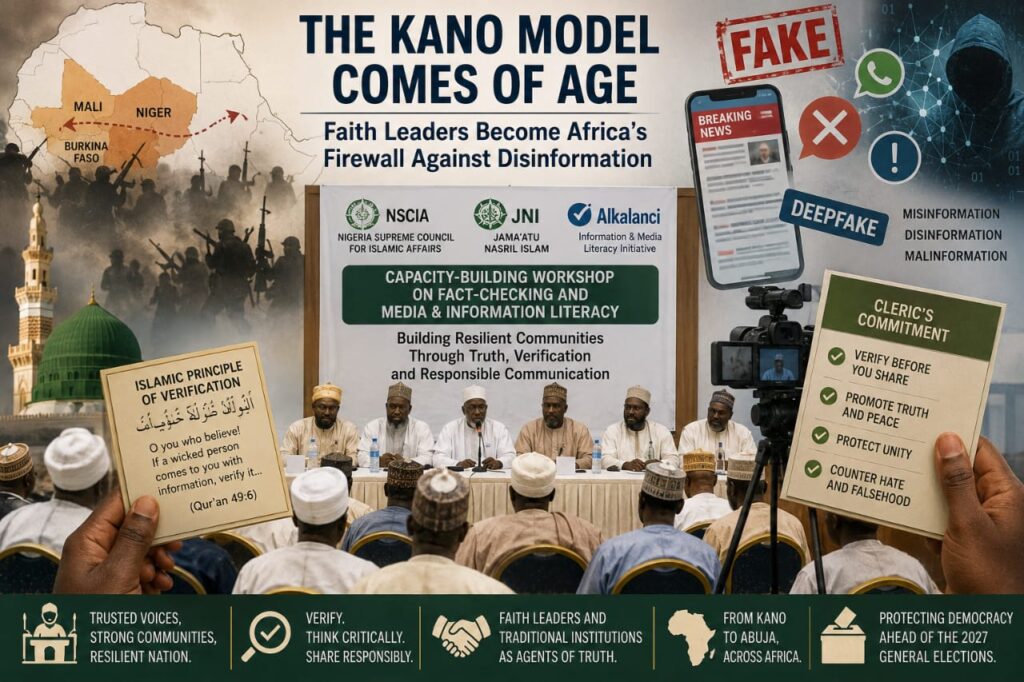
The Kano Model Comes of Age: Faith Leaders Become Africa’s Firewall Against Disinformation
In an era where digital connectivity has outpaced media literacy, the city of Kano, Nigeria, has emerged as the unlikely epicenter of a groundbreaking resistance movement against the rising tide of online disinformation. Once viewed merely as a regional hub, Kano has formalised a sophisticated strategy—now dubbed the “Kano Model”—that leverages the unrivaled moral authority of religious leaders to combat the spread of viral falsehoods. By integrating traditional storytelling with modern digital verification techniques, the city has created a structural framework that is increasingly being studied as the gold standard for social stability across the African continent.
The core of the Kano Model lies in the recognition that in many African communities, an Imam’s sermon or a Bishop’s benediction carries significantly more weight than the findings of a fact-checking NGO. Recognizing this, civic organisers have spent the past two years meticulously training faith leaders to act as “truth intermediaries.” Rather than approaching the digital age with suspicion, these leaders are being equipped with the tools to scrutinize WhatsApp forwards and social media propaganda, transforming the pulpit into the final line of defense against incendiary misinformation that has historically incited civil unrest in the region.
The success of this initiative is fundamentally rooted in the concept of communal trust. Disinformation thrives in environments where institutional trust is low, creating a vacuum that charlatans and provocateurs readily fill with sensationalist narratives. By placing the onus of verification on pillars of the community, the Kano Model bridges the gap between abstract internet safety and local cultural ethics. Participants are instructed to treat the dissemination of false information as a moral failing, effectively rebranding digital hygiene as a religious duty, which has proven far more effective than government-mandated censorship or top-down digital literacy campaigns.
However, the transition from local experiment to regional policy has not been without its hurdles. Critics and skeptics initially questioned whether involving religious institutions would invite ideological bias, potentially creating new echo chambers. Yet, the data suggests otherwise; organizers have been careful to implement a strictly secular approach to verification, focusing on objective data and logical fallacy identification. This careful separation of religious authority from partisan politics has allowed the model to transcend sectarian lines, fostering an environment where leaders from disparate backgrounds emphasize shared truth as a communal necessity rather than a political debate.
As the Kano Model demonstrates its efficacy, neighboring nations are beginning to take note, eyeing the framework as a modular export for their own volatile social landscapes. Ethiopia, Kenya, and Ghana are among the countries currently exploring how to adapt this faith-based intervention to their specific socio-political contexts. The brilliance of the model is its scalability; while the content of the teachings may vary, the structural mechanism—empowering local influencers to curate the digital information landscape—remains a potent, cost-effective solution to a problem that has previously thwarted even the most well-funded tech giants and international regulatory bodies.
Looking ahead, the evolution of the Kano Model signifies a paradigm shift in how global societies manage the “infodemic.” By moving away from a purely technocratic view of information warfare and toward a community-centric philosophy, Kano has provided Africa with a distinct advantage in the age of generative AI and deepfakes. As the continent continues to grapple with the dual pressures of increasing internet penetration and political polarization, the faith-led firewall established in Nigeria stands as a testament to the power of human connection. The future of African digital stability, it seems, will not be determined by algorithms alone, but by the strength of the traditional bonds that have always anchored its people.