


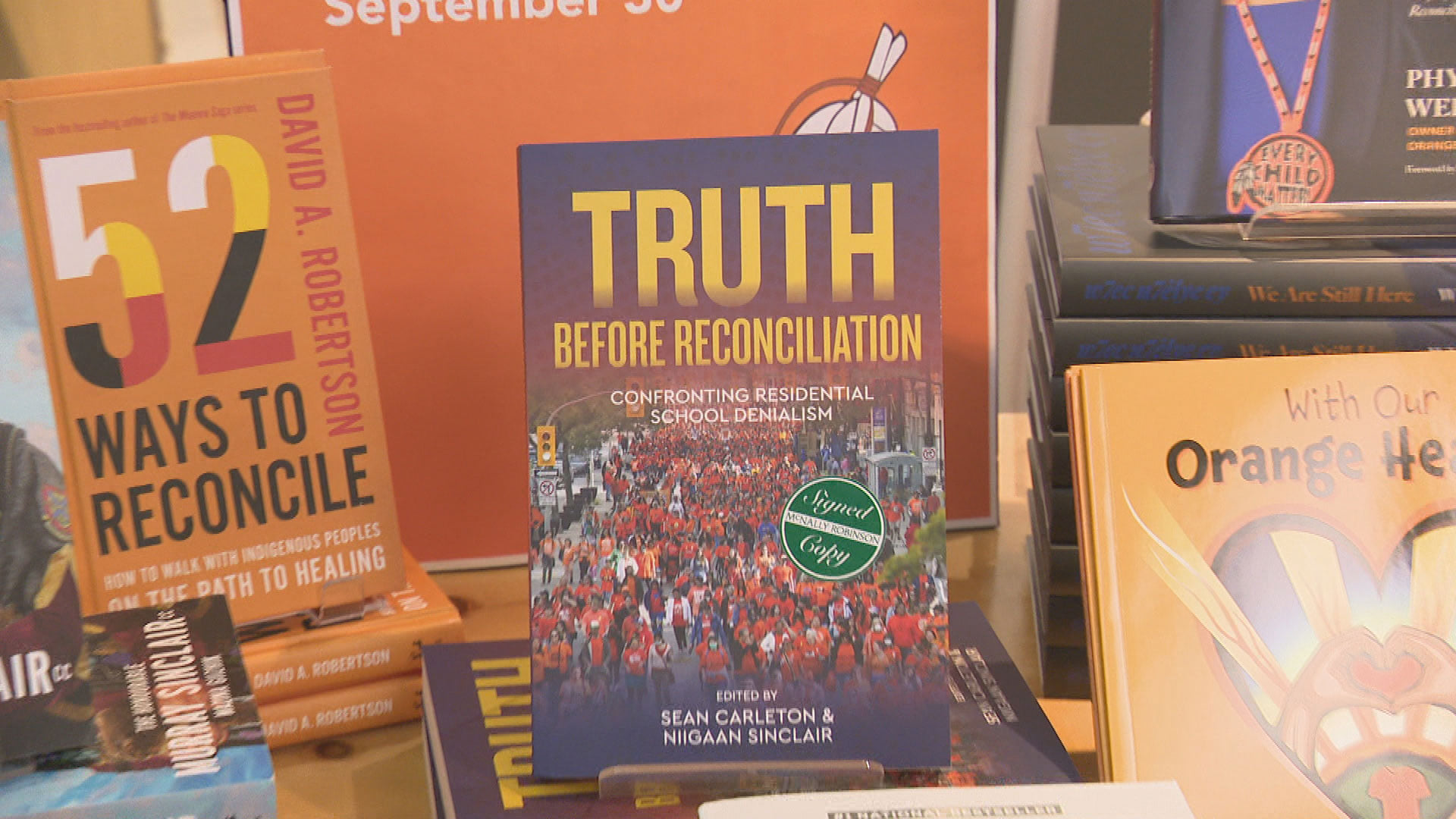
Truth Before Reconciliation: Book Launch Becomes a Public Contest Over Canada’s History
The launch of Truth Before Reconciliation: Confronting Residential School Denialism was never going to be a quiet evening. The book, a collaboration between Anishinaabe scholar and columnist Niigaan Sinclair and historian Sean Carlton, sets out to dismantle the growing industry of residential school denialism in Canada, and the evening’s atmosphere reflected exactly that polarizing task. According to Tiar Wheatle, who reported from the event, the room contained both those who had come to honour the truth and those who had come to challenge it. Wheatle described the mood as “electric and fragile,” with Indigenous elders, survivors, students, educators, and allies sitting alongside a small but vocal group of denialists who appeared determined to disrupt the proceedings before they even began. The authors were introduced after an opening prayer and a drum song, and the applause for them was warm, sustained, and emotional. But not everyone in the room was applauding. Wheatle observed a handful of attendees in the back rows who kept their arms crossed, pulled out their phones, and began recording the stage from the moment Sinclair and Carlton stepped forward. One of those attendees was heard muttering that the event was “a waste of a good evening.” Another, louder, said that the country was “tired of being shamed.” The contrast was stark, and it did not escape the authors. Sinclair looked out over the full room, smiled briefly, and said, “This is exactly why we wrote this book.” The launch, in other words, was not simply a literary ceremony. It was a live demonstration of the book’s central thesis: that truth and denialism are locked in a struggle for the soul of Canadian memory, and that reconciliation cannot begin until Canadians decide which side they are on.
Sinclair and Carlton are not strangers to the long and painful history of residential schools. Sinclair is one of Canada’s most prominent Indigenous public intellectuals, a professor, a writer, and a frequent commentator on Indigenous rights, treaty relationships, and the ongoing effects of colonialism. Carlton is a historian whose work has focused on the relationship between education, memory, and power, and on the way that Canadians have been taught to forget the racist foundations of assimilationist policy. Together they have produced a book that is both a historical study and an urgent political intervention. Truth Before Reconciliation documents the residential school system in the terms used by the Truth and Reconciliation Commission: a policy of cultural genocide, a system designed to break the bonds between Indigenous children and their families, languages, lands, and identities. The book details the devastating impact of the schools, the widespread patterns of neglect, disease, and abuse, and the deliberate erasure of Indigenous knowledge and governance. But the authors do not stop at history. They carefully identify and dismantle the myths that have come to define residential school denialism: the claim that the schools were well-intentioned experiments that simply failed; the claim that survivors have exaggerated their suffering; the claim that the discovery of unmarked graves was based on unreliable technology or manufactured evidence; and the claim that Indigenous peoples should simply “get over” the past. The authors trace these denialist narratives back through Canadian history and show how they are part of an ongoing effort to avoid accountability, reparations, and meaningful change. In a era where denialist content is spreading across social media, and where even some public figures have questioned the findings of the Truth and Reconciliation Commission, Sinclair and Carlton argue that the only way forward is to place truth at the centre of every conversation. Without truth, they insist, reconciliation is just rhetoric.
The supporters who filled the launch venue were as diverse as the country itself. According to Wheatle, the crowd included Indigenous elders and youth, survivors of residential schools and their descendants, university students, teachers, librarians, union organizers, church members, and non-Indigenous Canadians who said they had come to listen and learn. Many wore orange shirts, the symbol of survivors’ resilience and of the movement to remember the children who never came home. A table near the entrance was stacked with copies of the book, and by the end of the night, almost every copy had been sold. Wheatle spoke to several supporters during the event. One elderly survivor, holding a faded photograph of herself as a young child, said that the book was “a gift” because it put a name to something she had always known: “They made us doubt ourselves for years,” she said. “They told us we were liars, that we were making it up because we were angry. This book is the proof that we were not lying. We were carrying the truth all along.” A high school teacher told Wheatle that she planned to use the book in her classroom because her students were being exposed to denialist videos and podcasts. “They need something they can hold in their hands, something with footnotes and primary sources,” she said. “They need to know that the truth is not just an opinion.” The launch also included moments of ceremony and grief. A survivor rose to speak and described the day she was taken from her family, and several people in the room wept openly. Another woman stood and thanked the authors “for speaking for those who cannot speak anymore.” Wheatle wrote that the supporter side of the room seemed to embody the book’s argument: residential school history is not an abstraction, but the living memory of real people, and to deny it is to wound them again.
The denialists, however, made sure that they could not be ignored. Wheatle reported that they were a small but determined presence, and they appeared to know one another, exchanging nods and whispers as the evening progressed. During the question and answer period, the tension became visible. A man stood near the back of the room and asked the authors why they were “so negative about Canadian history,” adding that the residential schools had “also provided education” to Indigenous children. A woman from the other side of the room accused Sinclair of teaching hatred and demanded that the authors “respect citizens who have different views.” At another point, a man began recording one of the survivors who was speaking, and muttering that her story “didn’t match the records.” The authors refused to enter into a shouting match. Sinclair leaned toward the microphone and responded: “Let me be very clear. We are not asking you to believe us. We are asking you to read the archives. We are asking you to read the testimony that was gathered by the Truth and Reconciliation Commission. We are asking you to look at the death records, the court cases, the confessions of the churches and the government. If you have evidence that the children were not harmed, bring it. But do not tell us that our memories and our histories are balanced by your opinions.” Carlton then added, in a measured tone, “There are not ‘two sides’ to a massacre. There are not two sides to a system designed to destroy a culture. There are facts, and there are lies. This book is about telling the difference.” Several denialists tried to interrupt, but the audience began to clap and drown out their voices. Wheatle noted that the denialists’ own conduct illustrated the book’s point: they were not engaged in good-faith curiosity, but in a determined effort to normalize lies, to tire out survivors, and to reframe accountability as persecution. The confrontation, Wheatle wrote, was uncomfortable, but it was also clarifying.
In interviews after the main event, Wheatle asked the authors what they hoped the book would accomplish. Sinclair spoke of the need for Canadians to move beyond the comforting myth that residential schools were a mistake made by well-meaning people. “We have to stop saying that the schools were a mistake,” he said. “A mistake is putting the wrong date on a cheque. This was a deliberate policy, supported by law, funded by the state, carried out by churches, and designed to take the Indian out of the child. We can only call it what it was, and we can only make reparations if we are honest about that fact.” Carlton echoed that point, describing the book as a response to a growing and dangerous movement. “Denialism is not ignorance,” he said. “It is active. It is organized. It is political. It has learned to disguise itself as skepticism, but it has no evidence. It never brings documents. It never tells survivors that they are believed. It simply repeats the same false talking points and demands that we treat them as equal to the truth.” Wheatle also spoke to several supporters after the event. One teacher said she now felt equipped to confront denialism in her classroom. “I was nervous before,” she said. “Now I know exactly where to turn. This book is a weapon against lies.” An Indigenous university student said the evening had been difficult because facing denialists in person was exhausting, but it was also empowering. “They came here to make us feel small,” she said. “But they forgot that the room was full of us. They forgot that we are alive. They forgot that truth is loud when survivors are present.” Wheatle noted that the exchange between supporters and denialists at the launch was unlikely to change the denialists’ minds, but it did demonstrate something crucial: that the responsibility for defending Indigenous history no longer rests alone on survivors and their families. A broader public is learning to stand beside them.
The evening ended, according to Wheatle, with a standing ovation, but the feeling in the room was not triumphant. It was resolute. Sinclair delivered a closing speech that returned to the book’s title and its central demand. “We have heard the words reconciliation and decolonization and truth so many times that they have begun to lose their weight,” he said. “But the truth is not a word. The truth is a child who was taken from her mother. The truth is a child who never came home. The truth is a mass grave. If we cannot speak that truth, then every promise of reconciliation is just another way to avoid the past.” The room held still for a moment, and then the drummers began to play again. Some denialists had already left; a few remained, perhaps waiting to see if the event would collapse, but the supporters stayed as well—elders, students, teachers, survivors, and strangers who had become a community. By the time the doors opened, the book had been written, the launch had happened, and the work had been handed over to everyone who was willing to carry it. Wheatle wrote that the scene offered a glimpse of what truth before reconciliation might actually look like: difficult, painful, and unavoidable. The book does not promise healing, and it does not offer easy answers. What it offers is a foundation. It asks Canadians to confront the full, unvarnished, documented history of residential schools, and to understand that denialism is not a harmless school of thought but an act of ongoing harm against Indigenous peoples. The launch crowd, in the face of denial, chose truth. The question now, Wheatle concluded, is whether the rest of the country will make the same choice in classrooms, communities, legislatures, and homes. Reconciliation cannot be built on a lie. This book is a reminder of that necessity, and, as its authors made clear, the fight for truth has only begun.