


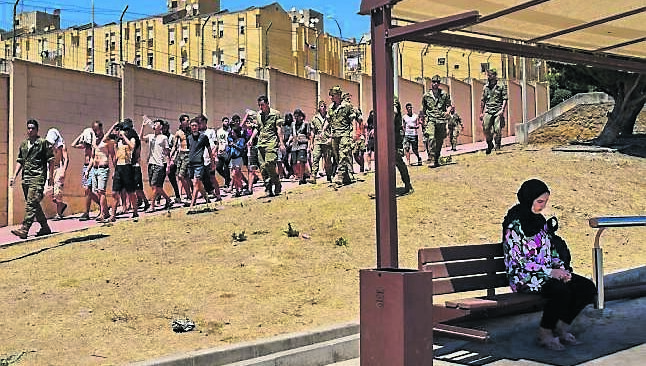
The recent influx of thousands into Ceuta, a Spanish territory on the North African coast, serves as a grim example of how social media can transform rumors into a dangerous reality. Encouraged by false information circulated online, crowds from across Morocco flocked to the border, leading to drownings, physical altercations, and immense chaos. While the majority of these individuals returned to Morocco within days, their failed journey underscored a harsh truth: digital misinformation can create life-threatening consequences, fueling a tragic cycle of hope and exploitation that is increasingly difficult to contain.
The event unfolded twice—first as a physical humanitarian crisis, and then as a digital firestorm. Within hours, the images of migrants at the border were detached from their original context and weaponized by politicians, influencers, and anonymous accounts to suit competing agendas. To some, the footage was proof of an “invasion,” while to others, it highlighted the failures of Europe’s border regime. This process reflects the realities of the attention economy, where migration—a topic laden with fear, identity, and morality—is distilled into short, impactful videos that prioritize emotional resonance over complex facts.
Central to this geopolitical friction is the anomalous nature of Ceuta itself. While Spain views the territory as an integral part of its state, Morocco considers it a lingering remnant of European colonialism. This historical dispute complicates the narrative of border security, as international observers argue over whether the crisis represents a failure of migration policy or a symptom of broader, unresolved territorial claims. Because the crisis was framed as a “permanent emergency” before the dust had even settled, the nuanced historical context was quickly buried under the weight of immediate, hardening political symbolism.
The incident also cast a spotlight on the fragility of Europe’s border-outsourcing strategy. By relying on neighboring states like Morocco to police migration, the European Union has created a system of mutual dependence that often leaves Spain vulnerable to geopolitical leverage. Whether or not Moroccan authorities intentionally loosened enforcement during the surge, the event served as a stark reminder that European borders are only as stable as their diplomatic relationships. Observers in nations like China have pointed to these events as evidence of European fragmentation, noting the internal friction between member states unable to reach a unified consensus on migration policy.
This phenomenon is not confined to the Mediterranean; it is being exported globally, including to countries like Ireland. As local migration concerns are increasingly absorbed into international narratives, events in places like Ceuta are reframed to serve domestic political battles. When isolated incidents are treated as symbolic of a failing system, the space for reasonable public debate shrinks. The danger lies in a political landscape where complex, multi-layered crises—encompassing humanitarian, diplomatic, and colonial elements—are stripped of their reality to serve as fodder for partisan agendas.
Ultimately, the tragedy of Ceuta serves as a warning for how the modern world processes global instability. While the physical crisis at the border dissipated, the “second Ceuta”—the digital afterlife—continues to exist, detached from geography and stripped of essential context. As information travels faster than understanding, the real danger is that future migration events will be pre-packaged into simplified narratives, making it increasingly difficult to address the underlying human and political issues at the heart of the movement.