


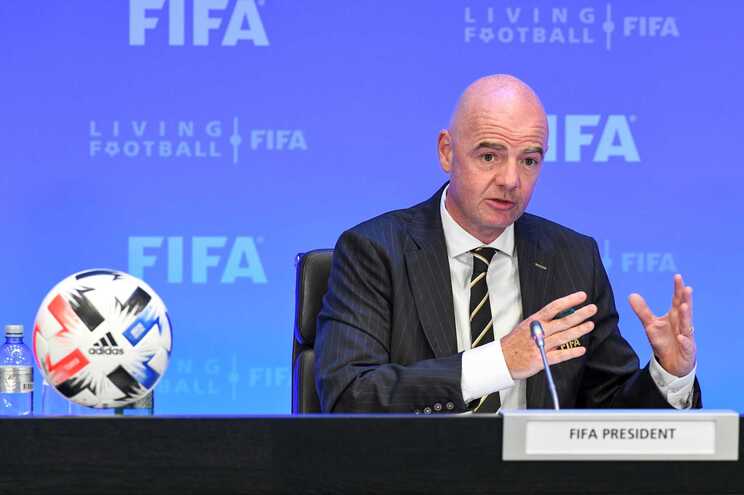
FIFA has accused UEFA of orchestrating a systematic “misinformation campaign” against FIFA president Gianni Infantino, as the two governing bodies brace for a high-stakes legal confrontation that could reshape the global governance of football. In a statement that has sent shockwaves through the sport, FIFA said UEFA had engaged in a deliberate and coordinated effort to distort facts, leak selective documents, and poison public opinion in connection with legal proceedings involving Infantino. The accusation represents a stunning escalation in a conflict that has been quietly brewing for years. FIFA did not specify the exact nature of the evidence UEFA allegedly leaked, but it insisted that the campaign was designed to “undermine the mandate” of Infantino and “damage the credibility” of football’s world governing body. The statement came amid an ongoing legal battle that touches on Infantino’s conduct, his reform record, and the balance of power between world football’s central authority and its continental confederations. Both organizations have long cooperated on issues like anti-doping, referee standards, and the fight against match-fixing. But beneath that surface, there has always been a simmering rivalry, one that has now boiled over into open warfare. FIFA says it will not be blackmailed by what it calls a “dirty tricks” operation, and it has vowed to defend its president and its own institutional independence at all costs.
The precise details of the legal dispute remain unclear, but sources close to FIFA suggest that UEFA has been trying to obtain confidential information about Infantino’s private and professional dealings, possibly through subpoenas and disclosure requests in courts across Europe. FIFA claims that UEFA has taken internal documents, taken them out of context, and then fed them to sympathetic journalists to construct a misleading narrative about the FIFA president. “This is not about transparency or accountability,” a senior FIFA official said. “This is a deliberate campaign to destroy the reputation of a democratically elected leader. Every document, every decision, every meeting has been twisted to fit a false story.” The organization insisted that all of Infantino’s actions had been lawful, ethical, and in line with FIFA’s own governance standards. It noted that no court, tribunal, or investigation had ever found Infantino guilty of wrongdoing. It also accused UEFA of engaging in “forum shopping” and of attempting to use legal systems as weapons in an internal political dispute. FIFA has demanded that UEFA withdraw what it describes as baseless complaints and stop spreading falsehoods. But UEFA has reportedly rejected those demands, arguing that its legal actions are grounded in legitimate concerns about accountability and the rule of law. European football’s governing body is said to have shared evidence with Swiss prosecutors in relation to Infantino’s conduct during his time as UEFA general secretary, before he took the helm at FIFA. That evidence reportedly relates to financial transactions, conflict-of-interest questions, and the terms of certain broadcasting agreements. UEFA has denied any misconduct in how it has handled the matter and insists that its only goal is to protect the integrity of football.
To understand the current conflict, one must examine the trajectory of Gianni Infantino himself. Before his rise to global prominence, Infantino spent more than a decade at UEFA, first as a legal expert, then as director of legal affairs, and finally as general secretary. He was known as a brilliant negotiator, the man who helped design the modern Champions League format and who worked behind the scenes to enforce financial fair play rules. When FIFA was plunged into crisis in 2015 following the corruption arrests that brought down Sepp Blatter, Infantino presented himself as the reform candidate. He promised to return FIFA to sanity, with term limits, transparency, and an inclusive approach. UEFA backed him enthusiastically, seeing one of their own as a safe pair of hands. But after winning the presidency, Infantino soon showed a different side. He consolidated power, expanded the World Cup, and began pushing for reforms that many in Europe viewed as dangerous. His relationship with UEFA soured as it became clear that he was no longer willing to act as Europe’s proxy. The break became undeniable when Infantino began promoting the idea of a biennial World Cup, a proposal that UEFA saw as an existential threat to the European Championships. He also pushed through a controversial Club World Cup expansion, which European clubs and leagues condemned as a money grab. In this broader context, the current legal battle over Infantino’s conduct is not simply about one man’s behavior. It is about the fundamental distribution of power and revenue in world football. FIFA wants to become stronger and more independent; UEFA wants to protect its privileged position. Infantino, once the ultimate insider in European football, has now become the target of European football’s establishment.
The term “misinformation campaign” is particularly charged, and it reflects a pattern that has become all too familiar in sports governance. FIFA claims that UEFA has used selective quotes, altered timelines, and exaggerated claims to paint Infantino as corrupt or incompetent. For example, UEFA is said to have circulated a dossier among national associations and media partners that presents a one-sided account of Infantino’s dealings, omitting exculatory evidence and necessary context. FIFA has called this document a “tissue of lies” and says it has requested an official retraction. But UEFA has fired back, accusing FIFA of playing the victim and avoiding the real issues. According to a UEFA spokesperson, “The public deserves to know the truth about how decisions are made at the highest levels of football. If FIFA has nothing to hide, then it should welcome scrutiny rather than trying to suppress it.” UEFA also noted that it had raised concerns about Infantino’s conduct long before the current legal proceedings, including during the 2018 FIFA Congress and in subsequent private letters. The organization insists that its legal team is not waging a campaign but rather conducting a careful, evidence-based examination of facts. It says its ultimate aim is to protect the interests of European football’s 55 member associations and the broader sporting ecosystem. Independent legal experts have pointed out that both sides are using the language of “campaigns” and “misinformation” to gain the upper hand in the court of public opinion. In many cases, such accusations are a standard legal tactic, designed to discredit the other party and taint potential juries or judges. But they also risk poisoning the well of governance, making it harder for officials to work together in the future. The longer this continues, the more damage it will do to the image of football as a whole.
This is not the first time FIFA and UEFA have clashed, and it will not be the last. Their relationship has always been cyclical, marked by periods of uneasy cooperation followed by moments of open hostility. Infantino’s election was supported by UEFA, but the two organizations soon found themselves at odds over a range of issues. The first major rupture came with FIFA’s proposal to expand the World Cup to 48 teams, a plan that UEFA felt diluted the quality of the tournament and increased the burden on players and clubs. Then there was the Qatar World Cup, which UEFA initially resisted because of its timing in the middle of the European season. More recently, FIFA’s decision to award the 2030 World Cup to a three-continent, six-country bid was met with irritation in Europe, where officials complained about a lack of consultation. But the most significant conflict concerns money and jurisdiction. FIFA’s new Club World Cup, scheduled for 2025, directly challenges UEFA’s Champions League as the world’s premier club competition. European clubs have complained that the expanded FIFA tournament adds to an already congested fixture schedule, and they have sought legal backing to block it. UEFA, for its part, has formed alliances with domestic leagues and player unions to take FIFA to court over what it calls “competition overlap.” The legal battle over Infantino is thus a proxy for a larger war over the economic future of football. FIFA accuses UEFA of trying to maintain a monopoly over elite football, while UEFA accuses FIFA of becoming a global bully that ignores the needs of players and clubs. Both sides believe they are fighting for the soul of the game, and neither is willing to back down. The result is a fragmented and litigious landscape, one where sports politics have become as intense as any on-field rivalry.
As the legal proceedings move forward, the football world is watching with a mixture of concern and fatigue. There is concern because the fight between FIFA and UEFA threatens to destabilize the institutions that govern the sport. If the two most powerful football bodies in the world are unable to coexist, what hope is there for smaller confederations and national associations? There is also fatigue, because many of the allegations against Infantino have been circulating for years without any conclusive finding of wrongdoing. FIFA remains confident that it will emerge victorious, and it has threatened to sue UEFA for damages, claiming that the “misinformation campaign” has caused significant reputational and financial harm. UEFA, however, has dismissed these threats as “baseless intimidation” and says it will not be silenced. The case is expected to wind its way through courts in Switzerland, where both organizations are headquartered, and possibly to the European Court of Justice. In the meantime, national associations are being forced to choose sides, a position that many of them find uncomfortable. Some have already called for mediation, warning that a prolonged dispute would damage the credibility of football’s leadership. But with positions hardened and personalities involved, a quick resolution seems unlikely. The dispute also raises fundamental questions about the accountability of sports governing bodies, which operate in a legal grey area between national law and international arbitration. Whatever the outcome, one thing is certain: the relationship between FIFA and UEFA may be permanently broken. Infantino, once UEFA’s great hope, has become its greatest adversary. The coming months will determine whether these two bodies can find a way to share power, or whether the game they both claim to love will be torn apart by the very people charged with protecting it. For now, the only real winners are the lawyers, who are counting their billable hours, and the media, who are feasting on the chaos. And the fans? Once again, they are left on the outside, wondering what their leaders are doing behind closed doors, and whether the beautiful game has lost its way.