


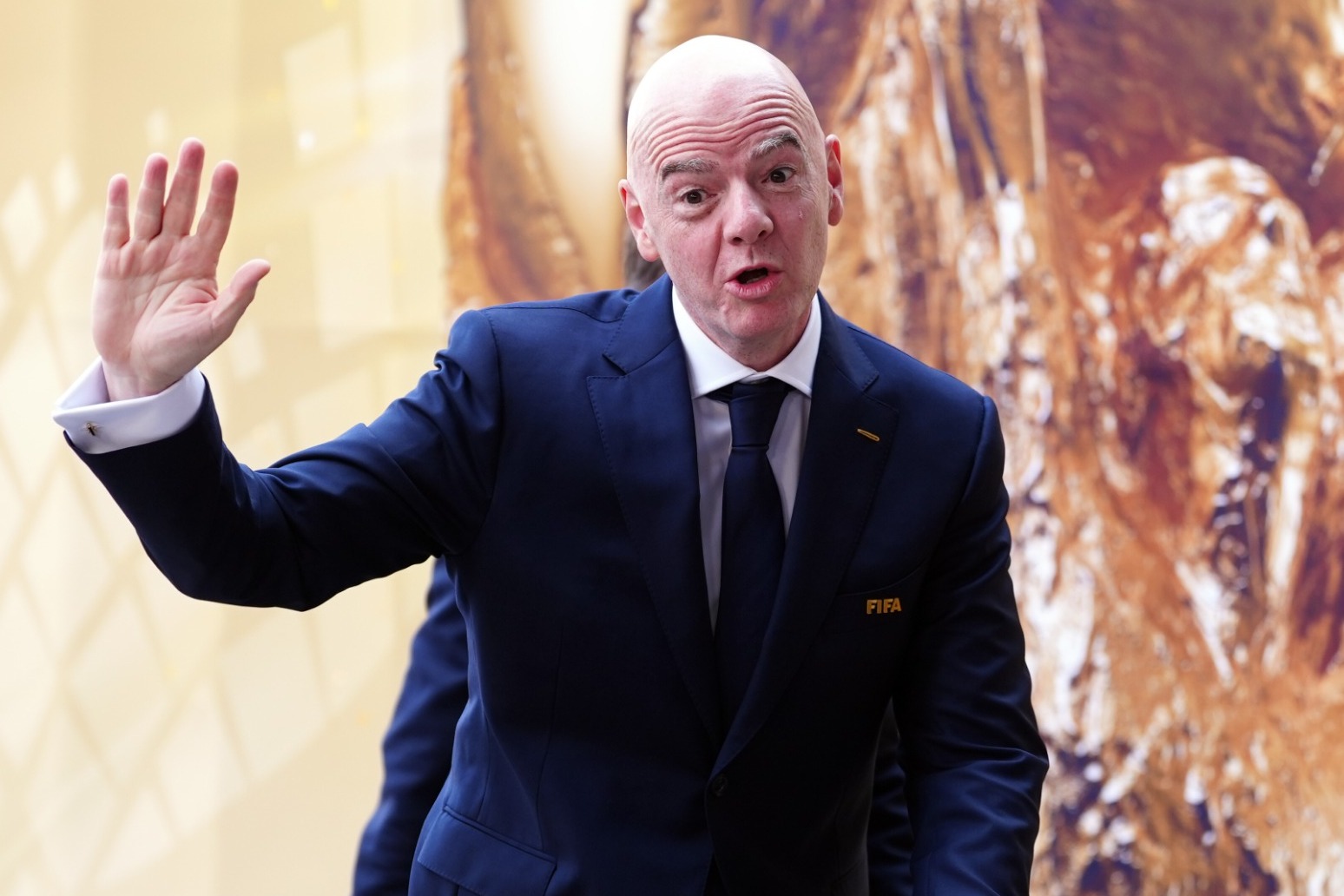
FIFA has launched an extraordinary attack on UEFA, accusing it of running a “misinformation campaign” designed to sabotage Gianni Infantino’s private investor proposal for the World Cup, as the two governing bodies brace for a fresh legal confrontation in the United States. In a legal filing made on FIFA’s behalf in the District Court of South Florida, the organisation said it would have been a “dereliction of duty” if Infantino had not explored the FIFA Forward Enterprise (FFE) proposal, a controversial scheme that was ultimately abandoned after being rejected by UEFA and two other continental confederations. The filing, which was seen by the Press Association, was made in response to UEFA’s motion seeking the disclosure of documents related to FFE, and it goes far beyond routine procedural arguments. FIFA’s lawyers reject any suggestion that Infantino stood to gain personally from the proposal, and stress that the scheme would have needed ratification from all 211 member national associations as well as the FIFA Council. They further accuse UEFA of bringing its application “for the purposes of harassment, rather than out of any legitimate need for discovery,” and argue that this alone should be an independent basis for denial. The language is striking, even by the standards of football’s famously adversarial politics, and it demonstrates the depth of the rupture between the global governing body and European football’s leadership.
At the heart of the dispute is FFE, a project that FIFA has described as an innovative way to bring private capital into the organisation’s development activities and tournament operations. According to the filings and previous reporting, the plan envisioned a large-scale enterprise that would have seen private investors put money into FIFA-backed football projects and events, with the promise of future returns from expanded competitions. Infantino was the driving force behind the initiative, and the legal filing argues that he was duty-bound to examine it, particularly at a time when global football is seeking new revenue streams to support development programmes across less wealthy confederations. The project, however, encountered fierce resistance from UEFA, which condemned it as opaque and financially dangerous, and with two other continental confederations also opposed, it collapsed. Rather than the matter ending there, UEFA has continued to pursue its concerns through legal channels, asking the American courts to order FIFA to hand over internal documents concerning the creation, structure, and valuation of FFE. UEFA contends that such disclosure is necessary to establish whether proper governance standards were followed and whether there was any basis for the vast financial figures attached to the scheme. FIFA, in response, has framed the request as a fishing expedition, arguing that UEFA has already made up its mind and is merely seeking documents to support a pre-existing narrative of impropriety. The filing marks a decisive escalation in a feud that has simmered for years, with the two organisations frequently at odds over issues of governance, competition formats, and political influence within the sport.
One of the most damaging claims made by UEFA in its original application was that FFE had been given a “fraudulently off-market” valuation of 20 billion US dollars. That figure suggested an inflated, artificially generated worth that might have benefited those involved in setting the arrangement, and UEFA has used it to question Infantino’s judgement and the motives of FIFA’s leadership. FIFA has now countered by saying that UEFA has deliberately conflated two entirely different financial concepts: equity value and enterprise value. In a detailed rebuttal, FIFA argued that the equity value of the proposed enterprise was not the same as its actual value as a business, and that the enterprise value was “more than twice” the equity value. The organisation suggested that UEFA either misunderstood the basic financial structure of the deal or chose to misrepresent it in order to make the proposal appear reckless. “UEFA would have learned all of this had it bothered to verify its assertions before publicly decrying the proposal or filing in federal court,” FIFA stated. The implication is that UEFA used the valuation as a headline-grabbing attack without conducting a good-faith analysis of the underlying numbers. This part of the filing is particularly significant because it goes to the heart of UEFA’s complaint: if the valuations were actually correct and properly structured, then the basis for UEFA’s alarmed reaction collapses. FIFA argues that the timing and framing of UEFA’s request suggest an agenda far removed from the pursuit of legitimate legal discovery. Instead, it characterises UEFA’s behaviour as part of a wider campaign to undermine Infantino’s credibility as he seeks another term as FIFA president.
The legal filing also directly questions the timing of UEFA’s application, noting that the deadline for candidates to submit nominations for FIFA’s presidential election is November 18. With the election scheduled for next year, FIFA has argued that UEFA’s decision to push for court-ordered disclosure at precisely this moment is no coincidence. The filing says the court should “reject any attempt to influence FIFA’s presidential election based on these grounds,” adding that UEFA is using the judicial process as a political weapon rather than as a means to resolve a genuine legal dispute. It is an accusation that elevates the case beyond financial oversight into the realm of institutional power struggles. FIFA appears to believe that UEFA is not genuinely interested in documents, but in manufacturing a scandal that could force Infantino out or galvanise opposition to his candidacy. The timing, from FIFA’s perspective, is too convenient: an application filed in the months before an election, making serious claims of fraud, would inevitably dominate headlines and raise questions among member associations. By linking the discovery application to electoral politics, FIFA hopes the court will decline UEFA’s request, on the grounds that granting it would serve no purpose other than to interfere with the internal governance of a Swiss-based organisation. Whether the court accepts that argument remains to be seen, but FIFA has clearly framed its defence around the idea that UEFA is not a neutral overseer but a rival political bloc engaged in a strategic campaign.
UEFA, for its part, has openly stated that it has lost confidence in Infantino despite the abandonment of FFE, and that it is seeking to put forward a credible alternative candidate to stand against him in the next presidential election. That statement alone signals that FFE is not simply a matter of financial prudence but has become a litmus test for leadership and accountability in world football. UEFA’s concerns about Infantino have been brewing for years, with European football officials increasingly frustrated by what they see as a centralisation of power in Zurich, a lack of transparency about FIFA’s finances, and the drive to expand competitions in ways that put more strain on players and domestic leagues. The decision to support an alternative candidate marks a return to confrontation, seemingly leaving little room for the kind of diplomatic compromise that has often characterised previous elections. The legal battle over FFE is therefore part of a much larger struggle for the soul of the sport’s governing body, with Europe attempting to position itself as a force for reform and transparency against what it perceives as a FIFA establishment that is resistant to scrutiny. For FIFA, these accusations are unfair and politically motivated, and the organisation has demonstrated a willingness to meet UEFA head-on in court rather than quietly resolve the dispute behind closed doors. The result is a public airing of matters that are normally kept confidential, and the proceedings in South Florida may yet reveal further layers of detail about the internal deliberations surrounding FFE, even if UEFA’s current discovery application is denied.
As the legal process unfolds, UEFA has been approached for comment by the Press Association, with no immediate response reported. The silence from European football’s governing body is notable, particularly after FIFA’s filing accused it of engaging in harassment and pursuing a knowingly misleading campaign. It is possible that UEFA is preparing a detailed response, or that it believes the filings, which are procedural in nature, speak for themselves. Either way, the dispute has now spilled into open court documents, making it one of the most high-profile governance clashes in the history of international football. The broader significance of the case lies in what it reveals about the fragile state of football’s institutional order. FIFA and UEFA were once able to resolve differences through quiet negotiation, but those days appear to be over. The FFE episode has shown that proposals introduced by FIFA can be vetoed by powerful confederations, and that the consequences of such a veto can linger long after the proposal itself is withdrawn. It has also shown that private investment, once seen as a potential way to modernise FIFA’s finances, has become a toxic subject in football politics, framed either as visionary or reckless depending on who is speaking. Whatever the outcome, the clash has left the global game’s leadership in an uncertain position, with national associations now expected to choose between competing visions of what FIFA should be. Infantino may have abandoned FFE, but the battle over its legacy is only just beginning, and the court in South Florida has become the unexpected stage for the next chapter of one of football’s most consequential rivalries.