


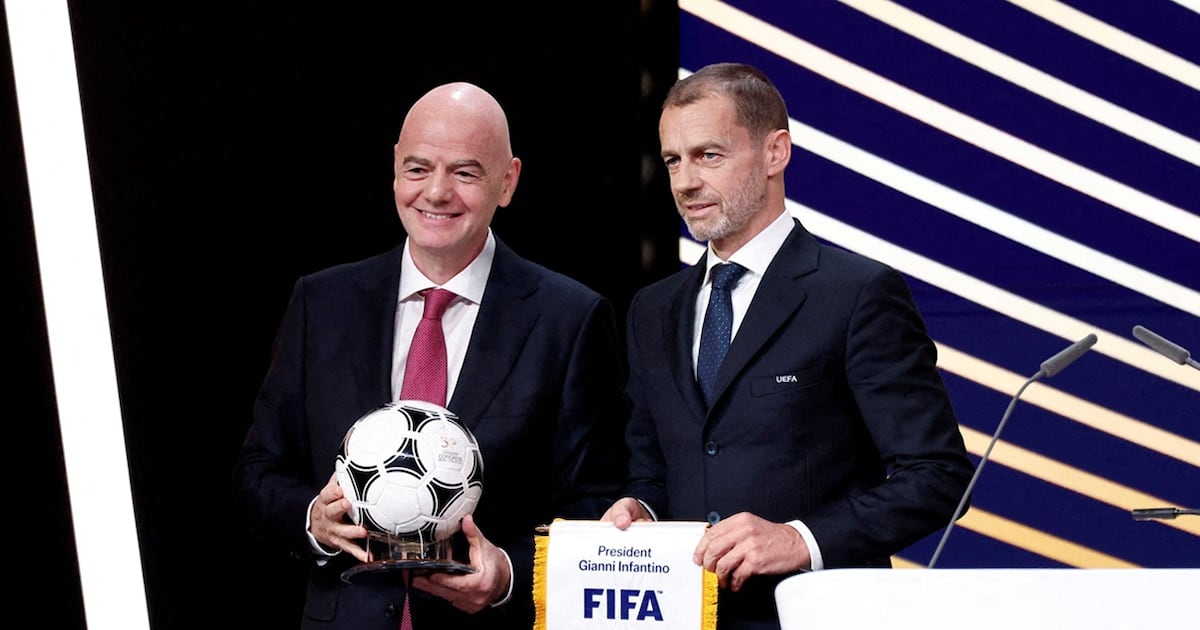
FIFA accuses UEFA of misinformation campaign and election interference over abandoned World Cup investment plan
FIFA has accused UEFA of waging a “misinformation campaign” and attempting to interfere in the race for the FIFA presidency, as the world governing body urged a US court to reject a discovery request linked to a controversial and now-abandoned investment proposal. In a filing in the Southern District of Florida, FIFA said UEFA’s application contained “numerous false or misleading statements about FIFA and Infantino” and alleged that the European body was seeking to influence the presidential election scheduled for March. The dispute centres on FIFA Forward Enterprise (FFE), a proposed subsidiary that would have held World Cup commercial rights and brought in private investors. UEFA last month asked a US federal court for permission to obtain testimony and documents for use in a planned criminal complaint in Switzerland against FIFA president Gianni Infantino over the scheme. FIFA responded forcefully, saying there was no basis whatever for the suggestion that Infantino sought to profit personally from the proposal. It also insisted that the FFE plan would have required approval by both the FIFA member associations and the FIFA Council, and that the subsidiary would have been subject to oversight by both groups within FIFA. “UEFA’s suggestions that Mr Infantino violated any law or ethical principle are categorically without merit,” FIFA said. UEFA declined to comment. The legal clash is the latest escalation of a long-running feud between the two organisations, and it comes at a sensitive moment for Infantino, who is expected to stand for another term as FIFA president when the sport’s global governing body holds its congress in March. FIFA’s filing was made public as world football prepares to defend its governance record against a wave of criticism from European and North American confederations.
At the heart of the dispute is UEFA’s claim that Infantino developed the FFE proposal in secret with a small circle of advisers and investors, bypassing FIFA’s normal governance processes. According to UEFA, the FIFA Council, regional confederations and member associations were not consulted, and the project was allowed to develop without the transparency expected of a body that governs a sport worth billions of dollars. The filing seen by Reuters asked the US court to authorise discovery from two Florida-based FIFA entities: FIFA (AMERICAS), Inc and FWC2026 US, Inc. Those entities are linked to FIFA’s commercial activities in the United States, one of the host countries for the 2026 World Cup. UEFA said investors would have paid $4.2bn for a stake in FFE, valuing the business at about $20bn. It argued that this figure significantly undervalued FIFA’s commercial rights, particularly those tied to the World Cup, and complained that the valuation had not been tested by an open auction or an independent valuer. The planned Swiss criminal complaint adds a legal dimension to the dispute, and the US discovery application is widely seen as an attempt to gather evidence that could support that complaint. The legal mechanism, known as a Section 1782 application, allows parties to obtain testimony and documents for use in foreign legal proceedings. FIFA, however, characterises the move as a misuse of legal process, and its latest filing frames the discovery request as part of a broader campaign to damage Infantino before the election. UEFA has not yet filed a formal criminal complaint in Switzerland, but its decision to seek discovery in the United States suggests that it is building a case and wants to secure evidence from FIFA’s American subsidiaries while there is still time.
FIFA’s response to the valuation argument was blunt, and it went to the heart of UEFA’s accusation. “UEFA, whether deliberately or through ignorance, conflates equity value with enterprise value,” FIFA said. It explained that FFE’s “initial equity valuation” — the value remaining for shareholders after debts have been paid off — was $20bn, while the subsidiary’s total “enterprise value,” meaning the entire value of the business, was well over $30bn. “Indeed, FFE’s enterprise value was well in excess of twice the equity value, and therefore far above the value UEFA says would be fair,” FIFA added. The distinction is central to the dispute because UEFA’s claim of undervaluation rested on the $20bn figure. FIFA argues that once debt and other obligations are taken into account, the deal would have valued the business at more than $30bn, making UEFA’s allegations of a giveaway inaccurate. FIFA also noted that materials distributed to member associations revealed FFE’s total enterprise value, suggesting that there was no attempt to hide the figures from the sport’s stakeholders. It accused UEFA of cherry-picking numbers to support a pre-determined narrative. The FFE project was abandoned in July after opposition from confederations including UEFA, Concacaf and the Asian Football Confederation, mainly over the lack of consultation. The controversy has since become a rallying point for those demanding governance changes at FIFA, and it has intensified scrutiny of Infantino’s leadership in the run-up to the election. For UEFA, the abandoned project appears to illustrate the dangers of concentrating power in the hands of the FIFA president and a small group of advisers, and it has used the episode to press for an independent review of FIFA’s decision-making structures.
Last week, Infantino wrote to all 211 member associations proposing an independent review of the governing body’s decision-making processes, an apparent acknowledgement that the handling of the investment plan had caused concern. The move was seen as an attempt to defuse criticism ahead of the March election, but FIFA also went on the offensive against UEFA. “Just before FIFA’s election, UEFA filed this 1782 Application [and three others] spreading misinformation regarding Mr Infantino,” FIFA said. “This court should reject any attempt to influence FIFA’s presidential election based on these grounds.” The reference to Section 1782 of the US Code, which allows discovery for use in foreign legal proceedings, underscores the strategic nature of the legal battle. UEFA has not publicly responded to FIFA’s characterisation, but its earlier filings show a determined effort to hold the FIFA president to account over the abandoned scheme. The dispute has exposed broader fault lines within world football, with European and North American confederations pushing for greater transparency and more direct distribution of FIFA’s financial reserves. Infantino’s proposal for an independent review was widely interpreted as a concession to those demands, although he stopped short of endorsing the specific reforms sought by UEFA and Concacaf. The election in March will now take place against a backdrop of legal proceedings, public accusations and unresolved questions about how FIFA should be governed. Infantino has made expanding FIFA’s commercial revenues and development programmes central to his presidency, but the FFE affair has given his critics a powerful tool to question whether the organisation has become too centralised under his leadership.
Separately, Infantino has ordered an assessment of proposals to distribute more money to national associations after calls from UEFA and Concacaf for a $2.1bn payout from FIFA’s reserves. In a letter to the six continental confederation presidents seen by Reuters on Monday, Infantino said the assessment would go before the FIFA Council on October 15, with any additional funding subject to financial checks and formal approval. “Until the assessment and necessary approvals are complete, no preliminary figure can be treated as an approved commitment to the Member Associations,” he wrote. The call for a payout came from UEFA president Aleksander Čeferin and Concacaf president Victor Montagliani, who proposed this month that each of FIFA’s 211 member associations receive at least $10m during the 2027-30 cycle, in addition to existing development funding. They also sought an independent review of FIFA’s reserves. Their September 18 letter questioned whether FIFA’s abandoned private-investment proposal had been necessary to increase funding, given reserves they projected at about $6bn at the end of 2026. They argued that their proposed distribution would leave reserves above $1.5bn throughout the following cycle, which they considered enough to protect FIFA’s financial position. The proposal was a direct challenge to the argument that FFE had been needed to unlock new money for football development, and it signalled that the major confederations would rather see FIFA’s existing wealth shared more widely than see the organisation take on outside investors. The plan would increase the flow of money to smaller national associations, many of which depend on FIFA solidarity payments to fund football programmes, and it was framed as a way to ensure that the sport’s growing commercial success benefits all 211 member associations, not just a handful of powerful confederations.
Infantino defended the rationale for the withdrawn commercial plan, saying it would have generated funding beyond what FIFA could distribute from existing resources. “The recent commercial proposal, now withdrawn, was intended to enable FIFA to invest more in football — not to replace support that could responsibly be provided from existing resources,” he wrote. “So, it would actually have been on top of it.” He said FIFA’s administration had already been examining how to provide further development and solidarity funding before receiving the confederations’ submissions, and he asked the confederation chiefs to send their financial models, assumptions and supporting information to the secretary general, with relevant FIFA committees involved in verifying the assumptions. The Council should determine the amount and timing of additional payments, the reserves needed to protect FIFA’s obligations and financial independence, and the eligibility, reporting and audit requirements attached to any distribution, he said. The assessment would also consider support for confederations facing demonstrable structural costs. Where sufficient evidence was available, the Council should receive a recommendation on October 15; otherwise, it should approve “the shortest reasonable timetable” for completing the work. The coming weeks will therefore be critical, both for the financial future of FIFA’s member associations and for the political contest surrounding Infantino’s re-election. The October 15 Council meeting will be watched closely by national associations, confederations, investors and legal teams, all of whom have an interest in how FIFA manages its money and whether the FFE affair leads to lasting changes in governance. For Infantino, the twin challenges of fending off UEFA’s legal onslaught and managing the expectations of member associations demanding a greater share of FIFA’s wealth will test his political skills as he seeks to secure another mandate.