


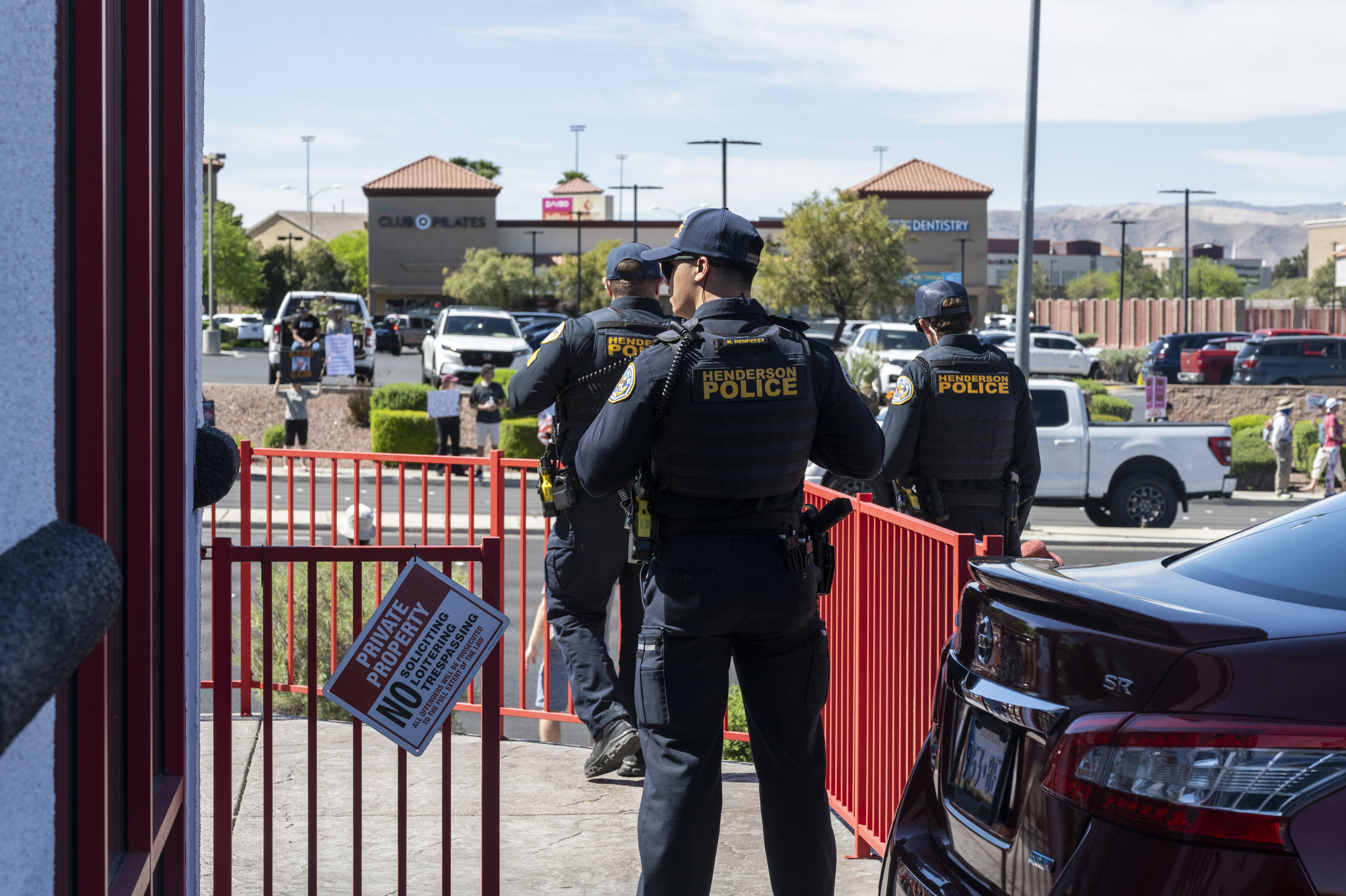
HENDERSON, Nev. — A proposal to allow U.S. Immigration and Customs Enforcement (ICE) to significantly expand its operations at the Eldorado Valley Regional Training Facility was effectively rejected Tuesday, after Henderson Police Chief Reggie Rader pulled the item from a joint meeting agenda and said it was not permitted under the existing agreement governing the facility. The item, which had been scheduled for discussion during a joint meeting of the Henderson Police Department and the City of Henderson, could have eventually allowed ICE to develop a more permanent training presence at the range, which is operated by Henderson and Boulder City and used by multiple Southern Nevada law enforcement agencies. Rader, who heads the committee overseeing the training facility, said the proposal had not been properly “vetted” and that it was not allowed under the existing interlocal agreement between Henderson and Boulder City. “The proposed item cannot and will not move forward under the existing agreement, and the matter will not be further considered or contemplated under that agreement,” Rader said during the meeting. His statement made clear that the proposal was not merely postponed, but that it was incompatible with the legal framework currently in place. The City of Henderson did not say when ICE first sent its inquiry about the proposed expansion, but city officials reiterated that the plan was not permitted. Boulder City, the facility’s co-operator, did not immediately respond to a request for comment.
About a dozen people appeared at the Tuesday afternoon meeting to testify against the proposal, including a representative from the American Civil Liberties Union of Nevada. Kaylah Maese, policy manager for the ACLU of Nevada, told the assembled officials that the community deserves a meaningful opportunity to give input into matters directly affecting local residents, especially those involving federal immigration enforcement. “We will continue tracking this item as we do believe that the community deserves the opportunity to give meaningful input into things that are happening directly in our community that are impacting people who live here,” Maese said. Her remarks underscored a broader concern among community members about the secrecy that often surrounds local and federal law enforcement partnerships. The public testimony highlighted worries not only about the training itself, but also about the process that allowed such a proposal to reach an agenda without broader public discussion. The fact that the item was removed before it could be considered does not erase those concerns. The ACLU’s pledge to continue monitoring the issue suggests that the underlying questions about how the facility is managed, who gets to use it, and how future proposals are evaluated have not been fully answered. Boulder City’s silence on the matter leaves additional uncertainty about how the two municipalities will coordinate in the future.
City documents indicate that ICE has used the Eldorado Valley Regional Training Facility for years, but the new proposal would have expanded its role considerably. Under the proposal, ICE would develop “shared on site training locations” at the facility and would be allowed to rent those locations out to other agencies when it was not using them. That arrangement would have turned ICE from a periodic user of the range into something closer to a partner and landlord, with the ability to sublease training space to other law enforcement entities. Such an arrangement would have raised significant questions about the management of a facility that is supposed to serve Southern Nevada law enforcement agencies. Would local agencies still have had priority access? Who would have been responsible for the facility’s upkeep and liability? Would ICE’s presence have expanded over time until it became the dominant tenant? The proposal also would have formalized and expanded an existing relationship. In 2025, ICE represented about 3 percent of the facility’s total use, while Homeland Security Investigations (HSI), a special subsection of ICE focused on transnational crime, represented about 7 percent. The facility is also used by other agencies, including the Drug Enforcement Administration and the Nevada Legislative Police. Combined, the ICE-related components accounted for roughly 10 percent of all facility use, which means the proposed expansion would have built on an already meaningful presence.
The Henderson proposal came at a moment when similar arrangements were drawing intense public scrutiny across the United States. In February, an agreement between ICE and the Southern California city of Escondido made national news after it was revealed that ICE agents had been training at a local police department firing range for more than a decade. The revelation prompted weeks of protests and a heated community debate about how local law enforcement resources were being used in support of federal immigration operations. In Escondido, the police department leased its training range to several local and federal agencies for training purposes, including Homeland Security Investigations. The parallels with Henderson were hard to ignore. In both places, a municipal training facility had been used by ICE or its components over a long period without broad public knowledge. In both cases, the arrangement involved a police department operating a range that was shared with other agencies. And in both cases, the disclosure of the relationship generated significant community concern. The Henderson proposal, which emerged shortly after the Escondido revelations, raised fears that a similar pattern was taking root in Nevada. By rejecting the proposal, Henderson officials distanced themselves from that controversy, but the episode highlighted how easily local training assets can become enmeshed in federal immigration enforcement.
The rejected proposal also arrived against a more complicated local backdrop. Months earlier, Henderson said it was reconsidering its contract with the U.S. Marshals Service to house ICE detainees at the local jail. That reconsideration was prompted by a combination of local backlash and financial uncertainty. The city has not publicly announced any decision on the jail contract since then, leaving the status of that arrangement unclear. But the simple fact that Henderson was willing to revisit the detention agreement signaled a shift in the political climate. Critics of the jail contract have long argued that local facilities should not serve as a backdoor for federal immigration detention, especially when the financial benefits are uncertain. The training facility proposal appeared to cut against that cautious stance. If the city was genuinely reconsidering its relationship with ICE over costs and community opposition, it was hard to understand why it would simultaneously consider allowing ICE to build a permanent training hub at a jointly run public facility. The inconsistency was not lost on the residents and advocates who spoke out. The rejection of the training proposal may help align Henderson’s actions with its stated attitude toward immigration enforcement, but the unresolved jail contract means the broader relationship between Henderson and ICE remains an active and unresolved issue.
Rader’s decision effectively killed the training expansion for now, but the wording of his statement left some room for future developments. He said the proposal “cannot and will not move forward under the existing agreement,” which tied the rejection to the current legal framework. If Henderson and Boulder City were to amend the interlocal agreement, or if the two cities agreed to renegotiate the terms under which the Eldorado Valley facility operates, a similar proposal could theoretically be brought back in the future. Neither city has signaled any intention to do so, and the matter is not currently under consideration. Still, advocates are likely to remain vigilant. The ACLU of Nevada has promised to keep tracking the item, and community organizations may push for greater transparency in the management of the training facility, including clear rules about how future requests from federal agencies are evaluated. They will also be watching for any decision from Henderson on the ICE detainee contract. Together, those two issues—training and detention—define the city’s broader relationship with ICE. For the time being, the rejection of the training proposal is a clear and decisive outcome. But it is also a reminder that legal agreements can be changed, and that lasting clarity will require not just a single rejection, but a transparent, ongoing process for deciding what role, if any, federal immigration enforcement should play in local facilities and institutions.