


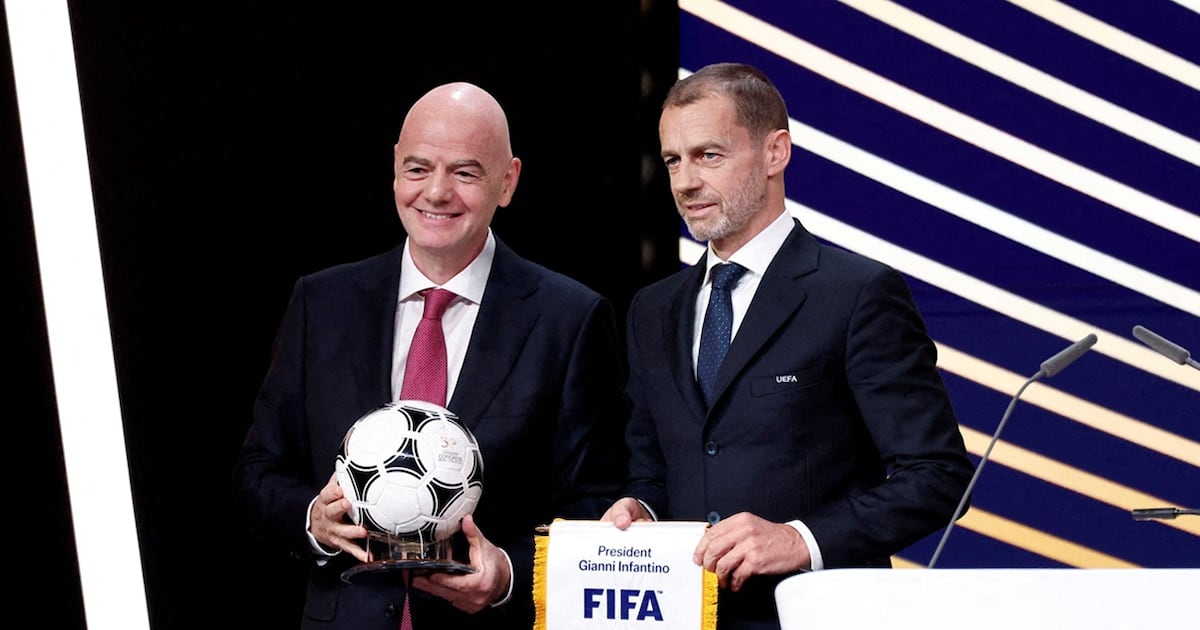
FIFA accuses UEFA of ‘misinformation campaign’ over Infantino and collapsed World Cup investment plan
FIFA has launched a blistering attack on UEFA, accusing European football’s governing body of waging a “misinformation campaign” against Gianni Infantino and attempting to influence the race for the FIFA presidency as the global body urged a US court to reject a discovery request linked to a controversial, now-abandoned investment proposal. In a legal filing in the Southern District of Florida, FIFA said UEFA’s brief contained “numerous false or misleading statements about FIFA and Infantino” and that the allegations against the FIFA president were made with “no basis whatsoever.” The dispute centres on a plan to transfer World Cup commercial rights into a subsidiary called FIFA Forward Enterprise (FFE), a proposal that was shelved in July after fierce opposition from confederations over a lack of consultation. UEFA had asked a US federal court for permission to obtain testimony and documents for use in a planned criminal complaint in Switzerland against Infantino over the scheme. FIFA, however, dismissed the move as an improper attempt to weaponise the US legal system for political ends, saying UEFA was trying to smear Infantino ahead of his re-election bid in March.
UEFA’s legal request, filed last month, sought court authorisation to conduct discovery from FIFA (AMERICAS), Inc and FWC2026 US, Inc, two Florida-based FIFA entities. European football’s governing body alleged that Infantino developed the FFE proposal in secret with a small group of advisers and investors, bypassing FIFA’s normal governance processes and failing to consult the FIFA Council, regional confederations or member associations. According to UEFA’s filing, investors would have paid $4.2 billion for a stake in FIFA Forward Enterprise, a valuation that put the business at approximately $20 billion. UEFA argued that this significantly undervalued FIFA’s commercial rights, and claimed the proposal had not been subjected to an open auction or tested by an independent valuer. The discovery request was intended to support a planned criminal complaint in Switzerland, where UEFA believes the facts surrounding the abandoned venture warranted scrutiny. UEFA declined to comment on FIFA’s latest filing, but the legal battle has laid bare the deep tensions between the two organisations, which have been at odds over governance, commercial strategy and the direction of world football.
In its response, FIFA mounted a vigorous defence of both the proposal and Infantino, insisting that the plan was never a vehicle for personal enrichment or improper conduct. “With no basis whatsoever, Uefa suggests that Mr Infantino sought to profit personally from the FFE proposal,” FIFA said in the filing. It added that the FFE plan was “subject to approval by both the FIFA member associations and FIFA Council” and that the subsidiary “would have been subject to oversight by both groups within FIFA.” FIFA described UEFA’s suggestions that Infantino violated any law or ethical principle as “categorically without merit.” The global body also took issue with UEFA’s valuation analysis, arguing that UEFA had misunderstood the financial mechanics of the proposal. “Uefa, whether deliberately or through ignorance, conflates equity value with enterprise value,” FIFA said. It noted that FFE’s “initial equity valuation” of $20 billion referred to the value remaining for shareholders after debts had been paid off, while the total “enterprise value” — representing the entire value of the business — was well over $30 billion. “Indeed, FFE’s enterprise value was well in excess of twice the equity value, and therefore far above the value Uefa says would be fair,” FIFA added.
The legal clash is the latest escalation in a broader power struggle that has convulsed world football since the FFE proposal became public. The project was abandoned in July following opposition from UEFA, Concacaf and the Asian Football Confederation, all of whom complained about a lack of consultation and transparency. The episode fuelled demands for changes to FIFA’s governance, with critics arguing that major strategic decisions should not be made by a small circle around the president. Last week, Infantino wrote to all 211 member associations proposing an independent review of the governing body’s decision-making processes, a rare acknowledgment that the handling of the investment plan had caused concern. But FIFA’s legal filing makes clear that it sees UEFA’s actions as politically motivated. With Infantino standing for re-election in March, FIFA accused UEFA of timing its legal manoeuvres to damage him. “Just before Fifa’s election, Uefa filed this 1782 Application [and three others] spreading misinformation regarding Mr Infantino,” FIFA said. “This court should reject any attempt to influence Fifa’s presidential election based on these grounds.” The filing underscores how the FFE dispute has become intertwined with the internal politics of FIFA, with UEFA and its allies seeking to use the controversy to force changes in leadership and governance.
Separately, Infantino has ordered an assessment of proposals to distribute more money to national associations, after UEFA and Concacaf called for a $2.1 billion payout from FIFA’s reserves. UEFA president Aleksander Čeferin and Concacaf president Victor Montagliani proposed this month that each of FIFA’s 211 member associations receive at least $10 million during the 2027-30 cycle, in addition to existing development funding. They also sought an independent review of FIFA’s reserves, questioning whether the abandoned private-investment proposal had been necessary given projected reserves of about $6 billion at the end of 2026. They argued that their proposed distribution would leave reserves above $1.5 billion throughout the following cycle. In a letter to the six continental confederation presidents seen by Reuters on Monday, Infantino said the assessment would go before the FIFA Council on October 15, with any additional funding subject to financial checks and formal approval. “Until the assessment and necessary approvals are complete, no preliminary figure can be treated as an approved commitment to the Member Associations,” he wrote. The letter appeared designed to manage expectations while acknowledging the political pressure for greater revenue sharing.
Infantino defended the rationale for the withdrawn commercial plan, insisting it was designed to generate new money for football rather than replace existing funding. “The recent commercial proposal, now withdrawn, was intended to enable FIFA to invest more in football — not to replace support that could responsibly be provided from existing resources,” he wrote. “So, it would actually have been on top of it.” He said FIFA’s administration had already been examining how to provide further development and solidarity funding before receiving the confederations’ submissions. He asked the confederation chiefs to send their financial models, assumptions and supporting information to the secretary general, with relevant FIFA committees involved in verifying the assumptions. The FIFA Council, he said, should determine the amount and timing of additional payments, the reserves needed to protect FIFA’s obligations and financial independence, and the eligibility, reporting and audit requirements attached to any distribution. The assessment would also consider support for confederations facing demonstrable structural costs. Where sufficient evidence was available, the Council should receive a recommendation on October 15; otherwise, it should approve “the shortest reasonable timetable” for completing the work. The combination of legal combat and financial negotiation leaves FIFA at a crossroads, with Infantino seeking to fend off UEFA’s legal challenge while also trying to quell dissent over governance and money. The coming weeks, leading up to the Council meeting and the presidential election, will determine whether the controversy surrounding FFE fades or deepens into a full-blown crisis for FIFA’s leadership.