


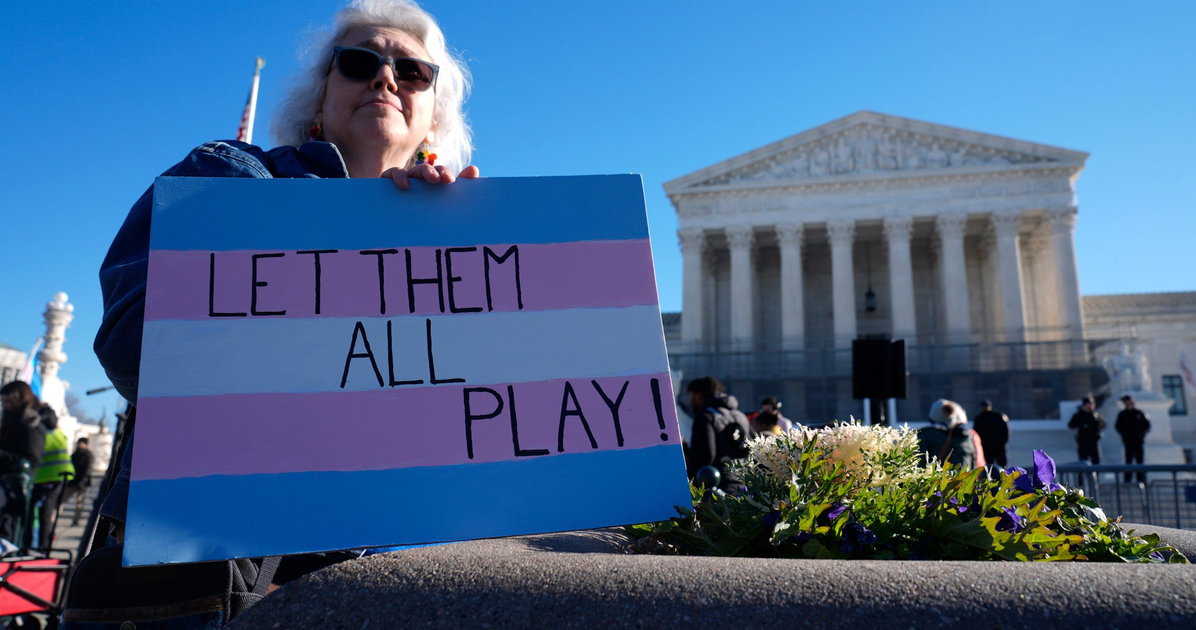
The campaign against transgender participation in sports has long relied on misleading statistics and selective presentation of data, but a new report from the Concerned Women for America Legislative Action Committee (CWALAC) offers a striking example of how easily flawed numbers can be turned into political ammunition. The organization, led by Penny Nance, claims that “trans-identifying males have stolen over 2,293 gold medals from women in the United States.” In a statement accompanying the so-called study, Nance insisted that “biological men have distinct advantages over biological women” and called on Congress to act to protect biological women. The figure has been widely circulated as evidence of a trans takeover of women’s athletics. Yet the underlying data, drawn from a crowdsourced database called HeCheated, does not support the sweeping conclusion CWALAC draws. An examination of the dataset reveals a sprawling, uncleaned collection of entries spanning nearly a century, multiple countries, and dozens of sports—including some that are not athletic competitions at all. The claim also ignores a substantial body of scientific research indicating that trans women do not retain the performance advantages sometimes assumed after hormone therapy. Rather than demonstrating dominance, the numbers reflect what researchers call dominance theory: the tendency to perceive a small minority as overwhelmingly present once they achieve any visibility. The CWALAC report is the latest attempt to translate anecdote and error into federal policy, including legislation that would strip funding from schools allowing trans girls and women to compete.
CWALAC says it used the HeCheated dataset, which launched last year alongside SheWon, to count gold medals won by trans women and girls in events where a cis woman finished second. According to the organization, that method produced 2,293 medals. But an independent attempt to replicate the number using the same stated criteria found 4,174 cases—almost twice as many. The discrepancy raises serious questions about how CWALAC arrived at its headline figure. The dataset itself is not a carefully curated record of trans athletic achievement. It includes entries from high school competitions, recreational races, professional leagues, and international events, and it lists trans and intersex athletes (labeled DSD) regardless of whether they won or lost. Some entries go back to 1927, which actually underscores the longstanding presence of trans people in society. The definition of “sport” is also extremely loose. Alongside swimming, soccer, and hockey, the database includes bowling, disc golf, Irish dance, and competitive oyster shucking. It even has a non-athletic section featuring prom queens, best actress nominations, and Jeopardy! performances. If trans people were truly dominating women’s sports, one would expect a far larger number of wins from a dataset this broad. Instead, the raw count is minuscule compared with the millions of medals awarded over the same period. The fact that CWALAC’s own number cannot be reproduced from its stated criteria suggests the “study” is less an analysis than a political document.
Even setting aside the replication problem, the data quality is poor. The HeCheated database is what researchers call an “uncleaned” or “dirty” dataset, meaning it has not been subjected to data cleaning practices that identify and correct errors and inconsistencies. Examples of the problems are easy to find. The database lists entries for “USA – Pennsylvania” and also for “USA – Philadelphia,” even though Philadelphia is famously part of Pennsylvania. It contains entries for the state of New York and for a nonexistent state called “New Yorko.” It also includes seven entries for “USA – Ontario” that, when investigated, turn out to be from Ottawa, Canada. These are not trivial errors; they indicate that the dataset was assembled from unverified submissions and internet links without rigorous quality control. A crowdsourced database can be a useful starting point for research, but it cannot support the weight of a national legislative campaign unless its entries are checked, standardized, and analyzed with transparent methods. CWALAC provided no such methodology. The organization did not explain how it selected entries, how it handled duplicate or erroneous records, or how it defined a “gold medal” in contexts where categories and divisions vary widely. In the absence of that information, the 2,293 figure is essentially meaningless. Yet the number has already been used to argue that trans women are stealing opportunities from cisgender women, and to push for federal action.
The broader statistical context makes the claim of trans dominance even harder to sustain. According to the Williams Institute, roughly 1 percent of the U.S. population is transgender. If trans women and girls were winning gold medals at a rate proportional to their share of the population, the number of victories over the past century would be far higher than 2,293. A closer look at one category of competition illustrates the point. The HeCheated database includes information on 5K running events, which are often more casual and less likely to have anti-trans policies barring participation. Since 1992, the database has identified 186 first-place medals won by trans women and girls in these events. Of those 186 medals, two trans people accounted for ten in 2025. One was a high school student competing in a school event. The other was a woman competing in the age 40–49 category at a Massachusetts event every week, often with only three or four other runners in her category. RunSignup, a race registration platform, hosted signups for 52,544 running events of five kilometers or less last year, with more than 8 million registrants. RunSignup estimates that it represents only half of the U.S. race registration market, which suggests that there are well over 100,000 such events each year. CWALAC appears to count winning an age category as winning a “gold medal.” The 5K most often won by a trans woman in 2025 had seven female age categories. Even assuming that is an above-average number, 500,000 women’s 5K gold medals could easily be awarded across the United States in a single year. Ten medals out of 500,000 is 0.002 percent. That is roughly one five-hundredth of what would be expected if trans women were winning at a rate commensurate with their share of the population. Trans people rarely compete in these events and rarely win when they do.
CWALAC is not releasing this “study” in a vacuum. The organization is using it to pressure Congress to pass several bills, including the “Protection of Women and Girls in Sports Act of 2025,” which would bar federal funding for school athletic programs that allow trans inclusion in sports. The same kind of misinformation has surrounded individual athletes, most notably swimmer Lia Thomas. ESPN commentator Stephen A. Smith has claimed that Thomas transitioned and began dominating women’s swimming, but that is not what the results show. Even in the race that former swimmer Riley Gaines has repeatedly cited in her campaign against trans athletes, Thomas and Gaines finished joint fifth. The narrative of a trans woman sweeping aside cisgender competitors does not hold up under scrutiny. What the HeCheated data actually shows is a very small number of wins spread across a huge, unevenly defined landscape of competitions. The CWALAC report treats every one of those wins as evidence of an “unfair advantage,” ignoring factors such as age categories, small fields, recreational events, and the diversity of sports involved. It also ignores the scientific consensus that gender-affirming hormone therapy significantly reduces muscle mass, bone density, and hemoglobin levels, narrowing any performance gap. The legislative push is based on a number that cannot be replicated, drawn from a dataset that has not been cleaned, and interpreted in a way that defies basic arithmetic. That is not a study; it is a talking point.
What is really happening, researchers say, is a phenomenon known as dominance theory. Because society’s assumptions are shaped by patriarchal and cis-heteronormative norms, a small minority group can be perceived as overwhelmingly present the moment it achieves any real visibility. The pattern has been documented in other contexts. In the 1980s, Dale Spender’s book Man Made Language found that men in mixed-gender conversations believed women were dominating the discussion when women spoke only 30 percent of the time. A study commissioned by the Geena Davis Institute found that if a movie crowd was more than 17 percent women, male audiences perceived it as a 50/50 crowd. The same perceptual bias is at work in the anti-trans panic over sports. A fraction of a fraction of a fraction of a percent of medals are won by trans people, and that is enough for the anti-trans movement to claim that trans women are stealing opportunities from cisgender women. The claim of media overrepresentation is similarly distorted: the right complains that trans representation is being “shoved down their throats,” yet no mainstream movie in 2025 included a single trans character. The CWALAC report is not an outlier in the anti-trans crusade; it is a representative example of how misinformation is manufactured and deployed. By presenting a dirty, crowdsourced dataset as a scientific study, and by choosing a number that even its own methods cannot reproduce, the organization hopes to influence lawmakers and public opinion. The actual evidence—from the 5K example to the broader statistical context—shows that trans people are not dominating women’s sports. What they are dominating is the imagination of those who have decided, in advance, that trans inclusion is a threat.