


Paragraph 1: The Alarming Scene at Ceuta and the EU’s Immediate Reaction
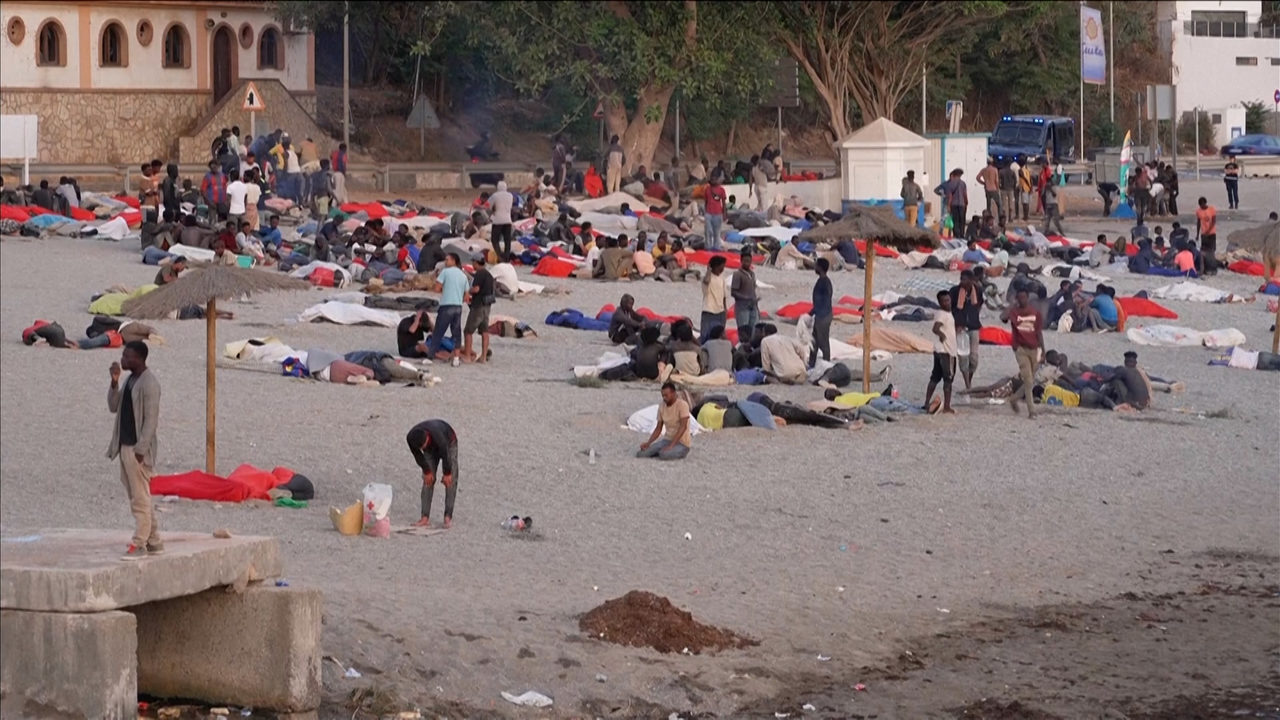
In the sweltering late-summer heat of late July, the Spanish enclave of Ceuta, a small strip of land on the North African coast that serves as the European Union’s only land border with Africa, became the epicenter of an unprecedented migration surge that jolted Brussels into a state of high alert. For months, the region had been plagued by sporadic attempts at illegal border crossings, but nothing could have prepared authorities for the sheer, overwhelming scale of the coordinated push that occurred on the 30th and 31st of July. According to official Spanish government figures, an estimated 72,000 migrants and refugees, primarily from sub-Saharan African nations and Morocco itself, converged on the border in a desperate, frantic attempt to reach European soil. The sheer number of people present within a 48-hour window immediately overwhelmed the local border guard, the Guardia Civil, and the Moroccan auxiliary forces, creating a chaotic and perilous situation that posed significant risks to human life and the integrity of the Schengen Zone. While the immediate physical security crisis was managed through a swift and controversial expulsion policy, the political and digital aftermath has taken center stage at the highest levels of the European Union. This is because the mass movement was not a spontaneous rebellion or a natural consequence of a regional disaster; rather, it was demonstrably catalyzed by a highly effective and viral disinformation campaign. European Commission Vice-President Henna Virkkunen, the bloc’s leading digital and transparency policy figure, has since issued a stark and urgent call to meta-platforms like Facebook, Instagram, TikTok, and X, demanding they escalate their internal policing measures to combat the weaponization of their algorithms as tools for cross-border coercion and human trafficking.
Paragraph 2: The Chronology of the Crisis and the Deadly Fallout
To understand the gravity of the Commission’s reaction, one must first examine the brutal reality of the border itself. Ceuta, along with its sister enclave Melilla, represents a fortress-like barrier between one of the wealthiest continents on Earth and the developing world. But on the night of July 30th, that fortress appeared vulnerable. The trigger for the stampede was a cascade of false information, circulated extensively onWhatsApp, Telegram, and TikTok, claiming that the Spanish government had unilaterally “opened” the border gates to all comers, and that the Moroccan security forces had been instructed to stand aside. This mythological promise of an open pathway to Europe instantly became a viral beacon, drawing colossal crowds from the nearby Moroccan towns of Fnideq and Castillejos, as well as thousands who had already been waiting in transit camps. The ensuing scenes were harrowing. Migrants swam around the sea walls, scaled the six-meter high double fences, and broke through the gates with sheer physical force. While roughly 70,000 individuals were swiftly detained and returned to Moroccan territory by Spanish authorities within hours—a logistical feat that involved bussing tens of thousands back across the border—the human cost was devastating. Reports indicate that at least 80 people perished during the attempt, losing their lives by drowning in the treacherous currents of the Mediterranean as they tried to swim around the breakwaters, while others were crushed in the panicked crush of bodies at the turnstiles. These fatalities underscore that disinformation is not merely a nuisance or an issue of digital etiquette; in this context, it functioned as a death sentence, directly driving vulnerable people toward mortal danger under the false pretense of guaranteed safety and entry.
Paragraph 3: The Mechanics of the Disinformation Machine
The European Commission’s concern extends far beyond the immediate human tragedy in Southern Spain. The Ceuta incident serves as a massive, real-world case study in how hyper-targeted disinformation is utilized as a hybrid warfare tool. The false claim regarding the border opening was not an isolated, random rumor; it followed a distinct pattern of algorithmic amplification that tech companies have been slow to curb. Analysts noted that the false narratives were seeded in local, high-engagement Facebook groups and spread rapidly via the “forward” mechanics of WhatsApp, which are famously difficult to moderate due to end-to-end encryption. The messages were strategically localized—some in French, some in Arabic, and some in the regional dialect—to appeal to different ethnic clusters within the migrant population. Furthermore, the visual component was engineered for virality: old stock footage of border gates opening was repurposed and edited with fake timestamps to suggest recentness. The emotional impact was instantaneous, exploiting the latent desperation and hope of those living in limbo. The scale of the impact has prompted Commissioner Virkkunen to emphasize that “we need stronger monitoring and closer cooperation on fact-checking.” Her statement reflects a growing consensus in Brussels that relying solely on the platforms’ own internal fact-checking mechanisms—which often lag behind viral spikes by hours—is inadequate. The call is now for proactive algorithmic intervention, where platforms are required to visibly throttled the spread of content that incites illegal border crossings, geolocated to high-risk areas, during times of known political or migratory tension.
Paragraph 4: The Golden Owl Analysis: A Staged Operation, Not Spontaneity
Perhaps the most troubling aspect of the Ceuta crisis, and the factor that solidifies the case for urgent platform regulation, is the conclusion that the entire event was a deliberately staged operation rather than a chaotic, organic explosion of migration. A comprehensive analysis conducted by the tech firm Golden Owl, which specializes in open-source intelligence (OSINT) and geospatial data analysis, has revealed telltale signs of coordinated logistical planning. By meticulously examining satellite imagery, timestamps of social media uploads, and movement patterns of crowds gathered via geolocated “check-ins,” Golden Owl researchers identified that the mobilization was not random. Buses had been chartered to ferry migrants from deeper within Morocco to the border area, and communication channels on encrypted apps showed a chain-of-command style instruction set—directing specific groups to attack different sections of the fence simultaneously. The report concludes, with high probability, that the disinformation served as the ignition switch for a pre-planned pressure action. This strongly suggests the involvement of organized smugglers, or potentially, state-linked actors using migration as a bargaining chip vis-à-vis Spain regarding territorial disputes in Western Sahara or fishing rights. For the EU, this transforms the perception of the event from a humanitarian migration issue into a deliberate commercial and geopolitical attack, leveraging vulnerable people as instruments of pressure. Consequently, the platforms that unwittingly (or negligently) relayed the “open border” lie are now viewed not just as communication tools, but as vectors for a hostile operation against the bloc’s external integrity.
Paragraph 5: Virkkunen’s Directive and the Regulated Digital Landscape
In response to these findings, Henna Virkkunen has moved beyond mere rhetoric to propose tangible, legislative-backed mechanisms. Utilizing the existing framework of the Digital Services Act (DSA), the Commission is now considering a “crisis response protocol” for external border events. This would see the European Center for Algorithmic Transparency (ECAT) work in real-time with border security agencies like Frontex. Under this proposal, when a surge event is flagged, the platforms would be mandated to implement enhanced “speed bumps” on content originating from the geographical proximity to the border. This includes the implementation of “disclaimers” that are impossible to scroll past, direct links to official government rebuttals, and most controversially, the temporary suppression of content by ephemeral “unverified” accounts. Virkkunen’s primary demand is that fact-checkers receive privileged API access to the viral trending rates of content milliseconds after it goes live, rather than waiting for subsequent reporting. There is also a push for a new “duty of care” that extends beyond election integrity to encompass national security and border safety. Drawing on the legal precedent that platforms can be held liable for incitement of violence, the EU proposes to categorize certain disinformation that directly endangers life—such as a false claim of an open border during a maritime storm—as an imminent threat. This shifts the burden onto the platforms to act proactively, rather than reactively taking down misinformation after the stampede has already occurred. While free speech advocates raise concerns about over-policing, Virkkunen maintains that a clear line exists between freedom of expression and directly actionable lies that result in mass casualties.
Paragraph 6: The Broader Ramifications and the Road Ahead
As the dust settles on Ceuta, the broader ramifications of this digital-age border assault are clear. The events serve as a sobering blueprint for future hybrid threats targeting the EU, demonstrating that the continent’s physical borders are only as secure as its data infrastructure. The collaboration between Spanish security services and Brussels will now focus on a multimodal defense strategy. This includes utilizing deep-sea surveillance algorithms to track not just boats, but the information networks that precede their departure. The EU is also ramping up its diplomatic dialogue with Morocco, aiming to secure a bilateral agreement on digital misinformation exchange, recognizing that these stagings are often performed by third parties who are equally disparaging of Moroccan sovereignty. For Commissioner Virkkunen, the takeaway is unequivocal: social media platforms have morphed from passive hosts into active accelerants of geopolitical crises. The request for “stronger monitoring and closer cooperation” is merely the opening salvo. In the coming months, we can anticipate binding regulatory changes that will demand rapid-response AI moderation tools from Big Tech, specifically designed to detect and neutralize mass-trigger migrations. The professionals at Golden Owl emphasize that these operations are becoming more sophisticated, utilizing VPNs and dead-drops to avoid tracing. Ultimately, the Ceuta crisis has taught European leadership a critical lesson: in an era of weaponized information, the battle for the border is won not only with fences and patrols, but with the relentless, immediate, and accurate verification of the data deluge that shapes human behavior. The onus now lies on the social media giants to prove they can be allies in this fight, or face devastating legal consequences for the lives lost in the gap between the lie and the truth.