


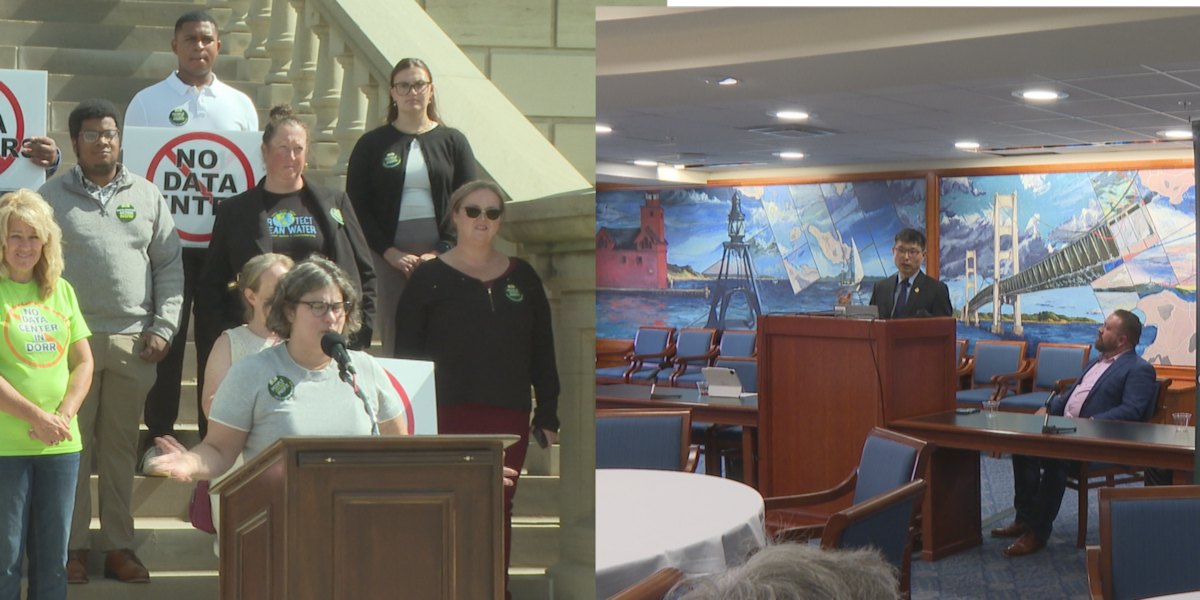
LANSING, Mich. (News 10) — Michigan State University’s Institute for Public Policy and Social Research held a conversation Tuesday to address common misconceptions about data centers, focusing on their impact on the state’s electrical grid and the broader public concerns that have grown up around them. As data center projects multiply across Michigan, driven by cloud computing, artificial intelligence and state economic development incentives, communities have increasingly found themselves caught between promises of jobs and tax revenue and fears about water use, electricity demand, environmental damage and a lack of transparency. The MSU forum, which brought together policy experts and the public, was designed to separate fact from assumption. Dr. Erik Nordman, director of the Institute of Public Utilities at Michigan State University, emphasized that reliable electricity is not just a commodity for technology companies but a foundation for everyone’s daily life. “If the electricity system is more reliable, we’re all going to benefit from that,” Nordman said. His comments suggested that, while data centers require vast amounts of power, the infrastructure investments made to serve them could also strengthen the grid for hospitals, schools and households. Yet just as the forum was taking place, environmental groups gathered across the street at the state Capitol to present a very different perspective. They called for more transparency, stronger legal protections and real seats at the decision-making table, arguing that the public is being left in the dark as powerful developers negotiate behind closed doors. The two gatherings encapsulated the state’s divided response to an industry that is expanding far faster than public policy has been able to adapt.
On the electrical side, Nordman’s remarks touched on a central theme: data centers are not simply energy burdens; their connection to the grid can force utilities to modernize infrastructure that benefits all ratepayers. Many older parts of Michigan’s electricity system were not designed for the kind of round-the-clock, high-density power demand that large server farms require. As utilities plan for data centers, they must consider new transmission lines, substations, storage capabilities and backup generation. If those investments are made wisely and with proper oversight, they can improve reliability during storms and periods of peak demand, helping businesses and residents in ways that extend far beyond the data centers themselves. Nordman’s point was that a more reliable system is a public good, and that the conversation should focus on how to achieve that reliability in a fair and sustainable way. But the discussion also carries a warning: if utility costs are loaded onto residential customers while the benefits flow mainly to giant technology companies, the result could deepen public resentment. Michigan’s energy mix is in transition, with coal plants retiring and renewables expanding, and data centers could accelerate the need for natural gas, nuclear energy or massive amounts of solar and wind power. Each of those choices has its own environmental and economic trade-offs. The MSU conversation did not pretend there were easy answers, but it helped reframe the problem as an infrastructure policy question rather than a simple fight between development and environmental protection. The state’s ability to manage all of this will depend on how quickly regulators, utilities and lawmakers can update their planning tools to keep pace with the AI-era demand surge.
Water was among the most sensitive topics at the forum. Many of the misconceptions surrounding data centers concern how much water they actually consume and whether that consumption is necessary. Data centers use significant amounts of water for cooling, particularly in large server installations that generate intense heat. Jean Hardy, associate director of the Quello Center at Michigan State University, said most developers today are keenly aware of the controversies that water use can create and are making an effort to respond. “Most data centers that are being built today are trying to conserve water because they see the controversies happening around water and they want to be responsible developers,” Hardy said. Technologies such as closed-loop cooling, air cooling and water recycling can dramatically reduce the impact of a facility, and many companies have announced goals to become water neutral. But Hardy was careful not to overstate the trend. She pointed directly to a proposed Google data center in Van Buren Township, saying it is expected to use “upwards of two million gallons of water a day.” That striking figure has become a symbol of the risks that large data centers pose to local water supplies. Even in a water-rich state like Michigan, a single facility consuming that much water could strain aquifers, alter local ecosystems and set a precedent for future projects. The fact that both responsible and less responsible projects are being proposed helps explain why public concern remains high. Residents wonder how much water their community can give without jeopardizing agriculture, recreation, drinking water and wildlife. Experts at the forum stressed that water use should be evaluated case by case, with precise data rather than generalities, and that local governments should have the capacity to assess and enforce water-protection conditions. But the groups gathered at the Capitol said the current legal framework does not guarantee that such scrutiny will happen.
Those environmental groups, including the Sierra Club of Michigan, Clean Water Action and the Michigan Climate Action Network, held a conference at the Capitol to make their case. Marta Johnson, legislative and political organizer for the Sierra Club Michigan, connected data center development to the broader national debate over artificial intelligence. She noted that even prominent technology figures, including Sam Altman and Elon Musk, have publicly warned about the speed of AI development. She criticized the Michigan Economic Development Corporation for not providing transparency around tax breaks given to data center developers. “We’re seeing [the MEDC] saying that they’re not going to provide any transparency for these tax breaks,” Johnson said. She said new information emerges every week about the dangers of AI technology, and that the economic benefits of data centers cannot be separated from those concerns. The activists argued that decisions about tax incentives, water permits and grid capacity are being made in a way that leaves residents with very little voice. They called for more seats at the table, meaning that community members and environmental advocates should be included early in the negotiation process, not brought in after major commitments have already been made. The conference highlighted the feeling that data center policy in Michigan has become a matter of corporate privilege. Without public disclosure of how many jobs a project truly creates, how much water and power it will use, and how much tax revenue is being waived, communities cannot evaluate whether a deal is actually in their best interest. The activists also pointed out that data centers do not exist in isolation; each new project adds cumulative pressure on the state’s infrastructure and environment. They sought to shift the conversation from individual facilities to a larger vision of sustainable economic development.
The information gap was a central concern for those activists, and it was also acknowledged, at least indirectly, by the MSU panel. Amanda Robert, network director for the Michigan Climate Action Network, described the experiences of communities that have been confronting data center proposals. “We’ve been hearing from them for a year and a half now,” she said. “They’re just really concerned; they’re overwhelmed with misinformation. They don’t know what information to trust.” This was a striking statement because it suggested that the problem is not simply NIMBYism or resistance to technology. Communities are receiving conflicting claims from developers, economic development officials, environmental groups and even the media. Some are told that data centers will create hundreds of jobs, while others learn that modern server farms operate with relatively few employees once constructed. Some are told that water recycling makes consumption minimal, while others see enormous withdrawal numbers that inspire panic. In this confusing environment, trust erodes quickly. Robert’s organization has spent months listening to residents and trying to help them understand what is real and what is exaggerated. But she said the burden should not fall on ordinary citizens to decipher technical reports and corporate press releases. Nichole Keway Biber, water justice manager for Clean Water Action offered an even more pointed challenge to the claim that voluntary corporate responsibility is sufficient. “If responsible data center owners exist, they shouldn’t be worried about real strong protections that are codified into law, enforceable, hold people accountable,” she said. “Because if they’re already doing that, what’s the problem with having those protections in place?” This argument reframed the debate: the issue is not whether every developer is good or bad, but whether the legal system ensures that even a careless owner cannot cut corners at public expense. Activists argued that enforceable laws provide certainty for everyone, including companies that already follow best practices, because they create a level playing field and prevent a race to the bottom.
The simultaneous events on Tuesday were more than a coincidence; they represented two different approaches to the same urgent policy question. The MSU conversation tried to correct misconceptions and build understanding of the complex technical realities behind data centers, emphasizing that the same facilities many people fear can, under the right circumstances, contribute to a more reliable and modern electricity system. The Capitol conference demanded that the public be given more information and more power, warning that without strong regulation, the costs of the data center boom will fall on ordinary people while the benefits are privatized. Neither side believes that data centers will simply disappear from Michigan. The real debate is over the conditions under which they will be built. Will they be subject to meaningful water limits? Will their electricity demands be integrated into a grid plan that protects ratepayers and the environment? Will tax incentives be fully disclosed and reviewed? Will communities be able to say no when a project is too large, too water-intensive or too opaque? Tuesday’s conversations suggested that these questions are still far from resolved. The risk is that Michigan will continue to approve data centers piecemeal, with each decision setting a precedent and no comprehensive vision guiding the state forward. The larger risk is that public trust will be permanently damaged if people feel that their concerns were ignored in the rush to attract investment. Ultimately, both the MSU experts and the environmental advocates were asking for something similar: a decision-making process based on facts, transparency and fairness. The difference lay in their confidence that such a process is actually underway. Michigan’s future with data centers will depend less on whether they are good or bad in the abstract, and more on whether the state can craft enforceable rules that protect its residents, its water and its energy system while allowing responsible development to proceed. That is not an impossible goal, but Tuesday made clear that it requires more than a single forum or one group’s demands—it requires a sustained commitment to democratic accountability in a time of rapid technological change.