


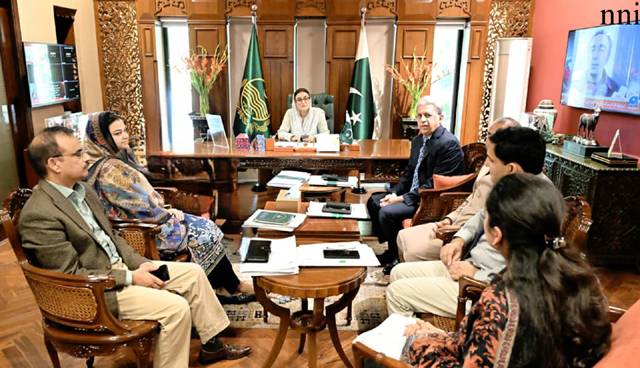
LAHORE — Punjab Information and Culture Minister Azma Zahid Bukhari has directed all relevant departments to adopt a proactive, timely, fact-based and coordinated strategy to counter disinformation, hate speech and anti-state propaganda, as the provincial government steps up implementation of the revised National Action Plan (NAP). She issued these directions while chairing the fourth meeting of the Information Steering/Review Committee, which reviewed the progress made so far in executing the revised NAP in Punjab. Secretary Information Punjab Syed Tahir Raza Hamdani and representatives of all relevant departments attended the meeting. The secretary briefed participants on the status of decisions taken during the previous meeting, including steps taken to improve inter-departmental coordination, ensure responsible dissemination of official information, and build a collective response to misleading narratives, negative propaganda, hate speech and anti-state content. The meeting’s agenda reflected a broader official recognition that information security and public communication have become critical components of the national security framework. The revised NAP, which was introduced after the Army Public School attack in 2014 and subsequently updated to address emerging threats, has evolved from focusing primarily on counter-terrorism operations to include digital disinformation, extremist narratives, and social media-driven polarisation as key areas requiring sustained institutional attention.
Addressing the meeting, the minister said disinformation and negative narratives could no longer be countered through a purely reactive approach. She stressed the need for a proactive, timely and fact-based strategy that could anticipate false narratives before they gained traction and respond to them with credible, verified information. Bukhari said that in an era of instant communication and viral content, waiting for falsehoods to spread before correcting them was a losing strategy. She directed all relevant departments to work in close coordination and develop a joint strategy to address emerging challenges in the information space. The minister underlined that no single department could deal with the scale and speed of misinformation on its own, and that a unified response mechanism was essential. She called for stronger cooperation between government departments, media regulators, law enforcement agencies, and civil society institutions to ensure that false and harmful content is identified quickly and countered effectively. The meeting also reviewed the performance of various departments in implementing previous decisions and noted that while some progress had been made, there was still a need for more efficient coordination and a clear chain of responsibility for responding to disinformation.
The minister said the Information and Culture Department was playing an effective and proactive role in achieving the objectives of the National Action Plan. She appreciated the department’s efforts in public communication and in highlighting the state’s narrative on key national issues. Bukhari also called for effectively highlighting Pakistan’s achievements and the national narrative during Marka-e-Haq, a campaign aimed at promoting truthfulness, national solidarity and factual awareness. She emphasised the need to use official platforms, media outlets and digital channels to project a positive image of Pakistan and to counter narratives that seek to undermine the state. The minister said that in addition to countering negative narratives, it was equally important to promote the country’s successes in counter-terrorism, economic development, social cohesion and regional stability. She noted that a strong, positive national narrative could serve as an effective shield against propaganda and falsehood. The meeting was informed that the Information and Culture Department had undertaken several initiatives to improve public outreach, promote factual reporting and support the goals of the revised NAP. The minister urged all departments to complement these efforts by ensuring that their public messaging was clear, accurate and aligned with the national narrative.
Expressing concern over the growing impact of misleading and negative content on digital and social media platforms, Azma Zahid Bukhari said young people and students were particularly vulnerable to fake information, hate speech and propaganda. She noted that students spend a significant amount of time online, often without the necessary tools to evaluate the credibility of the content they encounter. False narratives, the minister observed, are designed to exploit emotions, create divisions and push vulnerable individuals toward extremism and social unrest. She stressed the importance of promoting media literacy, critical thinking and responsible digital behaviour in educational institutions. The minister called for a comprehensive approach that would enable students to question the authenticity of information, verify sources and understand the consequences of sharing unverified content. She said that educational institutions could become powerful platforms for building resilience against disinformation if students are taught to think critically and act responsibly online. Bukhari warned that the digital space has become a battleground for narratives, and that without proper awareness, young people could easily be manipulated by actors seeking to spread chaos and confusion.
The minister directed that school counselling services and other relevant forums be effectively engaged to raise awareness among students about the dangers of disinformation, hate speech and anti-state propaganda. She called for special initiatives to educate students about responsible social media use, identifying fake and misleading information, and fact-checking. Bukhari said developing critical thinking and media literacy skills among students was essential to help them distinguish between verified information and fabricated content. She added that educational institutions could play a key role in promoting social harmony, tolerance and a positive national narrative. The minister proposed that curricula and co-curricular activities should include elements of digital citizenship, media ethics and information verification. She also suggested involving teachers, parents and student organisations in awareness campaigns so that the message of responsible digital behaviour reaches every section of society. The meeting was told that these educational measures would not only protect students from harmful content but also enable them to act as ambassadors of truth and harmony in their families and communities. The minister’s emphasis on education reflected a long-term strategy to address the root causes of digital vulnerability rather than merely managing its symptoms.
At the conclusion of the meeting, the participants decided that all relevant institutions would enhance their role in countering disinformation, hate speech and anti-state propaganda through improved coordination and a more effective joint strategy. The decisions taken at the meeting are expected to strengthen the provincial government’s capacity to respond to information threats in a timely and organised manner. The meeting also reinforced the principle that countering disinformation requires not only the removal or correction of false content but also the active promotion of truth, education and positive national values. The minister’s directives are likely to lead to new initiatives in media literacy, public communication, institutional coordination and digital awareness. By focusing on the vulnerability of young people and the need for proactive engagement, Punjab has signalled that it sees the information space as an essential front in the implementation of the revised National Action Plan. Officials present at the meeting expressed commitment to implementing the decisions and strengthening cooperation across departments. The fourth meeting of the Information Steering/Review Committee served as a reminder that in the modern era, defending the state is not limited to physical security; it also involves securing the minds of citizens against falsehood, extremism and malicious propaganda.