


Researchers Design Eye-Tracking Study to Measure How the Word “Disinformation” Shapes Bulgarian News Readers’ Cognitive Processing
BROD, a Bulgarian digital media research group and one of the fifteen hubs of the European Digital Media Observatory (EDMO), has published a detailed methodological paper by Ruslana Margova and Irina Temnikova. The paper, titled “Experiment Design of a Balanced Eye-Tracking Study for Measuring the Cognitive Impact of the Stimulus Word ‘Disinformation’,” is not a study of results. It does not claim to find that the word “disinformation” makes readers more skeptical, more anxious, or more engaged. Instead, it presents the experimental framework for a future study that will ask one deceptively simple question: does the presence of the word “disinformation” change how Bulgarian readers visually process news content? The article is a design paper, and the authors are explicit that the actual experiment is planned as future work. This distinction matters because research on media effects is often published after data collection and analysis, with all of the choices and missteps hidden from view. By publishing the design first, Margova and Temnikova are attempting to open the research process to scrutiny before the experiment is run. Their article is therefore best understood not as a set of findings but as a blueprint, a pre-registration, and an invitation for other researchers to examine the logic, the variables, and the planned measurements before any participant is recruited.
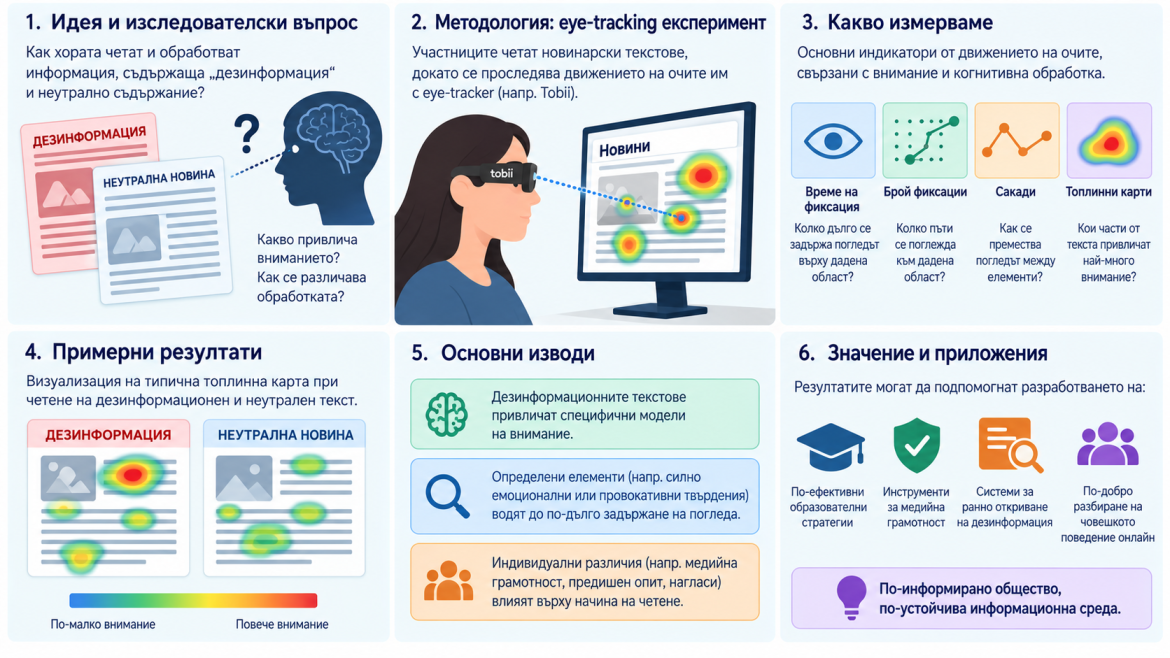
Why would a research team use eye-tracking to investigate a single word? The answer lies in the difference between what people say they pay attention to and what their eyes actually do. Eye-tracking is a well-established tool in media psychology and reading research because visual behavior offers a direct, real-time record of cognitive processing. When a person reads a news article, their eyes move in a sequence of fixations and saccades. A fixation is a short pause during which the eyes take in visual information; a saccade is the rapid movement between fixations. The location, duration, and sequence of these movements reveal what is salient, surprising, confusing, or emotionally significant to the reader. In the planned BROD study, the word “disinformation” will be used as a controlled stimulus within news items. The researchers will likely measure a range of eye-movement indicators, including first fixation duration, total dwell time, fixation count, regressions, and pupil dilation. First fixation duration tells us how quickly a word captures attention. Dwell time tells us how long a reader stays with a particular element of the page. Regressions, which are backward eye movements, can indicate confusion, re-reading, or an attempt to reconcile contradictory information. Pupil dilation, meanwhile, is often used as a proxy for cognitive load or emotional arousal. By collecting these measurements, the authors hope to determine whether the label “disinformation” changes the way readers process the surrounding news content in measurable ways. The word may function as a warning, a cue to stop and think, or an emotional signal that interferes with normal comprehension.
The word “balanced” in the title is central to the experiment’s logic. In experimental research, a balanced design controls for the order and sequence effects that can undermine causal conclusions. If every participant were to see the same version of every article, any observed difference in eye movements could be attributed to the order in which the stimuli were presented, to fatigue, or to practice effects. A balanced design counteracts this by rotating the conditions across participants. In the planned study, this might mean that each participant sees multiple news articles, some containing the word “disinformation” and some not, in different orders. It could also mean that the same underlying article is prepared in different versions: one with the word in the headline, one with the word in the body text, and one without the word at all. Because the content is otherwise identical, any difference in reading behaviour can be attributed to the stimulus word rather than to the facts of the story. The design also needs to account for individual differences among readers. Bulgarian adults come to a laboratory with different media habits, different levels of political interest, and different prior experiences with disinformation. Some may be frequent consumers of fact-checking websites; others may be deeply distrustful of mainstream journalism. All of these factors can affect eye movements and cognitive processing. A balanced design alone cannot eliminate such differences, but it can distribute them across conditions, making it more likely that any observed effect is caused by the word rather than by the characteristics of the participants. The authors’ decision to foreground this planning suggests that they are aware of the many ways in which eye-tracking studies can go wrong and are trying to avoid them.
The practical details of an eye-tracking experiment are considerable, and the paper is likely to address them in depth. The researchers must decide which type of eye tracker to use, whether desktop-mounted or remote, and what sampling rate is required to capture rapid eye movements. Calibration is a delicate process in which each participant must fixate on a sequence of target points so that the tracker can map their gaze accurately to the screen. Even small head movements, poor lighting, or moisture on the eyes can contaminate the data. The article will need to define precise areas of interest, or AOIs, on each news page. These might include the headline, the lead paragraph, quotations, bylines, images, and the exact location of the word “disinformation.” By mapping gaze data to these regions, the authors can compare how much time readers spend on the warning and how much time they spend on the factual content. The study will also involve decisions about the reading task. Participants might be asked to read naturally, as they would at home, or they might be told that they will be asked comprehension questions afterward. Questions can test memory for facts, recognition of the source, or subjective credibility. A follow-up questionnaire might ask participants whether they found the article trustworthy and whether they noticed the word “disinformation” at all. These self-report measures can be combined with eye-tracking data to connect visible behaviour to internal judgments. For example, a reader who lingers on the word “disinformation” but then cannot recall the central facts of the article may be experiencing cognitive load; a reader who skips the body text entirely may be making a quick, snap decision based on the label alone.
The publication of this experimental design is significant beyond the narrow world of eye-tracking methodology. It comes from BROD, a Bulgarian research group embedded in the EDMO network, which is supported by the European institutions to monitor and counter disinformation across Europe. The network’s focus is often on mapping harmful narratives, identifying bad actors, and supporting fact-checkers. This paper shifts the focus to the vocabulary that surrounds the disinformation problem. The word “disinformation” is used constantly by journalists, politicians, platforms, and fact-checkers, but its effects on readers are not fully understood. When a social media platform labels a post as disinformation, does that label make users more likely to reject the post? Or does it make them more curious and more likely to click into it? When a news organization writes that a claim is disinformation, does that warning make readers more careful, or does it simply raise their anxiety about everything they read? For Bulgarian newsrooms, where trust in media is fragile and where disinformation can spread quickly through social networks, the answers have practical consequences. If the eye-tracking study finds that the word “disinformation” changes the pattern of reading, that evidence could inform editorial guidelines about how to present false claims without amplifying them. It could also influence the design of platform labels and public service announcements. The methodological paper, even before it produces results, is already part of a larger conversation about how the very language of media criticism affects the public’s relationship with the news.
The most important thing to remember about this paper is that it contains no experimental outcomes. Margova and Temnikova are not reporting that “disinformation” causes a particular effect; they are reporting how they intend to find out. This is unusual in the fast-moving field of disinformation research, where public pressure to produce urgent findings often leads to underpowered studies, poorly controlled designs, and overinterpreted correlations. A design paper, by contrast, is humble in its claims. It says: this is the question, these are the methods, this is the analysis plan, and here is how the results will be interpreted. It gives other researchers the opportunity to identify weaknesses, suggest improvements, and perhaps run their own versions of the study. The full article is available through BROD and can be read on the group’s platform. In the coming months or years, the authors plan to recruit Bulgarian-speaking participants, run the eye-tracking sessions, clean and analyze the gaze data, and publish the actual findings. Those findings may show that the word “disinformation” has a strong cognitive effect, or they may show that readers barely notice it. Either outcome would be informative. If the word disrupts attention to important news content, that would be a serious concern for journalists and platform designers. If it has no measurable effect, that would suggest that warnings are neutral and can be used without fear of unintended consequences. The design paper is therefore not the end of a project but the start of one. It is a solid foundation for future work, a useful model for other researchers, and a reminder that rigorous science begins not with data collection but with careful thought.