


By TNND
(TNND) — A sweeping new study from the Pew Research Center’s Pew-Knight Initiative reveals a deeply conflicted American public when it comes to the boundaries of press freedom: while a strong majority views a free press as essential to the health of the nation, a surprising share also believes the government should be empowered to censor or punish news organizations under certain circumstances. According to the study, 73% of Americans describe freedom of the press as “very” or “extremely” important to the well-being of society, a sentiment that cuts across partisan lines. Majorities of both Democrats and Republicans agree on the fundamental importance of press freedom, though the poll found Democrats are more likely than Republicans to elevate it as a critical societal pillar. However, that broad commitment to the First Amendment principle collides with practical and often partisan views about when the government may intervene in the news cycle. More than half of all Americans — 59% of Republicans and 45% of Democrats — said it is acceptable for the government to demand that a news organization take down a story if it contains false information. Even more strikingly, 60% of Americans overall, including 72% of Republicans and 50% of Democrats, said the same when a story poses a risk to national security. These findings suggest that while the American public venerates the concept of a free press in the abstract, many are willing to tolerate significant governmental authority over journalistic content in the name of accuracy and public safety.
Peter Loge, director of the School of Media and Public Affairs at George Washington University, said the results reflect a nuanced and historically rooted public understanding that no right is absolute. He noted that Americans have long accepted that speech can be limited in specific, narrowly defined circumstances, comparing the tolerance for national security-related restrictions to the classic legal principle that one cannot falsely shout “fire” in a crowded theater. “Most Americans would agree for some national security purposes, there’s some things best left unsaid, or at least unsaid in the moment,” Loge said. He emphasized that journalists themselves carry a heavy ethical burden — including obligations to avoid harm, tell the truth screed and strive for fairness — and that these professional responsibilities are essential to maintaining public trust. But Loge drew a sharp line between self-regulation by the press and government oversight, arguing that official censorship is a far more dangerous remedy than imperfect journalism. “I may not love all journalists policing themselves,” he said. “I really loathe the government trying to police journalists.” His comments underscore a central tension in the Pew findings: Americans appear comfortable with the concept of restrictions, but the application of those restrictions by the state raises profound questions about who decides what is false, what is harmful, and what truly endangers national security in a democratic society.
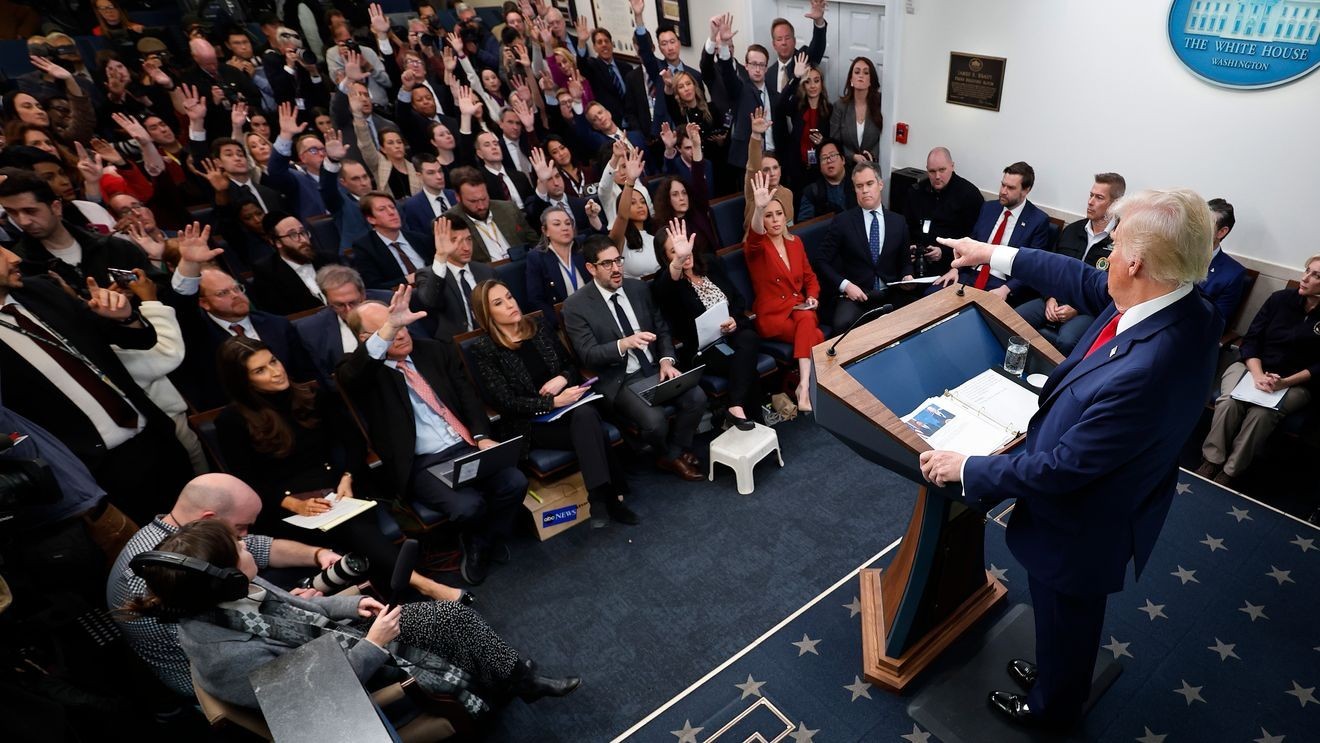
The study also captures a strikingly polarized perception of the current state of press freedom under the Trump administration, with more than four in ten Americans saying the press has become less free during President Donald Trump’s second term. That view is heavily concentrated among Democrats, with 72% saying press freedom has declined, while just 15% of Republicans agree. Loge argued that Trump’s combative relationship with the media has contributed to this erosion of confidence, particularly his frequent characterization of reporters and news organizations as “enemies of the American people.” Loge said such rhetoric is dangerous because it delegitimizes the role of the press as a check on power and encourages a climate of hostility toward journalists who report critically on the administration. “Too often, this president has said the reporters or journalists are enemies of the American people – typically, when those reporters or journalists say things the president doesn’t like,” Loge said. “That’s remarkably dangerous.” He was careful to distinguish between legitimate criticism and existential attacks on the institution, noting that a president can and should contest specific facts or coverage. “The president can say, ‘I disagree with this reporter, I don’t like that point of view,’” Loge said. “But they should always embrace a robust and open debate. Our democracy demands no less.” His remarks reflect growing concern among press advocates that rhetorical attacks from the highest office in the land can have a chilling effect on journalism and embolden those who would seek to physically or legally harm reporters.
Partisan differences in the Pew survey extend beyond perceptions of the Trump administration and reveal fundamentally different worries about the sources of press freedom threats. The Pew Research Center found that Democrats tend to worry more about direct government restrictions on the press, such as censorship, legal retaliation, or executive action aimed at specific outlets or reporters. Republicans, by contrast, more often expressed concerns about false information and the influence of news organizations themselves, including concerns about editorial bias and the power that major media companies hold over what news people are able to see. This ideological split is central to understanding the overall findings: while both parties support press freedom in principle, they define its greatest enemies differently. For many Democrats, the threat comes from the state; for many Republicans, the threat comes from the media’s perceived failure to be impartial and accurate. The survey found that only 28% of Americans currently believe the media is completely free to report the news, a strikingly low figure that suggests widespread skepticism about the actual independence of journalism in practice. Meanwhile, 46% of Americans say they are extremely or very worried about potential restrictions on press freedom in the future, with Democrats expressing significantly more worry than Republicans. These numbers paint a picture of a public that is both anxious about overcensorship and, paradoxically, willing to sanction certain forms of government intervention, especially when it aligns with their existing grievances about media bias or national security concerns.
The Pew study also probed public attitudes toward more aggressive forms of government action against the press, and the results show that a sizeable minority of Americans are open to measures that would traditionally be considered severe violations of press independence. Around 30% of Americans said it is at least sometimes acceptable for the government to force journalists to reveal the identities of unnamed government sources, a practice that is crucial to investigative journalism and generally protected by legal precedent and journalistic ethics. A similar share — roughly 30% — said it is at least sometimes acceptable for the government to take away a news organization’s license to broadcast, which would effectively be a death penalty for a media outlet. While these positions are held by a minority, their presence in the survey is notable given the First Amendment’s explicit protection of press freedom and the longstanding legal tradition that shields journalists from being compelled to expose confidential sources. The survey also found an extraordinary level of distrust in the flow of information, with around 80% of Americans saying the government at least sometimes intentionally keeps important news from reaching the public. Nearly the same proportion said news organizations themselves also at least sometimes deliberately withhold important information from their audiences. This mutual suspicion — directed at both state institutions and media enterprises — suggests that Americans are navigating a media landscape they believe is rife with manipulation, secrecy, and hidden agendas, and that this cynicism is fueling support for interventionist policies they might otherwise reject.
In the end, Loge argued, the findings should be read not as a rejection of the First Amendment but as a reflection of the public’s struggle to balance competing values in an increasingly fragmented and often deceptive information environment. Americans want to be informed, but they are not sure whom to trust; they want the press to be free, but they also want to be protected from lies and national security threats. Loge said that protecting press freedom is not merely a legal obligation but a foundational requirement for self-governance, and that even when journalists make mistakes or publish uncomfortable information, the answer is more speech, not more censorship. “Democracy is an ongoing debate about what to do next,” Loge said. “You can only have an honest debate if you have all perspectives and all perspectives are represented.” His comments serve as a caution against the seductive appeal of government-managed truth, reminding citizens that the remedy for bad speech is not state coercion but robust, open, and ultimately more complete journalism. The Pew study, with its contradictory impulses and partisan divisions, ultimately reflects a broader national uncertainty about how to handle the very freedom that makes democracy possible. As Americans continue to argue over the proper limits of press freedom, the debate itself is proof that the question remains very much alive — and that whatever the government’s power, the people have not yet surrendered their right to know.