


**TNND — A new Pew Research Center study from the Pew-Knight Initiative reveals a deeply ambivalent American public when it comes to press freedom: While an overwhelming majority considers a free press essential to democracy, most Americans also believe there are circumstances in which the government should be allowed to suppress news coverage. The study found that 73% of Americans describe freedom of the press as “very” or “extremely” important to the well-being of society, with majorities of both major parties agreeing. Democrats are more likely than Republicans to hold this view, but the partisan gap is relatively narrow on the principle itself. At the same time, however, the survey exposed a significant appetite for government intervention in journalism. Fifty-one percent of Americans — including 59% of Republicans and 45% of Democrats — said it is acceptable for the government to demand that a news organization take down a story if it contains false information. Even more striking, 60% of Americans overall — including 72% of Republicans and 50% of Democrats — said the government should be able to force the removal of a story if it poses a risk to national security. The findings paint a complicated picture: Americans cherish the First Amendment ideal of an independent press, yet many are willing to tolerate government control when they perceive threats to accuracy or national safety.
Peter Loge, director of the School of Media and Public Affairs at George Washington University, said the results reflect a long-standing American tension between democratic ideals and practical concerns. Loge noted that most Americans understand there are legitimate restrictions on speech, just as the legal system recognizes that one cannot “falsely yell fire in a crowded movie theater.” He said many reasonable people agree that, for national security purposes, some information is best left unpublished, or at least delayed. But Loge drew a sharp line between journalists exercising ethical judgment and the government imposing its own editorial control. Journalists, he said, have professional obligations to avoid harm, tell the truth, and strive for fairness. Yet even when members of the media fall short of those standards, Loge argued, the answer is not government censorship. “I may not love all journalists policing themselves,” Loge said. “I really loathe the government trying to police journalists.” His comments underscore a central dilemma in the survey: Americans may want accurate and secure news, but they do not necessarily want politicians deciding what the public can see.
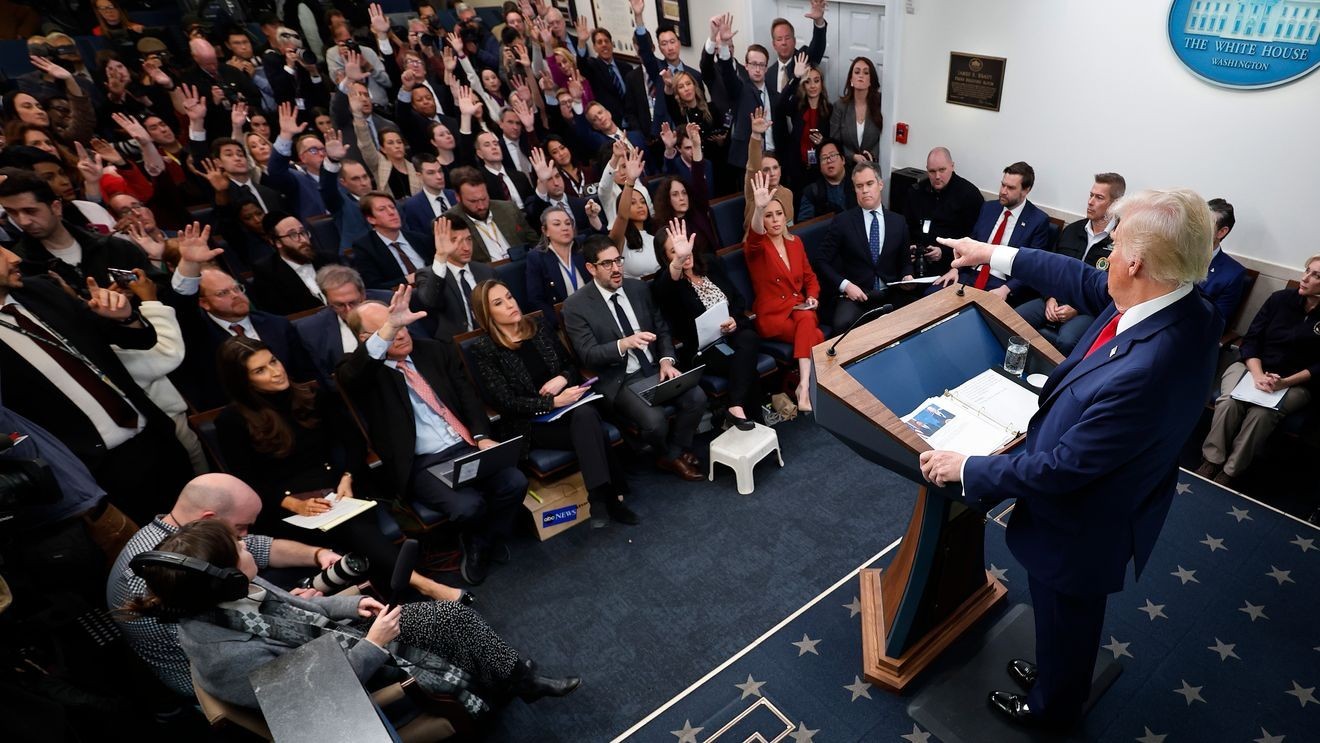
The survey also found widespread concern that press freedom has deteriorated in recent years, particularly during President Donald Trump’s second administration. More than four in 10 Americans told Pew that the press has become less free during that period. That perception is sharply partisan: 72% of Democrats said press freedom has declined, while only 15% of Republicans agreed. Loge attributed much of this distrust to Trump’s repeated attacks on reporters and news organizations. He said the president has often described journalists as “enemies of the American people,” particularly when they publish stories unfavorable to him. Loge warned that such language is dangerous, even if the president disagrees with coverage. “The president can say, ‘I disagree with this reporter, I don’t like that point of view,’” Loge explained. “But they should always embrace a robust and open debate. Our democracy demands no less.” His remarks highlight how presidential rhetoric can shape public confidence in the media and influence whether Americans see the press as free or as a target of government hostility.
Republicans and Democrats raise different concerns when discussing press freedom, according to Pew. Democrats tend to focus on direct government restrictions, such as censorship, surveillance, or legal threats against journalists. Republicans, by contrast, often emphasize concerns about false information and the power of news organizations to control what people see. These differing priorities help explain why support for government intervention varies by party. Republicans are more likely to support forcing outlets to remove false stories and national security risks, while Democrats are more worried about government overreach. Overall, only 28% of Americans say the media is completely free to report the news today. That leaves roughly seven in 10 Americans who see at least some limits on press freedom. Additionally, 46% of Americans say they are extremely or very worried about potential restrictions on press freedom, with Democrats more likely than Republicans to express that concern. The data suggests that while press freedom is widely valued, Americans are divided over what threatens it most: government power or the media’s own influence and credibility.
Other findings from the Pew study reveal further willingness to allow government control in specific areas. About 30% of Americans say it is at least sometimes acceptable for the government to force journalists to reveal the identities of unnamed government sources. A similar share said it is at least sometimes acceptable for the government to take away a news organization’s license to broadcast. Those numbers reflect a notable minority that supports stronger enforcement tools against journalists. At the same time, Americans are highly skeptical that the public is getting the full story. Around 80% of Americans said the government at least sometimes intentionally keeps important news from reaching the public. An identical share said news organizations themselves also intentionally withhold important information. This widespread distrust of both official institutions and media outlets helps explain why support for press freedom coexists with support for censorship: Many Americans simply do not trust the gatekeepers, whether they are in government or in newsrooms.
Loge said the findings ultimately reinforce the vital role of press freedom in a functioning democracy, even as he acknowledged that journalists sometimes fail to meet professional standards. He described democracy as an ongoing public debate about the future of the country — a debate that cannot happen if important perspectives are missing from the conversation. “Democracy is an ongoing debate about what to do next,” Loge said. “You can only have an honest debate if you have all perspectives and all perspectives are represented.” In that sense, Loge argued, the question is not whether the press is perfect, but whether it remains free enough to represent the range of voices and facts Americans need to make decisions. The Pew study suggests most Americans still believe in that ideal, even as they struggle with where to draw the line between freedom and responsibility. The challenge for the country, Loge said, is to maintain an independent press that can hold power accountable without sacrificing accuracy or security — and to do so without letting the government become the ultimate judge of what Americans are allowed to know.