


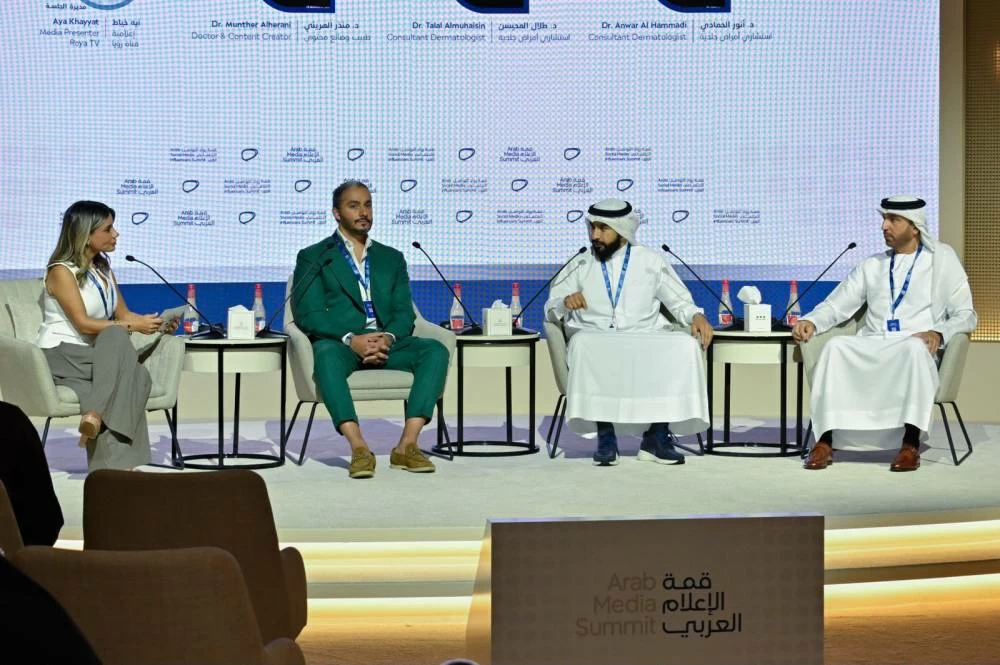
Dubai: Experts at the Arab Media Summit have issued a stark warning over the growing spread of misleading medical information on social media, urging doctors to challenge false health claims online without turning medicine into product marketing.
Speaking during a panel discussion entitled “Doctor or Influencer: Who Do We Believe?” on the second day of the summit, health experts said inaccurate health claims can go viral within seconds, while it may take doctors weeks or months to correct them and raise public awareness. They explained that personal experiences shared by influencers about medicines, treatments and health products have become among the most significant sources of misinformation. The panel stressed that viral content should not be treated as proof of accuracy, and called on doctors to have a stronger presence on digital platforms by presenting clear and accessible medical information capable of competing with influencer content through the same algorithms and channels. “The spread of information does not mean that it is true,” the experts said, adding that views and engagement are not reliable measures of medical accuracy. The session underscored a growing tension between professional medical practice and the rapid, unregulated flow of health advice online, where entertainment, advertising and personal anecdote are often indistinguishable from scientific evidence. With millions of people turning to social media for health guidance, the experts argued that the medical profession cannot afford to remain on the sidelines. The challenge, they said, is no longer simply to produce accurate information, but to ensure that accurate information reaches audiences quickly, credibly and in formats that resonate with modern digital habits.
Dermatology consultant Dr Anwar Al Hammadi described social media as a “golden opportunity” for medical professionals, saying it can help build a more informed and health-conscious society when used responsibly. He said public trust is earned by those who provide valuable information, and warned against doctors using their platforms primarily to market products. “I am with the influential doctor and not the marketing doctor,” he said. Al Hammadi noted that some doctors have recently begun promoting specific products and services, calling this one of the major challenges facing the profession. He added that paid medical advertising places even greater responsibility on doctors regarding the information they share. He also called for stronger self-regulation among content creators and cautioned against misleading promotional material, particularly “before-and-after” videos linked to cosmetic products and procedures. Al Hammadi stressed that a doctor’s role should extend beyond diagnosing patients and prescribing medication to include raising public awareness and correcting inaccurate health information. He argued that social media provides doctors with a unique platform to engage with the public, answer common questions, debunk myths and explain complex medical concepts in simple language. However, he insisted that the credibility of medical professionals depends on their ability to remain impartial and trustworthy, rather than becoming just another voice selling products. The responsibility, he suggested, is particularly heavy in fields such as dermatology and aesthetics, where visual content and commercial pressures can easily distort professional judgment. By combining ethical practice with digital literacy, Al Hammadi said, doctors can turn social media into a powerful tool for public health education rather than a marketplace for dubious treatments.
Dermatology consultant Dr Talal Al Muhaisen said doctors now share the digital space with influencers who often prioritise views, engagement and audience growth. He said that despite doctors adhering to professional standards, they face a challenge because “the voices of influencers today are louder than the voice of the doctor”. According to Al Muhaisen, influencers benefit from their constant presence on social media and their willingness to make sweeping promises, whereas doctors remain bound by professional and ethical responsibilities. He added that advertising remains one of the key challenges, stressing that promotional content should be clearly identified as advertising to ensure transparency with audiences. Al Muhaisen warned that widely viewed videos are not necessarily accurate and pointed out that medical misinformation can become a trend in a matter of minutes, while correcting it often requires months of effort. He said personal experiences have become one of the most popular forms of online content and can attract millions of views, but may be dangerous when treated by audiences as scientific or medical evidence. Referencing an influencer who discussed personal experiences with slimming injections, Al Muhaisen said the risks arise when audiences generalise individual experiences and assume other advice from the same source is equally reliable. “The spread of information does not mean that it is true,” he said, adding that views and engagement are not reliable measures of medical accuracy. He emphasised that influencers are often not maliciously trying to mislead, but are operating within a system that rewards attention and emotional engagement over accuracy and nuance. This means that even well-intentioned content can become harmful when it is stripped of medical context, individual variation and professional caution. Al Muhaisen argued that doctors must therefore learn to communicate in ways that are engaging and accessible without abandoning their responsibilities to evidence-based practice and patient safety.
Cosmetic dentist and content creator Dr Munther Al Harini said medical education does not adequately prepare doctors for media appearances and communication through social media platforms. He stressed that doctors have a responsibility to challenge and correct false medical information whenever it appears online. Al Harini also warned against the casual use of psychological and medical terms on social media, noting that labels such as “narcissist” or references to hyperactivity disorders are increasingly being used without professional diagnosis. He said doctors need to communicate in simple language and adopt styles that resonate with audiences. “If the influencer can reach people through video, then the doctor should use the same tools and algorithms to reach the audience,” he said. Al Harini added that doctors should not limit themselves to traditional responses to misinformation but should create engaging content capable of reaching large audiences and spreading accurate medical information more effectively. He argued that the medical profession needs a new generation of communicators who are comfortable in front of cameras, skilled at storytelling and familiar with platform algorithms, while maintaining rigorous scientific standards. Medical training, he said, has traditionally focused on clinical knowledge and patient care, leaving many doctors unprepared for the public arena where half-truths and sensational claims thrive. As a result, the digital health space has been left largely to influencers, lifestyle bloggers and self-styled wellness experts who are not bound by medical ethics or professional accountability. Al Harini called for integrating communication and media skills into medical education, as well as creating opportunities for doctors to collaborate with media producers, digital storytellers and social media specialists. Only then, he said, can accurate medical information compete on an equal footing with misinformation in the crowded digital landscape.
The panel discussion formed part of the wider Arab Media Summit, which brought together media professionals, health experts and digital creators to explore the changing dynamics of influence, credibility and public trust. The session highlighted a broader global concern about the role of social media in shaping health beliefs and behaviours, particularly among younger audiences who increasingly rely on influencers rather than traditional medical institutions for advice. In many cases, these influencers have built massive followings based on relatable content, personal journeys and visually appealing presentations, all of which can make medical claims appear more convincing than a doctor’s cautious explanation. The experts acknowledged that the problem cannot be solved solely by warning the public to be careful about what they believe online. Instead, they argued, it requires a multi-layered approach involving medical professionals, social media platforms, regulatory bodies and the influencers themselves. This approach would include clearer labelling of promotional content, stronger enforcement against dangerous health claims, greater transparency about conflicts of interest and more proactive engagement by doctors in digital spaces. The experts also noted that medical misinformation is not limited to obvious quackery or miracle cures; it can also involve the misuse of legitimate terms and conditions, the over-simplification of complex treatments and the promotion of unregulated products that pose serious risks to vulnerable people. In this environment, professional silence is no longer a neutral position. By failing to participate, doctors leave the field open to those who are more skilled at capturing attention but less concerned with accuracy, safety and patient well-being. The panel therefore called for a cultural shift within the medical profession, one that recognises public communication as a core responsibility rather than an optional add-on. Hospitals, medical associations and academic institutions were urged to support doctors in their digital efforts, to provide training and resources, and to develop ethical guidelines that protect both professional integrity and public health.
Ultimately, the experts concluded, the answer lies not in trying to silence influencers but in building a more informed and discerning public sphere, where accurate medical information is as visible, engaging and accessible as the misinformation it aims to replace. The doctors must compete for attention by using the same algorithms, formats and storytelling techniques that make viral content so powerful, but with the crucial difference that their content is grounded in science and aimed at public welfare rather than commercial gain. At the same time, medical professionals must resist the temptation to adopt the worst habits of influencer culture, including exaggeration, dramatisation and the unregulated promotion of products. The boundary between being an influential doctor and being a marketing doctor is one that every medical professional must actively protect. The ongoing battle for health information online is not only about correcting individual falsehoods; it is about establishing a new model of digital health communication that is trustworthy, transparent and capable of reaching mass audiences. The Arab Media Summit session made clear that the stakes are high, but so too is the opportunity. With the right training, mindset and support, doctors can reclaim their role as the most credible source of health information, not by dominating the conversation with authority alone, but by participating in it with clarity, empathy and integrity. As Dr Anwar Al Hammadi said, the influential doctor is not the one who sells products, but the one who provides valuable information, earns public trust and helps build a truly health-conscious society. In an age where a single video can reach millions within hours, the need for doctors to become effective digital communicators has never been more urgent — and neither has the need to ensure that their influence is guided by ethics, evidence and the genuine interests of patients.