


Pew Study: Americans Value Press Freedom but Back Some Limits, Partisan Split Emerges
By TNND
A new study from the Pew-Knight Initiative at the Pew Research Center reveals a deeply complicated American relationship with freedom of the press: while overwhelming majorities across the political spectrum describe a free press as essential to the health of American society, significant numbers of those same Americans also believe the government should be allowed to suppress certain stories, especially when false information or national security concerns are involved. According to the survey, 73 percent of Americans say freedom of the press is “very” or “extremely” important to the well-being of society, a figure that includes strong majorities of both Democrats and Republicans. Yet those broad commitments to the First Amendment ideal do not translate into absolute protections in practice. Just over half of Americans, including 59 percent of Republicans and 45 percent of Democrats, told Pew researchers it is acceptable for the government to demand that a news organization take down a story if it contains false information. Even more strikingly, 60 percent of Americans — including 72 percent of Republicans and 50 percent of Democrats — said the same of a story that poses a risk to national security. The findings capture a tension at the heart of American civic life: citizens cherish the idea of an unfettered press, but they are also willing, in certain circumstances, to accept government intervention that would have been unthinkable to the Founders and that many press advocates warn is a slippery slope toward authoritarian control.
Peter Loge, director of the School of Media and Public Affairs at George Washington University, said the Pew findings reflect a commonsense understanding that even constitutional rights are not unlimited. He drew an analogy to the classic legal principle that the First Amendment does not protect the right to falsely yell “fire” in a crowded theater, arguing that most Americans intuitively recognize there must be some limits on speech and publication. “Most Americans would agree for some national security purposes, there’s some things best left unsaid, or at least unsaid in the moment,” Loge said. Journalists, he noted, operate under ethical codes that demand truthfulness, fairness, and a commitment to avoiding harm, and those professional responsibilities are part of what makes the institution trustworthy. But Loge was emphatic that ethical self-regulation by journalists is not the same as government censorship, and he expressed deep skepticism about handing public officials the power to decide what news is fit to print. “I may not love all journalists policing themselves,” he said. “I really loathe the government trying to police journalists.” His comments underscore a crucial distinction between voluntary editorial judgment and coercive state power: even when journalists make mistakes or publish material that some consider dangerous, the solution in a democratic society, he argued, is not for the government to become the arbiter of truth. The Pew data suggest that many Americans have not fully internalized that distinction, and Loge said that should be a cause for concern among those who care about the future of democratic governance.
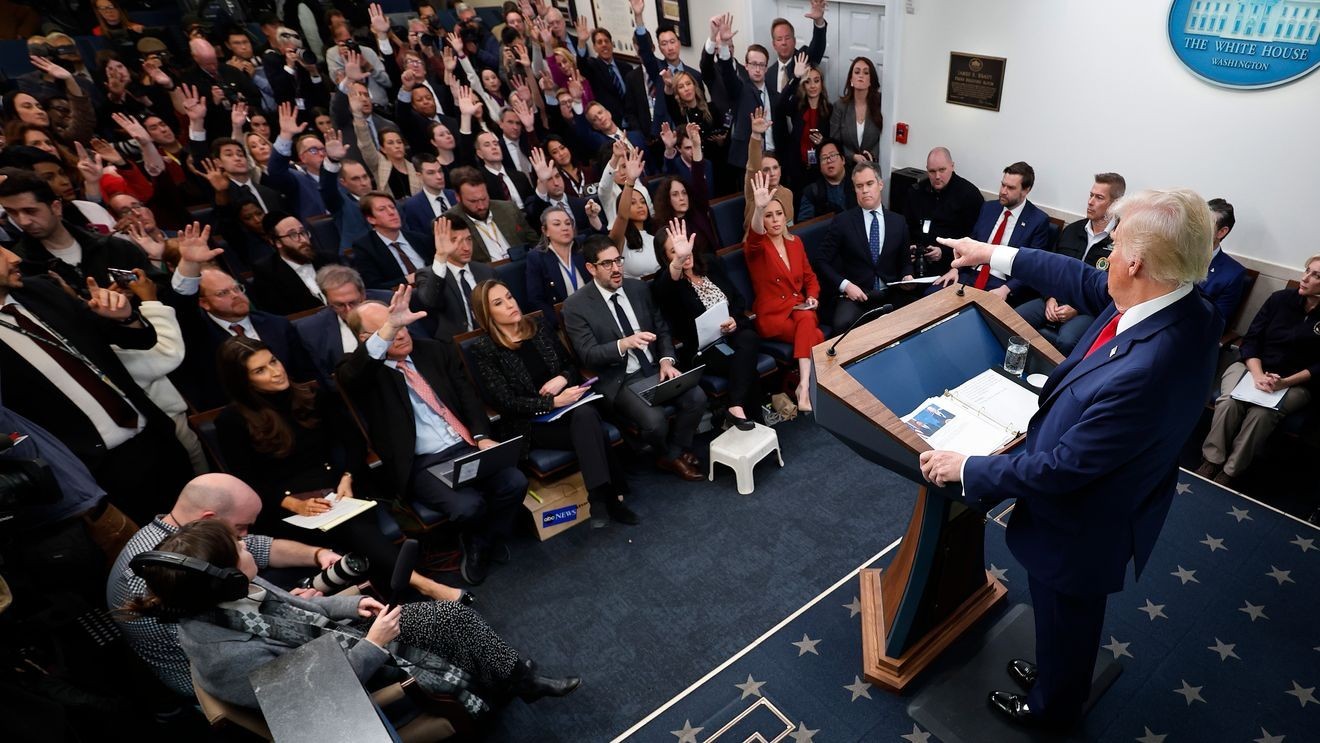
The survey also exposed a sharp partisan divide over whether press freedom is expanding or contracting in the current political era, and those divisions are deeply intertwined with perceptions of President Donald Trump. More than four in ten Americans told Pew that the press has become less free during the second Trump administration, but that aggregate number masks a chasm between the parties: only 15 percent of Republicans said press freedom has declined, while 72 percent of Democrats said it has. Loge argued that Trump has played a direct role in undermining public confidence in the media through his aggressive and often personal attacks on reporters. “Too often, this president has said the reporters or journalists are enemies of the American people — typically, when those reporters or journalists say things the president doesn’t like,” Loge said. He warned that such language is not merely rhetorical bluster but carries real danger for democratic institutions. The president, Loge acknowledged, has every right to criticize the media and to push back against coverage he believes is unfair or inaccurate. But there is a profound difference between disagreeing with a journalist and casting the press as a hostile enemy of the nation. “The president can say, ‘I disagree with this reporter, I don’t like that point of view,’” Loge said. “But they should always embrace a robust and open debate. Our democracy demands no less.” The Pew data suggest that Trump’s attacks may have landed differently depending on the audience: Republicans who trust the president and share his skepticism of mainstream media may see the press as more free than ever, while Democrats who view Trump as a threat to democratic norms see the media as increasingly under siege. That partisan lens, experts say, is itself a symptom of a broader political polarization that makes it difficult for Americans to agree on basic facts about the state of their institutions.
The Pew Research Center also found that Democrats and Republicans are worried about different kinds of threats to press freedom, reflecting their broader anxieties about power and information in American society. Democrats, according to the study, tend to focus on direct government restrictions: censorship, legal harassment of reporters, and the use of state power to punish outlets that publish unfavorable stories. Republicans, by contrast, often express concerns about false information, editorial bias, and the outsized role of news organizations in controlling what stories the public sees and how those stories are framed. That distinction helps explain why Republicans are more willing than Democrats to support government intervention to remove false content or suppress stories that might endanger national security: they see the media itself as a powerful institution that needs to be checked, while Democrats see the media as a crucial counterweight to government power. The partisan split also appears in broader attitudes toward media freedom. Overall, only 28 percent of Americans say the media is completely free to report the news today, a figure that suggests widespread skepticism about the actual independence of news organizations. Meanwhile, 46 percent of Americans say they are extremely or very worried about potential restrictions on press freedom, with Democrats significantly more likely than Republicans to express that concern. These numbers paint a picture of a public that is simultaneously suspicious of the media and worried about the government’s willingness to censor it — a combination that leaves little common ground for a shared understanding of what a healthy press system should look like.
Other findings from the Pew study further illustrate the public’s willingness to entertain government actions that press freedom advocates would consider deeply troubling. Around 30 percent of Americans said it is at least sometimes acceptable for the government to force journalists to reveal the identities of unnamed government sources, a practice that is critical to investigative reporting but that journalists fiercely protect in order to encourage whistleblowers to come forward. A similar share of Americans said it is at least sometimes acceptable for the government to revoke a news organization’s license to broadcast, a move that would effectively end an outlet’s ability to operate in the United States. While these percentages represent a minority of the public, they are striking nonetheless, because they suggest that a substantial bloc of Americans is open to government action that would fundamentally alter the landscape of American journalism. The survey also found that roughly 80 percent of Americans believe the government at least sometimes intentionally keeps important news from reaching the public, and an almost identical share said the same of news organizations. That parallel distrust is remarkable: Americans see both their government and their media as institutions that routinely hide important information from them, and they are unsure which one to blame or trust. The result is a news environment in which citizens are deeply cynical about the information they receive, whether it comes from official sources or from the press, and that cynicism may make them more receptive to solutions that promise to protect them from falsehoods, even when those solutions come from the government.
Loge said freedom of the press remains vital to American democracy, even if there are times when he believes journalists should exercise restraint in what they report for the greater good. He rejected the notion that the press should be free to publish anything without regard for consequences, but he also insisted that the answer to bad journalism is not government censorship. “Democracy is an ongoing debate about what to do next,” Loge said. “You can only have an honest debate if you have all perspectives and all perspectives are represented.” The Pew study suggests that Americans are struggling to balance those competing values: they want a press that is free enough to hold power accountable and expose uncomfortable truths, but they also want protection from misinformation, national security threats, and media bias. Those goals are not inherently incompatible, but they require a level of trust in both journalists and government officials that is currently in short supply. The study, conducted under the Pew-Knight Initiative, a collaboration between Pew Research Center and the John S. and James L. Knight Foundation, is likely to fuel continued debate about the future of the First Amendment in an era of polarized politics, rapid technological change, and growing public skepticism. As the second Trump administration continues to test the boundaries of executive power and its relationship with the media, the findings serve as a reminder that Americans have not fully decided where those boundaries should be drawn. For now, the public remains caught between two powerful instincts: the desire for a free press that can speak truth to power, and the fear that a free press, left entirely to its own devices, will not always tell the truth. The challenge for the country, Loge suggested, is to find a way to uphold the former without succumbing to the temptation of the latter. That is a challenge the Founders themselves could not have fully anticipated, but one that will define the health of American democracy for generations to come.