


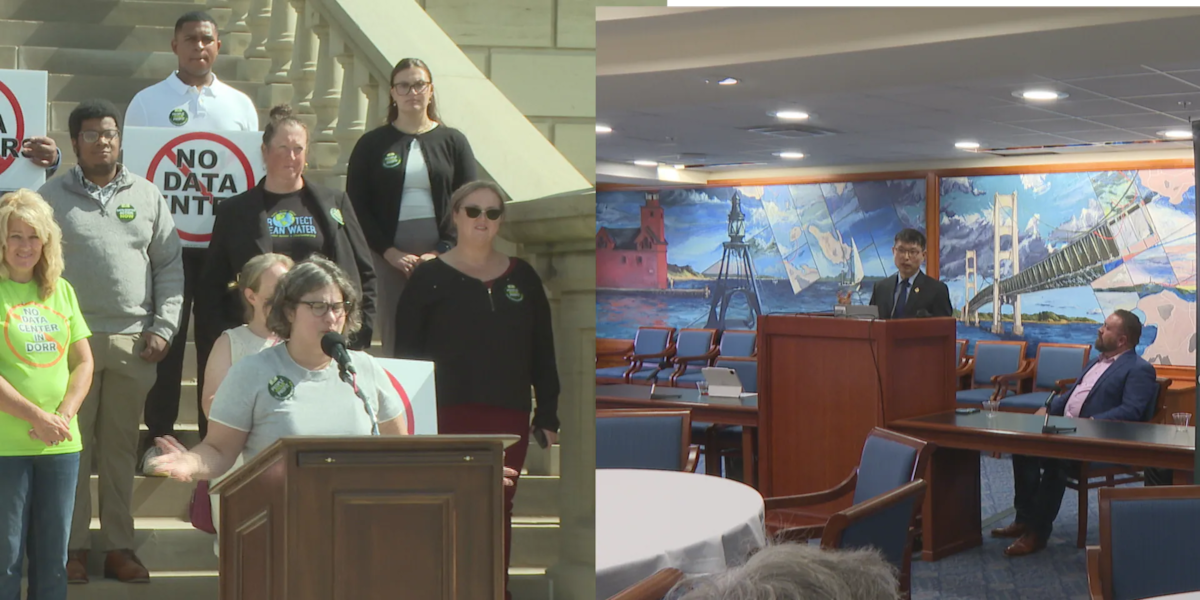
‘Overwhelmed with misinformation’: What data centers mean for the environment
For communities across the United States, few infrastructure questions are more confusing than the arrival of a data center. Sometimes pitched as a clean, high-tech answer to dwindling manufacturing jobs, sometimes feared as a crypto mine that will burn coal and drain local water supplies, the data center resists easy labels. Michigan officials and environmental advocates say they are “overwhelmed with misinformation” as proposals multiply in counties around Lansing, Grand Rapids, and Detroit, and similar debates are unfolding in Ohio, Virginia, Texas, and the Mountain West. Data centers are large buildings containing thousands of computer servers that power cloud storage, streaming video, online banking, weather forecasting, autonomous vehicles, and artificial intelligence. They operate around the clock, drawing enormous amounts of electricity and, in many cases, water to keep the machines cool. Because they look benign from the outside—windowless boxes with low humming fans and maybe a small grassy lawn—their true environmental footprint can be hidden. The result is a public debate shaped by viral images, half-true statistics, and legitimate but often exaggerated fears. Understanding what data centers actually mean for the environment requires separating two questions: how much physical resource they use, and whether that use is wasteful or essential. The answers are not as clear as either proponents or opponents often suggest. In the simplest terms, a data center is a building that stores and processes digital information. Every time a person opens an app, sends an email, watches a show, or asks an AI chatbot a question, that request travels to a server somewhere in a data center. The more digital life expands, the more data center capacity is needed. The International Energy Agency estimates that data centers already consume about 1 to 2 percent of global electricity, and with the explosive growth of artificial intelligence, that figure could roughly double by 2030. For local communities, that translates into large power lines, new substations, and long-term contracts with utilities, all of which raise the question of whether the economic benefits are worth the environmental burdens.
The most straightforward environmental concern is electricity consumption. Data centers need power not only to run millions of microprocessors but also to operate cooling systems, backup batteries, and on-site transformers. A single hyperscale data center can draw as much electricity as a medium-sized city, and in the United States many of those facilities are connected to grids that still rely heavily on natural gas and coal. In Michigan, where coal plants are being retired and replaced with renewables and gas, a large data center can effectively slow the transition by requiring firm, dispatchable power around the clock. Utilities may keep older gas units online longer or build new combustion turbines to serve the increased load, which could lead to higher emissions in the near term. At the same time, major technology companies—Amazon, Google, Microsoft, Meta—are among the largest corporate purchasers of renewable energy in the world. They often sign power purchase agreements with wind and solar farms to match their electricity use on an annual basis. But matching annual consumption is not the same as powering a facility every second with clean energy. When the wind is not blowing or the sun is not shining, the data center still pulls from the grid, and the system must be balanced by fossil fuels or stored power. This nuance is often lost in the public conversation. Some advocates claim data centers are entirely clean because tech companies buy renewables, while critics claim every data center is a “carbon bomb.” The truth depends on the grid mix, the time of day, the company’s storage investments, and whether the renewable energy being purchased is additional—meaning whether it would not have been built without that data center’s money. Without that level of analysis, claims on both sides become misinformation.
Water use is the second major environmental issue, and it is perhaps the most misunderstood. Data centers generate heat, and that heat must be removed to keep chips from melting. Many facilities use cooling towers that evaporate water, much like an industrial cooling system for a power plant or a large office building. In drought-prone regions such as Arizona, California, and parts of Texas, the groundwater use has sparked protests and stricter permitting rules. In Michigan, with its abundant freshwater resources, the problem is less acute, but local water utilities still have to supply millions of gallons a day to a single facility, which can strain aging pipes and well fields. There is also confusion about what happens to that water. Most cooling water is not consumed in the traditional sense; a large portion is returned to a municipal sewer system, but a significant amount is lost as steam through cooling towers. That evaporation means the facility is effectively removing fresh water from the local watershed. However, a newer generation of data centers uses closed-loop cooling systems that recycle water, and some designs use no water at all, relying instead on outside air or refrigerants. The water footprint of a data center is therefore highly design-dependent. A state-of-the-art facility in a humid northern climate might use very little fresh water, while a similarly sized facility in the desert with old cooling towers can use millions of gallons per day. Many local officials have been caught in the middle of this nuance. They may sign a tax abatement and an economic development agreement before discovering that the data center operator’s proposed cooling strategy has changed, or that the actual water consumption differs from the marketing brochure. This mismatch between public expectations and operational reality has fueled the very misinformation that now overwhelms city councils and planning commissions.
A third issue is land use and physical infrastructure, and here the misinformation is especially loud. Data centers are generally large, single-story warehouses with concrete floors, heavy electrical equipment, and expansive parking lots for employees, though they employ far fewer workers than a traditional factory. A data center might create 30 or 50 permanent jobs, while an automotive parts plant could employ 2,000. Opponents often seize on this number and conclude that data centers are worthless. But proponents point out that data centers pay high property taxes, provide millions of dollars in local revenue with very few public services needed, and can serve as an anchor for other technology investment. They also occupy land that is often either brownfield or already zoned for industrial use, and they require significant construction labor—hundreds of workers during the building and fit-out phase. The environmental tradeoff is real: a data center is not a job creator in the same way as a hospital or an auto assembly plant, but it is also not an empty warehouse. It brings heat, noise, diesel generator testing, and electromagnetic noise to surrounding neighborhoods. Some communities have complained about the constant hum of industrial fans, while others have welcomed the tax revenue. The physical footprint can be even more disruptive: new high-voltage transmission lines, large transformers, and access roads cut through farmland and wetlands. The recent trend of locating data centers in rural counties or small towns exacerbates these impacts because the local grid was never designed for that kind of load. Residents may see a 20-acre wooded lot cleared, a massive concrete pad poured, and a dozen diesel storage tanks installed, all before any meaningful public discussion. By the time anyone tells the full story, the data center is already under construction, and the narrative has already been captured by whoever spoke first. This is why state and local officials are increasingly calling for standardized environmental disclosure requirements before a data center receives a permit.
The misinformation problem is also amplified by social media and by the legitimate but often unrelated issue of cryptocurrency mining. Crypto mining facilities are data centers of a kind, but they perform no useful computation beyond solving puzzles to create digital coins. They consume enormous amounts of electricity with no commercial output other than speculation, and they have been widely criticized for making coal plants run longer and causing severe noise pollution. Because crypto mines look like data centers—accidentally or on purpose—the public often merges the two categories. A viral TikTok video of a crypto mine in upstate New York can become evidence that “all data centers are destroying the environment,” even though a hyperscale cloud data center is a completely different operation. Cloud and AI data centers run hospitals, banks, and universities; they are not just spinning machines. That distinction is often lost in the angry comments section of a city council meeting. It is also true, however, that some data centers have been built in the last five years specifically for AI training, and AI models are far more energy-intensive than ordinary cloud computing. A single AI query can use ten times more energy than a traditional Google search. As companies race to build out AI capability, they are now considering data centers with capacities that previously seemed absurd, sometimes requiring their own dedicated power plants. This has created a drumbeat of doom headlines predicting that data centers will crash the grid or drive up residential electricity rates by 20 percent. Those headlines are often based on worst-case projections from industry forecasts, but they are not all wrong. The demand is real, and the grid is not ready. What is missing is an honest conversation about who pays for the necessary grid upgrades, whether the companies should be required to pay for their own pollution, and how communities can set conditions without scaring away investment.
Despite these challenges, there is a constructive path forward. Data centers can be made much more environmentally friendly through design standards and regulatory requirements. They can use waste heat to warm local buildings, schools, or greenhouses. They can be required to use direct liquid cooling, which reduces water use and electricity consumption. They can be paired with on-site solar arrays, long-duration better storage, and iron-air batteries. They can be located in existing industrial zones where the transmission capacity and water lines already exist, rather than on pristine farmland. They can be subject to mandatory disclosure of annual energy use, water use, emissions, and backup generator runtimes, so that the public can verify what the company is actually doing. They can also be required to pay a data center-specific tariff, as some utilities have implemented, to ensure that residential ratepayers do not subsidize a facility’s expensive new transmission hookup. The fight over data centers is not a fight against technology; it is a fight for information. Both sides want to know what is actually going to happen, and both sides have been forced to rely on exaggerated quotes from the other side. The phrase “overwhelmed with misinformation” is not just a shrug—it is a warning that the public lacks the tools to distinguish a modest utility concern from an apocalyptic threat. The solution is transparency. States and counties should pass laws requiring data center operators to provide telemetered, publicly available data on electricity and water use, along with an environmental impact assessment that accounts for the entire lifecycle, from server manufacturing to decommissioning. If a company is genuinely building a clean, efficient facility, it should welcome that transparency. If a community is considering a data center, it should demand that report before a single tree is cleared. The future of the digital economy depends on data centers, but so does the future of the local environment. Those two futures should come together at a table where facts, not memes, are the starting point. In the meantime, residents who are “overwhelmed with misinformation” would do well to ask one simple question: show me the meter, the electric bill, and the water bill. The answer, more than any slogan or press release, will tell them what the data center really means for their water, air, and energy future.