


This Week’s Fact Checks: Old Videos, False Locations, and Misleading Contexts
The digital information ecosystem has become a battleground where truth increasingly struggles to outrun viral falsehoods. Every week, social media is flooded with videos, photographs, and claims that are stripped of context, misdated, or geographically displaced, often with the clear intent of stoking political tensions, communal discord, or fear. This week, the fact-checking team at Newschecker has dissected several such viral claims, and their findings reveal a troubling pattern: old footage from one state is passed off as fresh evidence from another, unrelated incidents are repurposed to fit ideological narratives, and genuine social concerns such as student protests, communal violence, and the drug crisis are exploited to generate engagement and outrage. From a video falsely claimed to show Prime Minister Narendra Modi interacting with Congress leaders at a recent wedding to a clip from Bangladesh that was amplified as evidence of a schoolgirl being harassed in India, the range of misinformation is both broad and deeply concerning. In this roundup, we summarize the week’s top fact checks, explain what the investigation uncovered, and stress the critical need for careful verification in an age when a few seconds of unverified footage can inflame real-world tensions.
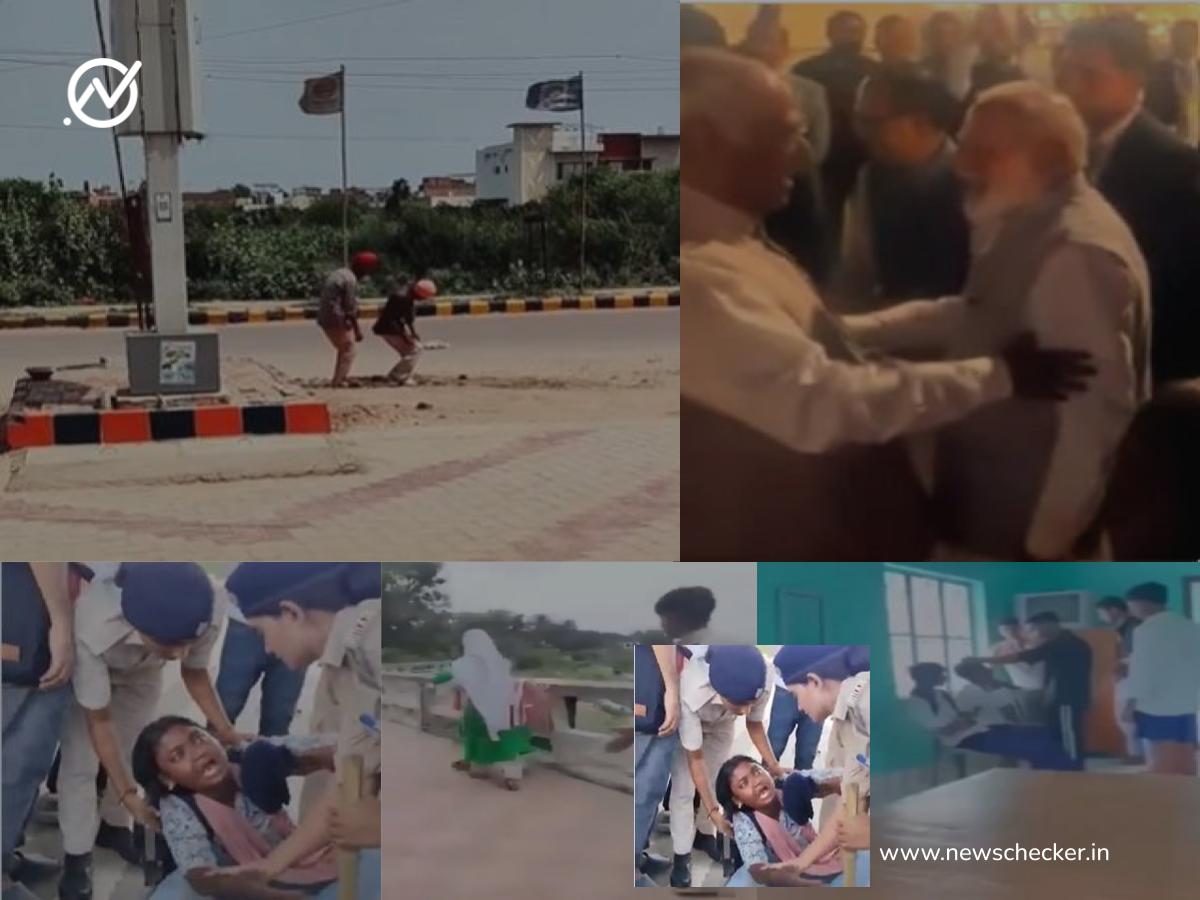
One of the most widely shared videos this week purported to show Prime Minister Narendra Modi engaging warmly with Congress leaders Mallikarjun Kharge and Priyanka Gandhi Vadra at the wedding reception of NCP-SP MP Supriya Sule’s daughter, Revati Sule. The clip spread rapidly across platforms, with many users claiming that the Prime Minister was setting aside political rivalries to greet opposition leaders at a high-profile social function. The implication was clear: the video was being offered as evidence of current political equations or behind-the-scenes diplomacy. However, Newschecker’s investigation found that the video is old and not from the recent wedding reception at all. The footage had been circulating on social media long before the Sule wedding event, and while it may show a genuine interaction between the leaders at some earlier gathering, it has no connection to the daughter’s wedding. Fact-checkers traced the video to its original context and determined that the date, location, and occasion of the footage did not match the claims being made. This is a classic case of temporal misdirection, where a viewer is led to believe that a video is current when in fact it is archival material. The damage done by such false associations is not trivial; it creates a false narrative about current political behavior, fuels speculation about secret alliances, and undermines the credibility of legitimate reporting. Worse, when such videos are shared by users with large followings, the false framing spreads faster than the correction, making it nearly impossible to fully undo the misrepresentation.
Another particularly dangerous viral video involved an alleged assault on a young Muslim student at a school in Karnataka. The clip, which ran for about 38 seconds, showed a boy being brutally beaten inside a classroom while other students looked on. The accompanying claim, shared aggressively on social media, said that BJP-backed miscreants had entered the school and attacked a Class 6 Muslim student in Bijapur, also known as Vijayapura. The claim immediately played into existing communal fault lines, and it was not long before the video was being used to accuse political actors of orchestrating violence against minorities. Newschecker’s team, however, found the claim to be false. A thorough investigation revealed that the video had originated in West Bengal and had been circulating on the internet long before this purported incident in Karnataka. There was no evidence tying the attackers to the BJP or any political organisation, and the location itself was wildly inaccurate. The fact-checkers traced the original footage, identified its actual context, and concluded that it had nothing to do with the Karnataka school. This is a textbook example of how an unrelated act of violence, regardless of how disturbing it is, can be weaponized by those who are eager to push a sectarian agenda. By placing the video in a different state and attaching a fabricated political and communal narrative, the claimants deliberately distorted reality in order to promote hatred and anger. The falsehood not only misleads the public but also inflicts real harm on the victims captured in the original footage, who had no connection to Karnataka or the political message being attached to their suffering.
A third viral video took a different but equally harmful route: geographic displacement across international borders. The footage showed a boy following a schoolgirl on what appeared to be a street, then kicking her, while another person can be seen recording the incident. The clip was widely shared with the claim that the incident took place in India, and many users tied it to debates about public safety and the treatment of women in the country. Newschecker investigated the video and discovered that it was not from India at all; it was shot in Bangladesh. The exact circumstances of the incident may still be unclear, and the video itself appears to have been recorded in a South Asian setting that could easily be mistaken by casual viewers for India. But the fact remains that the Indian location claim was false. This kind of misinformation is especially destructive because it simultaneously misrepresents a genuine incident and distorts the local context. Instead of prompting a useful conversation about safety, the false framing invites comparisons between countries and communities that are both unfair and inaccurate. Moreover, because the original incident took place in a different legal and social environment, any calls to action based on the false Indian location are misguided. The video, in its original form, may well deserve attention and resolution, but attaching it to India changes the story entirely and risks causing international misunderstandings. In an interconnected social media world, where users often look for quick validation of their pre-existing beliefs, such videos travel across borders in a matter of minutes, leaving fact-checkers to untangle a web of false assumptions long after the clip has gone viral.
The fourth fact check comes amid ongoing student protests in Jharkhand, where tensions have risen over a range of demands and, in some cases, police action against demonstrators. In this charged atmosphere, a video showing a woman crying inconsolably was circulated on social media with the claim that she was a female protester who had been lathi-charged by police during the recent crackdown. The footage was presented as raw evidence of police brutality, sparking anger among users who saw it as an example of the state suppressing student voices. Newschecker, however, found the claim to be false once again. The video was unrelated to the Jharkhand protests; it had been shot in a different context and was not connected to the recent events. Fact-checkers located the original source and demonstrated that the woman was not a protester at a lathi-charge, and the video had no bearing on the police actions in Jharkhand. This is a particularly insidious form of misinformation because it exploits a legitimate climate of protest and concern. There may be genuine issues worth investigating in Jharkhand, but when unrelated and emotionally overwhelming images are attached to the story, the real facts become obscured. The use of such footage also undermines the trustworthiness of authentic documentation, making it more difficult for actual victims of police violence to be believed. By manipulating emotional responses, the sharers of such videos are able to manufacture outrage and direct it at institutions, with the result that both the institution and the genuine protesters lose. This pattern, repeated month after month, teaches the public to view viral images with suspicion, even when they may be authentic.
Finally, the week’s fact checks also addressed a claim relating to the drug crisis in Punjab, a topic that has generated widespread concern in India and abroad. A video showing two turbaned men standing utterly motionless on what appeared to be a roadside was shared with the assertion that it had been recorded in Punjab and that the men were under the influence of a so-called “zombie drug” called xylazine. The clip seemed to confirm the worst fears about a drug epidemic spiraling out of control, and it was used to call for tighter enforcement and to warn parents about the dangers of addiction. Newschecker’s investigation, however, found the claim to be misleading. The video did not actually show what was being claimed; it was either filmed in a different location or it had been removed from its original context, and there was no credible evidence that the two men were in an intoxicated state caused by xylazine or any other synthetic drug. This is a particularly troubling example of misinformation because it touches on a real and serious public health issue. The presence of xylazine and other dangerous substances in Punjab and other parts of India is a matter of genuine concern, and the public certainly deserves to be informed about it. But when false videos are attached to the issue, they erode the credibility of legitimate reporting and allow skeptics to dismiss all such stories as exaggeration or propaganda. The viral video, by overstating and misrepresenting the reality, also risks trivializing the suffering of actual substance users and complicating the efforts of health officials, law enforcement, and civil society to address addiction in a rational and compassionate manner. In this case, the correction did not mean that the drug crisis was not real; it simply meant that this particular evidence was not credible.
Taken together, this week’s fact checks illustrate a fundamental challenge of the digital age: the staggering speed at which misinformation can spread versus the slow, painstaking work of investigation and correction. In the cases above, the falsehoods ranged from misdated political footage to misplaced images of violence, from international videos rebranded as local incidents to emotionally charged clips used to delegitimize protests, and from misleading drug claims to the deliberate weaponization of communal anxieties. What unites them all is the willingness of anonymous social media users, and sometimes public figures, to sacrifice truth for the sake of a narrative. The consequences are not abstract. A false video can provoke communal violence, damage reputations, sway public opinion during elections, and make it harder for genuine victims to receive justice. It can also desensitize the public to real crises, because every true story becomes suspect when it is accompanied by false evidence. The best defense against this onslaught is a combination of robust fact-checking journalism and a more vigilant public. While platforms and regulators have a role to play, individual users must also take responsibility: pause before sharing, question the source, look for dates and locations, and seek out verified reports. The fact-checks compiled over this week are not just corrections of specific errors; they are reminders of the importance of critical thinking in every encounter with viral content. As the media landscape grows more complex and the tools for manipulation become more sophisticated, the demand for accurate information and the discipline to check before sharing are more essential than ever. Without that discipline, the digital public square will remain a fertile ground for the very hostility, misunderstanding, and risk that these false videos so often seek to create.