


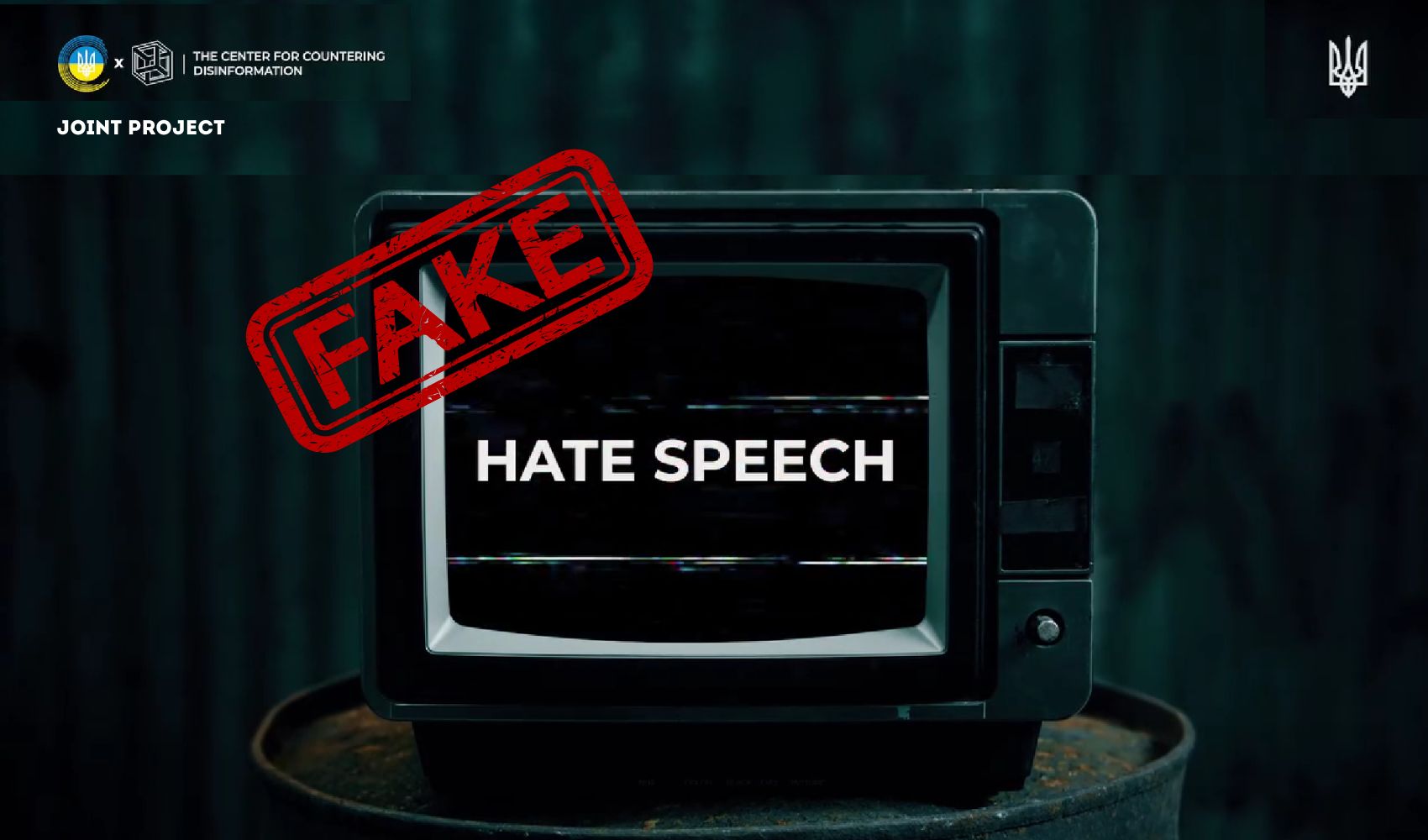
Ukraine Launches ‘Hate Speech’ Project to Expose Russian Propaganda to the World
On September 11, 2026, Ukraine’s National Council and the Center for Countering Disinformation at the National Security and Defense Council released the latest episode of the Hate Speech project. The project is a joint effort to bring the language of Russian propaganda directly to the attention of the English-speaking world. Its stated goal is simple and unambiguous: to demonstrate that the statements made by Russian propagandists are not empty words, but the clearest evidence of the threat posed by the Kremlin. As the announcement puts it, “Through specific examples of statements made by russian propagandists, we will demonstrate that Putin and his aggression are not as distant as they may seem on television.” This sentence lies at the heart of the whole initiative. For viewers in the United States, Britain, Canada, Australia, and other countries, the war in Ukraine often feels like an event taking place somewhere else, in a time zone far away, behind the protective glass of a television screen. The Hate Speech project is designed to break that glass. It collects, translates, and contextualizes the words of those who are actually planning and supporting the war, exposing the aggressive ideology that drives Russian policy. It is an act of counterinformation in a war where information is one of the most powerful weapons. The new episode, released today, continues this work, offering a specific, shareable slice of the massive amount of evidence that Ukrainian researchers have been gathering for years. The format is designed for the digital age: short enough to be watched, strong enough to be remembered. The title itself is deliberate. The project does not simply speak about misinformation or propaganda in general. It focuses on hate speech, the language of dehumanization, incitement, and elimination that historically precedes violence. Hate speech, as the project understands it, is not a matter of taste. It is the first step on a path that can lead to genocide. The Russian war against Ukraine has been accompanied by mass graves, shelling of residential areas, and the deportation of Ukrainian children. None of this happened in silence.
Ukraine has been living with Russian disinformation for more than a decade, long before the full-scale invasion of February 2022. The Kremlin began constructing its modern propaganda machine in earnest after the 2014 Euro-Maidan revolution, when Ukraine turned toward Europe and Russia responded by seizing Crimea and funding separatist violence in the east. From that moment, Russian state television and official media worked to rewrite the facts, describing the Ukrainian revolution as a coup and presenting the annexation of Crimea as an act of liberation. By the time Russia launched the full-scale war, this propaganda apparatus had grown into a complex ecosystem of state channels, internet trolls, bot accounts, fake historians, pseudoscientists, and Western voices willing to repeat Russian talking points. The goal is not simply to support the actions of the Russian army. It is to weaken the will of democratic societies before, during, and after combat operations. Russian propagandists tell their own people that the war is necessary to protect Russia from NATO aggression. They tell Western audiences that Ukraine is corrupt and hopeless, that the war is unwinnable, and that supporting Kyiv is a mistake. They tell the Global South that the conflict is only a quarrel between white nations. Each message is tailored to a specific audience, and all of them are monitored by Ukrainian institutions. The Center for Countering Disinformation was established under Ukraine’s National Security and Defense Council precisely to track this machine and coordinate responses. It operates like an early-warning system, analyzing likely lies, identifying patterns, and warning citizens before harmful narratives take root. The National Council, as the state body responsible for media regulation, adds another layer of expertise: it knows how broadcast propaganda is created, what channels are used, and how to expose the relationships between Russian officials and their mouthpieces. Together, the two institutions realized that monitoring disinformation in Ukrainian was no longer enough. The propaganda is aimed at the world, so the counterattack must also be conducted in the world’s language. The Hate Speech project is a natural result of that realization. By turning a vast archive of Russian-language broadcasts into English-language evidence, they are giving investigators, journalists, researchers, and ordinary people a tool that was previously unavailable outside Ukraine. In doing so, they are drawing attention to an often-forgotten fact: Russian propaganda is not only a problem for Ukraine. It is a problem for every democracy, because it is an attack on the very idea of a shared reality.
What exactly is the latest episode? The announcement does not include a full transcript, but the description makes the method clear. The project relies on the power of “specific examples.” Instead of saying that Russian propagandists are dangerous, it shows them at work. A typical episode may take a viral statement from a Russian television host, a speech by a ministry spokesperson, a tweet from a state senator, or a monologue from an evening political talk show, and place it before the world with a translation and context. The audience sees the original language, the tone of voice, the audience applauding, and the reactions of other panelists. Then the project’s experts explain what the statement actually means, what historical myths it draws upon, and what actions it is designed to justify. This method is important because many people assume that propaganda is simply a series of crude lies. In fact, the most effective propaganda works through suggestion, repetition, and the normalization of extremes. It is not enough to be told that a statement is false; one must also see how it is framed, why it is false, and who is intended to believe it. The Hate Speech project treats the audience as intelligent enough to handle the evidence. This format also helps to undermine the Kremlin’s claim that Western audiences simply do not understand Russia. Once the words are in English, that excuse disappears. By preserving the original material and providing precise context, the project also avoids the accusation of distortion. It is not a parody or a caricature; it is evidence. Furthermore, the project is explicitly designed for English-speaking audiences in various countries around the world. This is not limited to native speakers. English is a bridge language in the European Union, in Asia, in Africa, and in North and South America. The project’s choice of English is a practical decision, but also a political one. It signals that Ukraine is not asking only for sympathy from its strongest allies. It is seeking to reach all those who can influence public opinion, from a student watching a video in Nairobi to a lawmaker in Paris or a policy analyst in Tokyo.
The themes exposed by the project are not random examples of crude language. They form a coherent ideological system. The first and most important theme is the denial of Ukrainian nationhood. Russian propagandists have repeated for decades that Ukraine is not a real country, that Ukrainian national identity is a Nazi invention, and that Russian-speaking people in Ukraine are actually Russians who have been forcefully separated from their motherland. This idea is the foundation of the invasion: if Ukraine does not exist as a nation, then the war is not an invasion at all, but a special operation to restore order. The second theme is dehumanization. Ukrainian soldiers and civilians are described as vermin, pigs, junkies, or puppets of the West. The use of animal names and pathological metaphors is not accidental. It is a well-known technique to make violence against the enemy psychologically possible. Once a person is described as a cockroach or a Nazi, it becomes easier to accept bombardments and mass graves. The third theme is the demonization of the West. Russian propaganda presents the United States, NATO, and the European Union as decadent, aggressive, and controlled by a global elite that uses Ukrainian blood to weaken Russia. This narrative is meant to drive a wedge between Ukraine and its supporters, encouraging Western voters to question their governments’ aid to Kyiv. The fourth theme, increasingly present since 2022, is nuclear blackmail. Russian propagandists do not merely discuss hypothetical scenarios; they describe with terrifying calm how the war could end with mushroom clouds over European capitals. This discourse is intended to spread fear not only among Ukrainians but among all peoples in countries supporting Ukraine. The Hate Speech project documents all four themes, showing how they overlap and feed into each other. By doing so, it makes the Kremlin’s ideology much more difficult to deny.
Why is it so important that this evidence reach the West? Because the outcome of the war is not decided only on the battlefields of Ukraine. It is also decided in the parliaments, media, and homes of the countries whose support gives Ukraine the ability to resist. The Kremlin knows that it cannot win a conventional war against NATO directly. Instead, it is waging a war of attrition against public opinion. The longer the conflict goes on, the more attractive the idea of negotiated peace becomes to Western voters, even if that peace would mean surrendering Ukrainian territory and accepting illegal annexations. Russian propaganda accelerates this process by spreading the idea that Ukraine is losing, that Ukrainians are ungrateful, that Western aid is wasted, and that the real enemy of ordinary people is the military-industrial complex that profits from war. In the words of the project announcement, Putin and his aggression are not as distant as they may seem on television. They are present in every cyberattack, every election influence operation, every false news story about Ukrainian corruption, every online debate about whether Ukraine should receive weapons. The distance between a comfortable living room and a besieged city can be closed in seconds by a single propaganda clip. The Hate Speech project is a counterforce. It cannot stop bombs from falling, but it can stop lies from being normalized. It gives Western audiences the information they need to see the geometry of the conflict, to understand that the words of Russian propagandists are not hot air but a prelude to action. For democratic societies, this kind of preparedness is essential. A well-informed public is less likely to be swayed by demagoguery. A journalism community that can quote Russian state media directly is less likely to be manipulated. A politician who has heard a propagandist call for genocide is less likely to call the conflict a simple misunderstanding. The project may not be able to change every mind, but it can ensure that those who wish to look at reality are not left without a lamp.
The September 11, 2026 release is described as “another episode” of an ongoing project, indicating that the initiative will continue as Russia’s propaganda evolves. In the weeks and months ahead, new statements will be recorded, new lies will be generated, and the project will be there to translate, archive, and challenge them. This long-term approach is essential in the fight against disinformation. An information campaign cannot be defeated with one report or one press conference. It must be answered continuously, with the same persistence that the propagandists themselves show. The Hate Speech project also serves as an archive for history. Future researchers and legal authorities will be able to use this documentary evidence to understand how Russia’s attack on Ukraine was prepared and justified. In times of war, hate speech is not merely a rhetorical category; it is an element of genocide prevention, war-crimes prosecution, and international accountability. Already, Ukrainian and international bodies have recognized that the incitement to hatred in Russian media is part of a broader pattern of human-rights violations. Projects like Hate Speech strengthen such cases by creating an accessible record. Ultimately, the project is a reminder that truth is a weapon in its own right. The Kremlin invests billions in hiding reality behind a fog of lies. The Hate Speech project, with far smaller resources, uses the most effective method available: it lets the Kremlin’s own words condemn it. Putin’s aggression is not distant, the announcement says. It is real, present, and audible in the language of hate emanating from Moscow. The best answer to that language is not silence but speech, not ignorance but evidence. The project offers precisely this. It asks its audiences to look at the words, to recognize the patterns, and to stop pretending that distance is safety. The war in Ukraine is the world’s war. The Hate Speech project is an attempt to make sure the world is not blind to it. It is also a monument to those who have already lost their lives, and who cannot speak for themselves. Every episode is a brick in the wall of vigilance. In that sense, the project is as essential as any military aid package, because without truth there can be no lasting peace.