


Paragraph 1
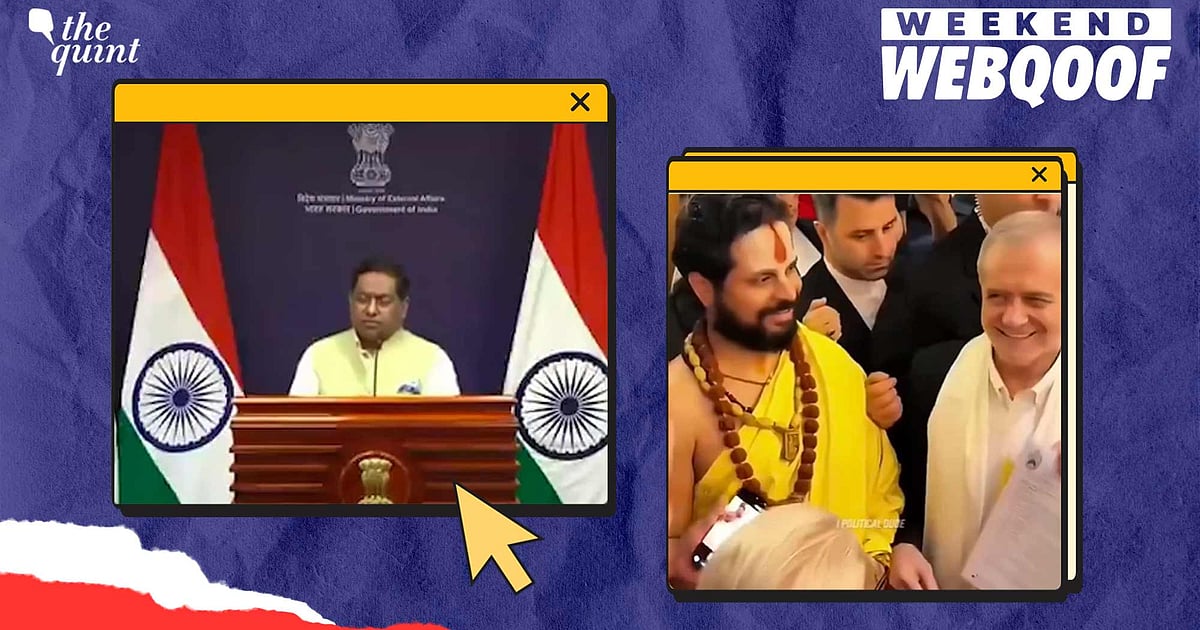
In the age of hyper-accelerated digital communication, where a single frame can be stripped of context and weaponized within minutes, the truth often becomes the first casualty. The latest episode of this phenomenon involves a misleading video that has swept across social media platforms, falsely claiming to show Iranian President Masoud Pezeshkian touching the feet of a Hindu religious leader during the 2026 BRICS Summit. The viral clips, shared thousands of times across X, Telegram, Facebook, and various WhatsApp groups, have ignited a firestorm of speculation, with users interpreting the apparent gesture as a profound act of deference or even a politically significant bow to a spiritual authority. The narrative was rapidly amplified by accounts that thrive on sensationalism, weaving a story that suggested a diplomatic or ideological subtext to the encounter. However, a thorough and meticulous fact-check has now conclusively debunked this narrative. The video does not depict President Pezeshkian paying homage to any religious figure. Instead, the footage clearly shows the Iranian president simply bending down to pick up a document that had fallen to the ground. The distinction is critical: one action is a voluntary act of reverence, the other is a mundane, entirely natural human movement. Yet, in the chaotic ecosystem of online misinformation, the mundane was deliberately reframed as the monumental, underscoring a dangerous trend where even the most innocuous moments at international gatherings can be distorted to serve a false agenda.
Paragraph 2
The video in question appears to have been recorded at a venue associated with the BRICS Summit, an annual gathering of major emerging economies that in 2026 has drawn heightened global attention due to geopolitical tensions and shifting alliances. In the footage, President Pezeshkian is seen in the foreground, surrounded by aides and other attendees, when he appears to lean forward and lower his torso. In certain truncated or carefully angled versions of the clip, this motion can be made to look as though he is bowing deeply before a bearded, elderly man in traditional saffron-colored robes, whom the captions identify as a Hindu religious leader. The association is not accidental: the presence of an Indian spiritual figure at the summit, perhaps part of a cultural or interfaith side event, provided the perfect visual hook for the false claim. The creators of the misleading content likely relied on the fact that most viewers would see the clip in a short, looped format, without sound or a clear view of the ground. By omitting the crucial detail—that a piece of paper was lying at the president’s feet—the manipulators transformed an act of simple practicality into a supposedly scandalous display of religious submission. As the video gained traction, several prominent social media accounts, some with substantial followings, began adding their own commentary, speculating on the nature of the relationship between the Iranian leader and the Hindu holy man, and even suggesting that this was evidence of a covert political or spiritual alliance forming under the BRICS umbrella.
Paragraph 3
The fact-checking process began when an investigative unit, monitoring viral content related to the 2026 BRICS Summit, flagged the video for verification. Analysts examined the full, unedited version of the footage, which was available from multiple news agencies and official livestreams covering the summit’s plenary sessions and bilateral meetings. In the complete sequence, the entire event is shown without any cuts: President Pezeshkian is standing in a corridor or meeting hall when a document carried by an aide falls from a stack of papers. The president instinctively bends down, retrieves the document, and hands it back to the aide, then continues his conversation. There is no religious leader in the immediate line of his movement; the man in saffron robes is standing at some distance, and the angle of the viral crop makes it appear that the president is bending toward him. A frame-by-frame analysis further reveals that Pezeshkian’s eyes are fixed on the ground, tracking the falling paper, rather than looking up at any individual. The audio, where available, captures the shuffling of feet and papers, not any exchange of greetings. Additionally, official photographs from the summit, released by the Iranian presidential office and the BRICS media pool, show the same moment from a different angle, clearly depicting the document on the floor. These pieces of evidence confirm beyond a reasonable doubt that the viral claim is baseless. It is a classic case of malicious editing and decontextualization, designed to provoke controversy and to create a fake historical moment that never occurred.
Paragraph 4
This incident is far from an isolated case; rather, it is a symptom of a broader and escalating crisis of misinformation surrounding major international events. The BRICS Summit, by virtue of bringing together leaders from nations with often adversarial relationships to the West, including Russia, China, Iran, and India, has become a fertile ground for disinformation campaigns. State-sponsored troll farms, partisan media outlets, and opportunistic social media influencers routinely manufacture or distort events to reinforce pre-existing narratives. In this case, the false story served multiple potential agendas. For some, it was a way to humiliate Iran by suggesting its president was subservient to a Hindu spiritual authority, a narrative that would appeal to certain anti-Iranian or sectarian audiences. For others, it was a means of stoking Hindu-Muslim tensions in India and the diaspora, by implying that a Muslim leader was paying obeisance to a Hindu holy man, a framing that could inflame extremist elements on both sides of the communal divide. The speed at which the video went viral, and the resistance to correction shown by those who had already shared it, demonstrates the deep-seated problem of confirmation bias in the digital age. Once a audience has accepted a narrative that aligns with their worldview, contradicting evidence is often dismissed as cover-up or damage control. The truth, in these echo chambers, is whatever reinforces the audience’s preconceived notions.
Paragraph 5
The response to the debunked video has been a mixture of exasperation, relief, and renewed calls for media literacy. Journalists and fact-checkers have urged social media platforms to flag the video and label it as manipulated, though the response of the platforms has been inconsistent at best. Official representatives from the Iranian delegation at the summit have not issued formal statements, likely because they view the matter as too trivial to warrant a diplomatic response, but the Iranian media has quietly reported that the video is fake, providing the full footage to their audiences. Meanwhile, fact-checking organizations have published detailed articles, complete with annotated screenshots and timestamps, explaining exactly how the deceptive edit was made. The Hindu religious leader in question, whose name has not been prominently reported in the context of this controversy, is believed to be a delegate attending the interfaith dialogue segment of the summit, and he has reportedly been startled by the chaos his presence, combined with a falling document, has caused. The entire episode underscores the urgent need for enhanced digital literacy among the general public. In a world where anyone can publish anything, the ability to critically assess visual content is no longer a luxury; it is a survival skill. This means checking the source of the video, looking for the original upload, examining the full context, and being wary of content that is designed to elicit an immediate emotional response, particularly anger or outrage.
Paragraph 6
Ultimately, the saga of the Iranian president and the document on the floor serves as a potent reminder of the fragility of shared reality in the 2020s. What began as a simple, unremarkable moment at a high-level diplomatic summit was transformed, through the alchemy of social media, into an international scandal that never happened. The falsehood traveled halfway around the world before the truth had even put on its boots. While the damage done in this instance is limited to another dent in public trust and a temporary embarrassment for the viral video’s creators, the underlying pattern is deeply concerning. If a simple act of picking up a piece of paper can be weaponized to spread false narratives about world leaders, then the potential for even more dangerous misinformation—concerning military actions, public health emergencies, or electoral integrity—is truly terrifying. The only defense is a combination of robust, independent journalism, transparent social media moderation, and a public that is willing to pause, question, and verify before sharing. As the 2026 BRICS Summit continues, and as future summits follow, we can be certain that the disinformation factories are hard at work, watching for the next innocuous moment to twist and exploit. The lesson of this video is clear: question everything, demand the context, and remember that sometimes the most dramatic story is the one that never happened. The truth, in this case, is painfully mundane: a president bent down, picked up a paper, and the world almost believed he had bowed to a god.