


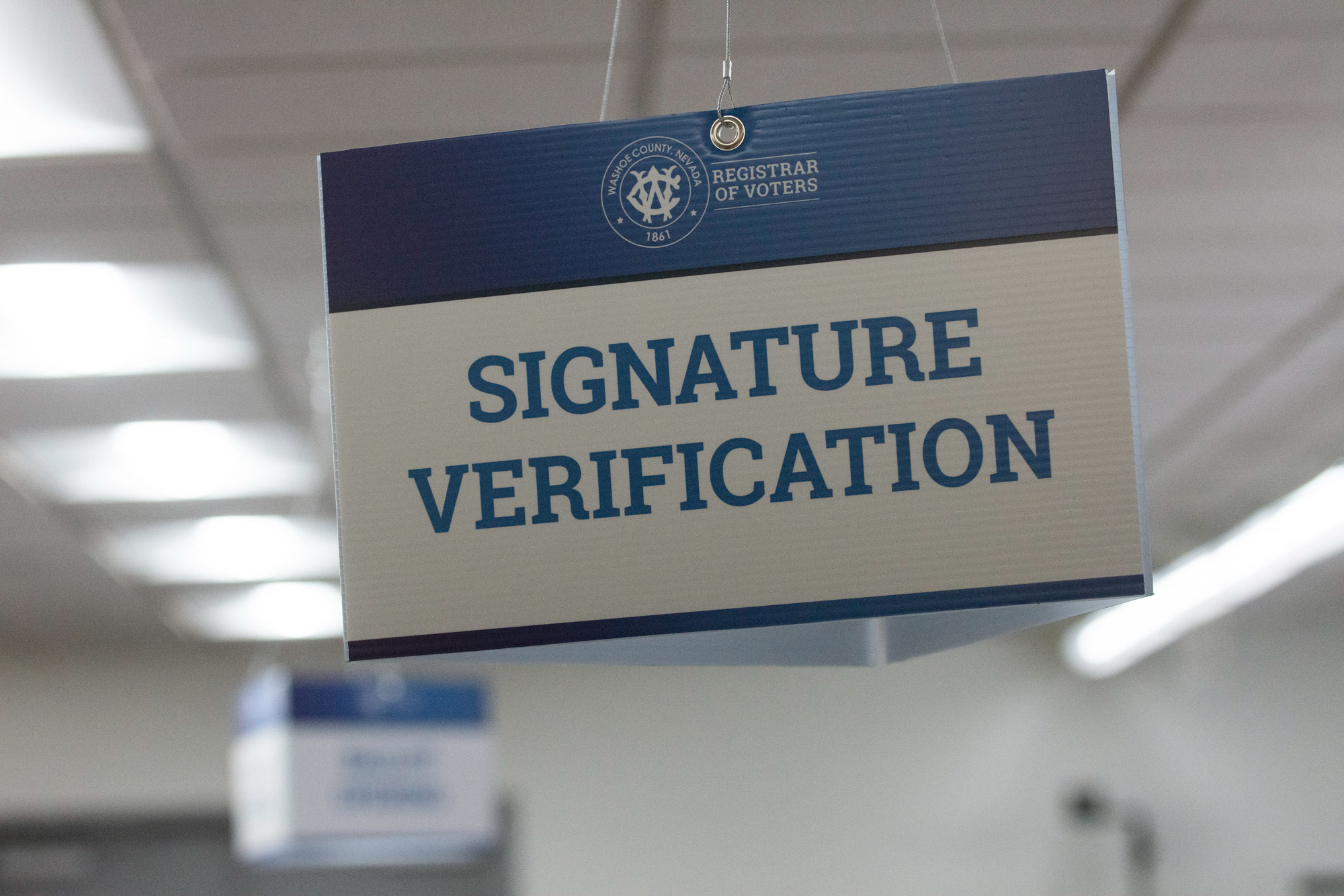
LAS VEGAS — Nevada officials do not accept a mail ballot simply because it arrives in an envelope. It must first survive a signature check, a legal requirement designed to make sure the person casting the ballot is the same voter who is registered to cast it. The Nevada Independent, in partnership with Gigafact, has released a fact brief on exactly how that process works. The brief responds to online conversation in which people expressed uncertainty or raised questions about whether mail ballots are actually verified before election officials count them. The answer is yes. Under Nevada law, election officials use an electronic device to determine whether the signature on a mail ballot matches the voter’s registration record. If the electronic scan does not match, the signature is then checked manually against every signature election officials have on file for that voter. If there is a “reasonable question of fact” about the signature’s validity, election officials are required to contact the voter and allow that person to provide a confirmation or an alternative signature. This process is not optional. It is built into the legal framework that governs elections in the state. The fact brief also supplies a reminder of what can happen when voters fail to respond: in recent election cycles, thousands of ballots have been invalidated because the voter never fixed a mismatched signature. About 9,000 such ballots were set aside in the 2024 general election, and about 2,000 signatures were left unfixed in the state’s 2026 primary. The goal is to be transparent and transparent about a process that is essential to election integrity and voter confidence.
The signature verification system begins at the moment a mail ballot is returned to a county election office. Election workers open the outer envelope, remove the envelope that contains the ballot, and then compare the signature on the envelope with the signature contained in the voter’s record. Nevada’s law is explicit that election officials must use an electronic device for this initial check, but that is only the first step. If the machine finds no match, it does not mean the ballot is immediately thrown away. Instead, the signature is sent for a manual review. During that review, election workers look at the signature against all of the signatures in the voter’s file—not just one signature, but the full collection that may come from a driver’s license application, previous voter registrations, earlier mail ballots, petitions, and other official documents on file with the state and county. This is intended to account for the fact that signatures naturally change over time. People may sign a ballot after an illness, after aging, or while in a hurry, and their writing may not look exactly like the signature they produced years earlier. The manual review is meant to be a common-sense comparison, not a rigid test requiring identical handwriting. If the reviewers believe there is a “reasonable question of fact” about whether the voter signed the ballot, the law moves into its next phase: the voter must be contacted and given the opportunity to confirm that they did sign it, or to provide a new signature. Only after that opportunity has been offered and the voter either responds or declines to respond does an election official make a final decision about whether the ballot should be counted.
The requirement to contact the voter is sometimes called a “cure” process, and it exists precisely because honest voters often make mistakes on their signatures. A person might sign with a middle initial one time and not use the middle name another time; a signature might be shorter, larger, or shakier because of the surface on which the envelope was resting. Nevada counties have worked to make the cure process accessible. Election officials are required to notify the voter that there is a problem with the signature and explain how to fix it. The voter may be contacted by mail, by telephone, or by email if election officials have that information on file. The exact steps available to a voter are set out in state law and by local election offices. A voter can usually provide a signature confirmation form or a fresh signature through the county election office, a state website, or other official means. The crucial point is that the process does not end silently in the rejection of a ballot. There is a path forward for voters, but that path requires the voter to take action. If a voter receives a notice from a county election official about a signature mismatch, ignoring it can be fatal to that ballot. The fact brief is blunt: thousands of ballots have been invalidated because the voter did not fix a signature. In the 2026 primary, about 2,000 signatures were not fixed. In the 2024 general election, the state tossed out 9,000 ballots because of invalid signatures. These numbers matter because every one of those ballots belonged to a person who cast a vote, and every one was rejected after a process that began with a signature match failure.
The statistics from Nevada are useful for understanding both the scale and the stakes of signature verification. In the 2024 general election, more than enough ballots were cast for president and other offices, and the 9,000 invalidated ballots represented a tiny fraction of total votes. But in a close race, 9,000 votes can be enormous. A local school board race, a ballot question, or a state legislative district can turn on far fewer votes. The fact that those ballots were never counted may also change the outcome or the verdict of the public about whether an election was fair. The fact brief is not an editorial; it is a response to a conversation in which people may have been asking themselves whether Nevada does anything to verify mail ballots before counting them. The answer offered by the brief is straightforward: yes, the state verifies signatures, and then goes one step further by giving voters a chance to correct a potential mistake. But the numbers also show that the system is not automatic. A voter who does not respond to a notice loses the chance to have that ballot counted. That combination—rigorous verification plus a voter-cure opportunity—is the same structure that many states across the country use to try to balance accessibility and integrity. It is also a system that relies heavily on the behavior of voters, who need to sign their envelopes and then pay attention to any follow-up from election officials.
The broader context is important. Nevada is one of the states that has moved aggressively toward mail voting, with ballots being sent to active voters automatically. This means mail-ballot signature verification is not a niche issue that affects only absentees; it affects a huge share of the electorate. In recent election cycles, mail ballots have become the most common way that Nevadans cast a vote. That makes the verification process central to the health of the state’s elections. Election officials must process mail ballots quickly and accurately while also maintaining confidence in the result. Signature verification is one piece of that, but it is not the only check. Ballot envelopes, voter files, and chain-of-custody documents are all used by election workers to make sure every counted ballot is legitimate. The fact brief published by the Nevada Independent and Gigafact is part of a larger fact-checking effort that responds to specific claims appearing online. The brief is concise but designed to illuminate a process that often remains invisible to voters. It lists the legal requirement, the manual review, the contact from election officials, and the fact that voters need to respond. It also highlights the two recent data points about rejected signatures: about 2,000 unfixed signatures in the 2026 primary, and 9,000 invalid-signature ballots in the 2024 general election. Those numbers are not presented to alarm voters, but to show the real consequence of the process. They are a reminder that the signature line on a mail-ballot envelope is no mere formality. It is a legal attestation that the voter is who they say they are, and election officials are required to treat it seriously.
In the end, the fact brief confirms that the signature verification process in Nevada is both robust and corrective. It begins with an electronic comparison, moves to a manual check when the machine is uncertain, and then requires election officials to contact the voter if there is still doubt. Voters are not left helpless; they are given an opportunity to confirm their signature or provide another one. That is exactly what a balanced election system should do. It protects against false or fraudulent ballots by requiring a match with a government record, and it protects legitimate voters from losing their right to vote because of a handwriting difference. The fact brief from the Nevada Independent and Gigafact is a useful reminder for voters: sign your ballot envelope truthfully, watch for notices from election officials, and remember that election workers are doing their job to confirm who you are before your vote is counted. As Nevada continues to rely on mail voting, the signature verification process will remain an essential element of the state’s election infrastructure. Voters who participate in that system should understand that their signature matters, and they should know that if there is ever a problem, the state’s law has a process to help them fix it—but only if they respond.