


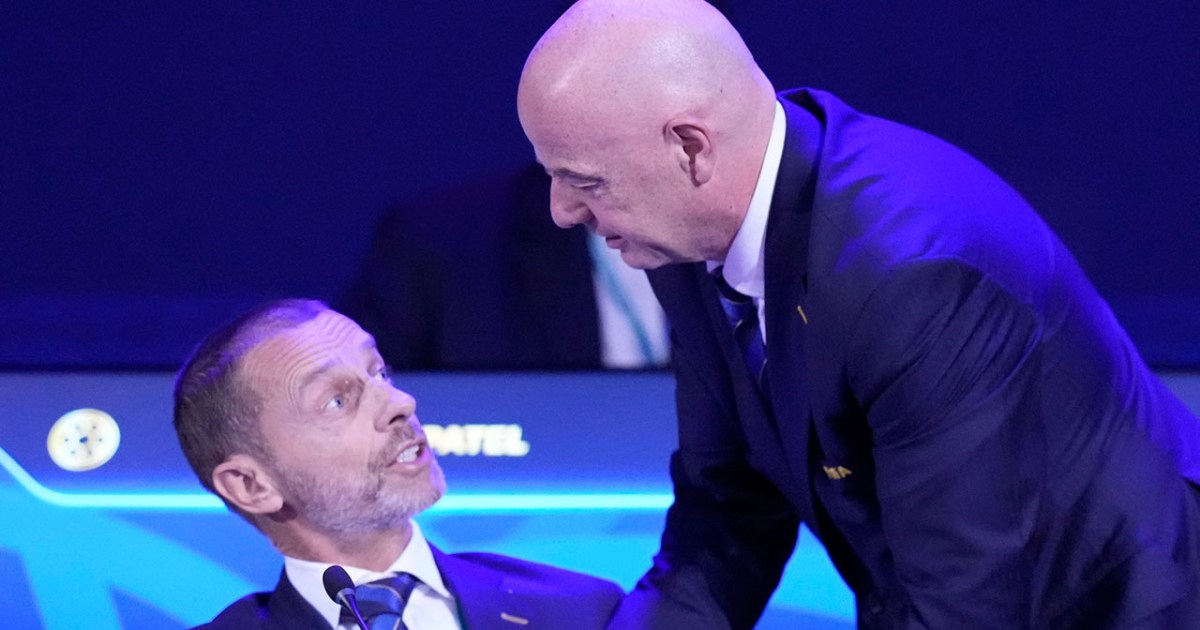
FIFA Accuses UEFA of Misinformation Campaign and Election Interference Amid Growing Governance Crisis
FIFA has launched a blistering attack on UEFA, accusing European football’s governing body of waging a “misinformation campaign” and attempting to influence the race for the FIFA presidency, as tensions between the two organisations escalate into a full-blown legal and governance crisis. In a filing submitted to a United States federal court on Tuesday, FIFA urged judges to reject UEFA’s discovery request linked to FIFA president Gianni Infantino’s controversial investment proposal for World Cup commercial rights. The filing, made in the Southern District of Florida, is the latest salvo in a bitter dispute that has exposed deep divisions within world football’s governing body, with Infantino now seeking a fourth term in office. FIFA described UEFA’s legal brief as containing “numerous false or misleading statements about FIFA and Infantino” and explicitly warned that the court should not allow UEFA to use the proceedings to sway the upcoming presidential election. The accusation of election interference marks a dramatic escalation, transforming what began as a commercial disagreement over a now-abandoned investment plan into a direct confrontation between two of the most powerful institutions in sport. With the presidential vote scheduled for March, and with Infantino having already written to all 211 member associations proposing an independent review of FIFA’s decision-making processes, the stakes could not be higher. The dispute threatens to destabilise the global football hierarchy and raises fundamental questions about transparency, governance, and the distribution of the sport’s immense financial resources.
At the heart of the legal confrontation is UEFA’s request earlier this month for permission from a US federal court to obtain testimony and documents for use in a planned criminal complaint in Switzerland against Infantino. That complaint concerns a now-abandoned proposal to transfer World Cup commercial rights into a subsidiary called FIFA Forward Enterprise, or FFE. UEFA alleges that Infantino developed the proposal in secret with a small group of advisers and investors, bypassing FIFA’s normal governance processes and failing to consult the FIFA Council, regional confederations, or member associations. These alleged governance failures, according to UEFA, amount to potential violations of Swiss law and ethical principles, and UEFA has sought to gather evidence through the US courts under a legal mechanism known as a 1782 application, which allows foreign litigants to obtain discovery for use in proceedings outside the United States. FIFA, however, has strongly rejected UEFA’s characterisation of both the proposal and Infantino’s conduct. In its response, FIFA asserted that the FFE plan was subject to approval by both the FIFA member associations and the FIFA Council, and that the entity, had it been created, would have been subject to oversight by both groups within FIFA. FIFA further declared that “UEFA’s suggestions that Mr Infantino violated any law or ethical principle are categorically without merit,” and insisted that the accusations were part of a deliberate strategy to damage Infantino’s reputation ahead of the election.
The dispute over the FFE proposal hinges on technical financial arguments as much as on governance concerns. UEFA has alleged that investors would have paid $4.2 billion for a stake in FFE, a figure that placed an equity valuation of approximately $20 billion on the business. European football’s governing body argued that this significantly undervalued FIFA’s commercial rights, and it noted that the proposal had not been subjected to an open auction or tested by an independent valuer. FIFA, however, has dismissed this criticism as either deliberately misleading or the product of confusion. In its court filing, FIFA stated: “UEFA, whether deliberately or through ignorance, conflates equity value with enterprise value.” FIFA went on to explain that the “initial equity valuation” of FFE, meaning the value that remains for shareholders after debts have been paid off, was indeed $20 billion, but that the total “enterprise value” of the business, which represents the entire value of the company including debt, was well over $30 billion. FIFA argued that the enterprise value was therefore “well in excess of twice the equity value, and therefore far above the value UEFA says would be fair.” This detailed rebuttal was intended to demonstrate that the proposed valuation was not only reasonable but generous, and that UEFA’s allegations of undervaluation were unfounded. FIFA’s response also served to portray UEFA as an organisation willing to distort financial facts in order to score political points against Infantino and the global body he leads.
The FFE project was ultimately abandoned in July, following sustained opposition from confederations including UEFA, the Confederation of North, Central America and Caribbean Association Football, and the Asian Football Confederation. The opposition centred on a perceived lack of consultation and concern that the plan had been developed without proper oversight, with critics arguing that such a significant commercial deal should have been discussed openly with all stakeholders before any decision was taken. The abandonment of FFE, however, did not end the controversy; rather, it fuelled demands for changes to FIFA’s governance structures and has increasingly become a rallying point for those who believe the organisation is in need of fundamental reform. In an apparent attempt to address these concerns, Infantino wrote to all 211 member associations last week proposing an independent review of the governing body’s decision-making processes. This proposal was widely seen as an attempt to regain the initiative and to demonstrate that FIFA is willing to listen to its members, but critics have questioned whether it goes far enough. The review, if carried out, would examine how FIFA makes decisions, how it consults with confederations and member associations, and whether its commercial practices are sufficiently transparent. It remains unclear, however, whether such a review would satisfy UEFA and the other confederations that have been pushing for more direct and meaningful involvement in FIFA’s governance, or whether it would merely serve as a temporary measure to defuse tensions ahead of the presidential election.
The timing of UEFA’s legal actions has become a central point of contention, with FIFA alleging that the filings are deliberately designed to influence the outcome of the presidential election. Infantino, a Swiss administrator who has led FIFA since 2016, is seeking re-election in March, and FIFA has made clear that it sees UEFA’s legal manoeuvres as an attempt to interfere in that process. “Just before FIFA’s election, UEFA filed this 1782 Application and three others spreading misinformation regarding Mr Infantino,” FIFA said in its filing. “This court should reject any attempt to influence FIFA’s presidential election based on these grounds.” The reference to three other applications suggests that UEFA has launched a coordinated legal campaign against FIFA and Infantino across multiple jurisdictions, a fact that has further inflamed the relationship between the two bodies. FIFA’s accusation of election interference is significant not only because of its directness but also because it raises the possibility that UEFA, an organisation that itself plays a major role in global football governance, is seeking to destabilise the leadership of its parent body. The dispute has already had practical consequences, with the FFE plan being abandoned and with ongoing discussions about the distribution of millions of dollars to member associations. Infantino has indicated that he is willing to discuss the disbursement of funds, and the exact amounts to be allocated to individual nations are set to be on the agenda of the FIFA Council’s October 15 meeting.
As the legal battle continues to unfold, the implications for world football are profound. FIFA’s response to UEFA’s discovery request is not merely a procedural objection; it is a broad defence of its governance practices and its leadership, and it sets the stage for an increasingly acrimonious run-up to the presidential election. The October 15 FIFA Council meeting will be a crucial test of whether the organisation can move beyond the FFE controversy and address the concerns raised by UEFA and the other confederations. Infantino’s willingness to discuss the disbursement of millions of dollars to member associations may help to shore up support among smaller national federations, which rely heavily on FIFA funding, but it will not necessarily resolve the deeper governance questions that have been raised. UEFA’s planned criminal complaint in Switzerland, if pursued, could cast a long shadow over Infantino’s campaign for a fourth term, and the US court’s decision on the discovery request will be closely watched as an indicator of whether UEFA’s legal strategy is likely to succeed. For now, FIFA remains defiant, rejecting UEFA’s allegations as baseless and accusing the European body of using the courts to wage a political campaign. The coming months are likely to see further legal twists, intense lobbying among member associations, and a mounting struggle over the future direction of global football. At stake is not only the presidency of FIFA, but the very model of governance that will shape the sport for years to come. With billions of dollars in commercial rights and the loyalties of 211 national associations in play, the battle between FIFA and UEFA is far from over, and its outcome will resonate far beyond the courtroom.