


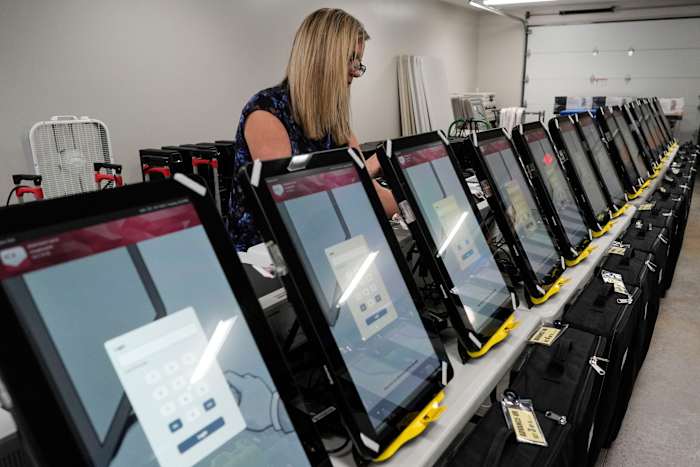
Trump Order Targets Barcodes on Ballots, Reigniting Misinformation Concerns
Former President Donald Trump’s recent executive order mandating the removal of barcodes from ballots has reignited a long-standing debate about election security and misinformation. The order, issued just weeks ago, claims that barcodes are susceptible to manipulation and fraud, echoing conspiracy theories that have circulated for years. However, election officials and cybersecurity experts overwhelmingly agree that barcodes are a crucial component of modern voting systems, providing vital safeguards against errors and streamlining the tabulation process. Trump’s directive has sparked widespread condemnation, with critics accusing him of fueling distrust in the electoral process and undermining democratic principles.
The controversy surrounding barcodes stems from a fundamental misunderstanding of how they are used in elections. These barcodes are not, as some misinformation suggests, linked to external databases or vulnerable to hacking. Instead, they contain encrypted information unique to each ballot, such as the specific races and candidates listed. This information allows for efficient scanning and tabulation of votes while simultaneously ensuring the integrity and anonymity of individual ballots. The codes themselves do not reveal voter choices, but rather act as a unique identifier for each ballot, enabling election officials to quickly and accurately process votes while maintaining an audit trail.
The use of barcodes has become an increasingly common practice in recent years, as election jurisdictions seek to modernize their systems and improve efficiency. They allow for quicker vote counting and reduce the potential for human error in manual tabulation. Furthermore, barcodes play a critical role in post-election audits, providing an independent verification mechanism to ensure accuracy. By comparing the scanned barcode data with the physical ballots, election officials can confirm that every vote has been counted correctly. This process adds a layer of transparency and accountability to the election process, enhancing public trust in the integrity of the results.
Trump’s attack on barcodes represents the latest in a series of unsubstantiated claims that have cast a shadow over American elections. Following the 2020 presidential election, the former president and his allies repeatedly asserted that the election was rigged and rife with fraud, despite multiple investigations and recounts confirming the legitimacy of the results. These baseless allegations have eroded public confidence in the electoral system and fueled a rise in political extremism. The order targeting barcodes appears to be another attempt to sow doubt and distrust, exploiting anxieties about election security for political gain.
Election security experts warn that this latest executive order not only lacks merit but also poses a significant threat to the smooth functioning of elections. Removing barcodes would necessitate a return to more time-consuming and error-prone manual counting processes, potentially leading to delays and inaccuracies in reporting results. Moreover, it would undermine the audit trail provided by barcodes, making it more difficult to verify the accuracy of election outcomes. The order could also disenfranchise voters, particularly those with disabilities who rely on accessible voting systems that utilize barcodes.
The bipartisan backlash against the order underscores the consensus among election officials about the vital role of barcodes in secure and efficient elections. Many election officials are openly defying the order, arguing that it is based on false premises and would compromise the integrity of the electoral process. They are urging state legislatures to resist the pressure to implement these changes and to prioritize evidence-based election security measures. The future of election administration now hangs in the balance as legal challenges to the order are expected and the fight against misinformation continues. The integrity of democratic processes depends on upholding the truth and rejecting baseless claims that undermine public trust in our electoral system.