


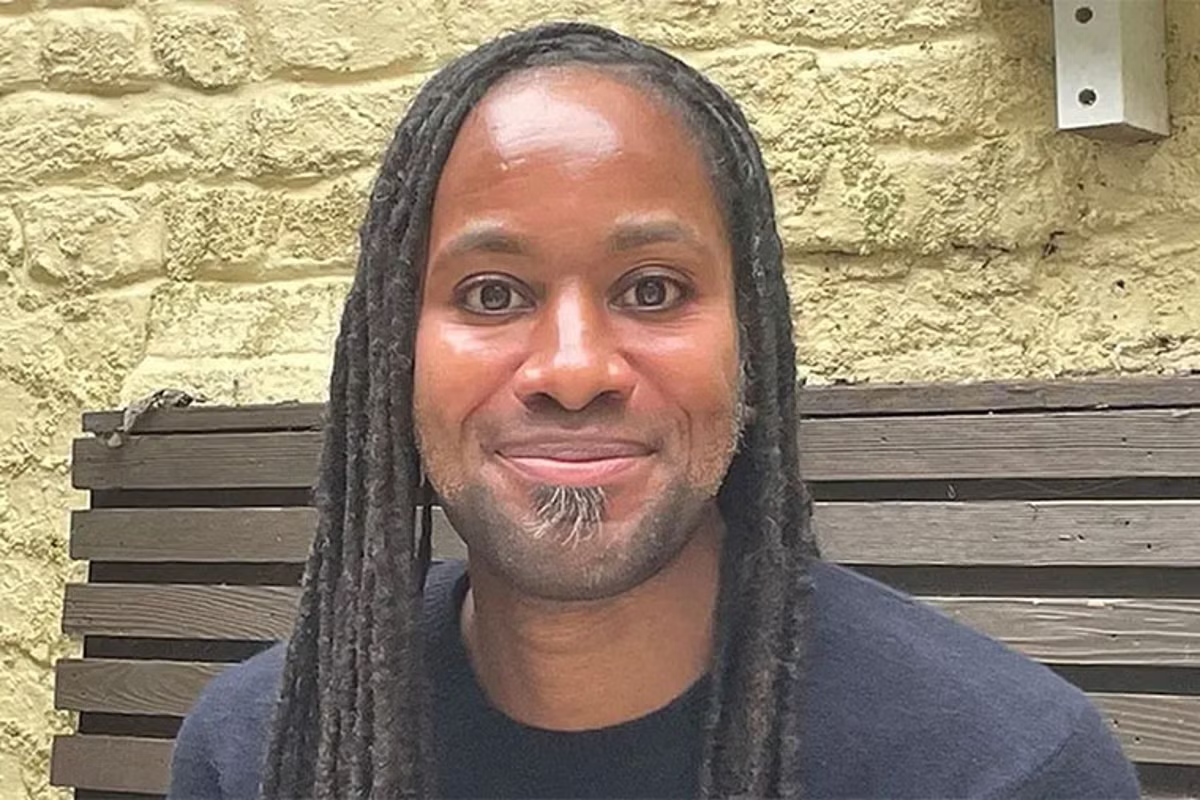
The academic world was plunged into mourning on Saturday following the sudden and tragic death of Professor Jason Arday, a former University of Cambridge professor whose meteoric rise and subsequent fall from grace captured global attention. Professor Arday, a prominent figure in the sociology of education, was pronounced dead after emergency services were called to an address in Battersea, south London, just after 3pm on Friday afternoon. According to the Metropolitan Police, officers and paramedics arrived at the scene to find a man unresponsive inside the property, and despite their best efforts, he could not be revived. The police have officially stated that his death is being treated as unexpected, but crucially, it is not believed to be suspicious, suggesting that there is no apparent third-party involvement in the tragic event. This preliminary classification allows the family and loved ones the necessary space to grieve without the immediate pressure of a criminal investigation. The news has sent shockwaves through the academic community, particularly within the field of education, where Professor Arday was regarded as a transformative and inspiring voice. Colleagues, students, and admirers across the globe have expressed their profound sadness, remembering him not only for his intellectual contributions but also for his warmth, his advocacy for diversity, and his commitment to opening doors for underrepresented groups in higher education. The sudden nature of his passing, coming just days after he made the decision to resign from his prestigious post at Cambridge, has inevitably led to questions and speculation regarding the immense pressures he faced in the final years of his life. His death has reignited debates about the treatment of academics in the public eye and the often devastating toll that institutional and media scrutiny can take on an individual’s mental health, leaving many to wonder if more could have been done to protect him.
Professor Arday’s career was nothing short of extraordinary, a testament to his resilience and brilliance. In 2023, he made history by becoming the University of Cambridge’s youngest Black professor, a milestone that was celebrated widely as a breakthrough for racial equity in one of the world’s most prestigious academic institutions. His research focused on the sociology of education, specifically examining the structural barriers that marginalised groups face in accessing higher education, and his work was highly influential in shaping policy discussions around widening participation and social justice. Prior to his appointment at Cambridge, he held academic positions at the University of Glasgow, Durham University, and Roehampton University, where he established himself as a leading scholar in his field. His personal journey was often highlighted as a source of inspiration; he overcame significant adversity, including a diagnosis of autism, to reach the pinnacle of academia, and his story resonated with many, particularly those from working-class and minority backgrounds who saw in him a reflection of their own potential. He was known for his passionate lectures, his dedication to mentoring students, and his outspoken critique of systemic inequalities in the education system, which earned him both praise and, at times, controversy. His forthcoming memoir, Great And Unfortunate Things, which was set to be published by Simon & Schuster on August 27th, was highly anticipated as a personal account of his rise, his challenges, and his reflections on the state of academia. His presence in academic halls was a beacon of hope for many aspiring scholars, making his departure from Cambridge—and now his sudden death—all the more heartbreaking for those who followed his career and were inspired by his determination to challenge the status quo.
However, Professor Arday’s celebrated career took a contentious turn amid a series of media reports alleging that he had plagiarised substantial portions of his PhD thesis, which he completed at Liverpool John Moores University, as well as other published research. The allegations, which surfaced in national newspapers, claimed that his doctoral work contained unattributed borrowings from a variety of sources, casting a shadow over his academic integrity and prompting a formal investigation. The accusations triggered a rigorous inquiry at Liverpool John Moores University, the institution that had granted him his doctorate, with examiners and independent experts tasked with examining the original sources and comparing them to his thesis. In a significant and potentially vindicating development, that investigation ultimately cleared Professor Arday of any wrongdoing, determining that the allegations were unfounded and that his work met the required academic standards for a doctoral degree. Despite this formal exoneration, the damage to his reputation and mental well-being had already been done, as the media storm that followed the initial allegations proved relentless and unforgiving. His name became a byword for controversy in academic circles, with public discourse often focusing on the accusations rather than his scholarship or his clearance. The prolonged scrutiny of his work, coupled with the very public nature of the accusations, placed an immense strain on him personally and professionally, impacting his ability to focus on his research and his teaching. His family has since stated that he was subjected to a “campaign of sustained abuse” for more than three years, a period that coincides with his time at Cambridge, arguing that this campaign was driven by individuals determined to undermine his achievements at any cost. They described the constant barrage of misinformation as an intolerable burden for a man they characterise as “gentle” and someone who “always wanted to see the best in everyone,” highlighting the disconnect between the public narrative and the private individual who suffered under its weight.
In response to the allegations and the ensuing fallout, the University of Cambridge initiated its own internal processes to address the matter, adding yet another layer of pressure to Professor Arday’s situation. Following his resignation, the university announced that it would conduct an independent review of “all relevant processes” alongside a specific investigation into how he was appointed by its Faculty of Education. This decision reflected the seriousness with which the institution viewed the matter, with administrators aiming to ensure that their hiring practices remained robust, transparent, and beyond reproach in the face of public scrutiny. Just last week, the university confirmed that it would continue its investigation into the circumstances surrounding Professor Arday’s “appointment and tenure” even after his departure, signalling that the academic inquiry would not simply be closed with his resignation. The findings of this review are intended to feed into a broader examination of the processes for appointing senior roles at the university, with the goal of preventing similar controversies in the future and safeguarding the institution’s reputation. This institutional response, while procedurally necessary and perhaps well-intentioned, created a prolonged period of uncertainty for Professor Arday, meaning that the allegations would not fade away from public discourse. The ongoing investigation kept his name in the headlines, subjecting him to continued professional and personal scrutiny, and creating a situation where his private life and mental state became intertwined with bureaucratic and legalistic procedures. For a scholar who had already been cleared by the institution that awarded his PhD, the repeated examinations of his work and character were deeply distressing, and the combined weight of the media attention and the university’s formal processes likely contributed to the overwhelming sense of despair that his family now describes.
In a poignant and emotional statement issued through his publisher, Simon & Schuster UK, Professor Arday’s family expressed their profound grief and shock, while also directly addressing the circumstances they believe contributed to his death. The statement read: “Jason was subjected to a campaign of sustained abuse for more than three years since he accepted the role of professor at Cambridge University by those who would leave no stone unturned in their quest to undermine him. The campaign of misinformation was too much for Jason, who was a gentle man and who always wanted to see the best in everyone.” The family continued, “We are in shock to have lost this amazing father, partner, brother, uncle and son.” They concluded with a heartfelt and desperate plea for privacy: “We won’t comment further at this point beyond asking the press to leave us alone now, and to stop the campaign of harassment which has been waged against Jason and his family for too long.” This statement is a stark and heartbreaking indictment of the pressures faced by public figures in the digital age, where allegations—whether proven or not—can have devastating and irreversible consequences. It also highlights the immense toll that his academic dispute took on his personal life, painting a picture of a man who was systematically worn down by external forces. In the wake of his death, Professor Arday had cancelled all upcoming events promoting his forthcoming memoir, a clear indication that he was struggling in the days leading up to his passing. The cancellation of these events, which were meant to be a celebration of his life and work, makes the loss even more tragic for his family, friends, and the many readers who were eagerly anticipating his story and hoped to gain insight into his remarkable journey.
The death of Professor Jason Arday raises critical questions about the intersection of race, academia, and the unforgiving nature of public scrutiny, and his passing serves as a sobering reminder of the human cost of institutional and media conflict. As a Black scholar who had broken significant barriers in a predominantly white, elite institution, his treatment by certain sections of the media and academic circles has been called into question, with his family pointing directly at a coordinated effort to destroy his career and reputation. His case serves as a cautionary tale about the potential consequences of investigative journalism and institutional investigations when they transform from objective inquiries into personal crusades against individuals, prioritising headlines over fairness and due process. The loss of such a prominent voice in the field of education is immeasurable, and it will undoubtedly lead to introspection within the academic community about how it supports its members during periods of crisis, as well as how it handles allegations of misconduct in a way that protects the accused from undue harm until a final verdict is reached. It also underscores the urgent need for better mental health support for academics facing public allegations, as the pressure of defending one’s integrity in the court of public opinion can become overwhelming. Following the announcement of his death, the publisher and various academic bodies have paid tribute to his contributions, noting the legacy of his work on widening access to higher education. In the midst of this tragedy, it is vital to remind readers and the wider public of the resources available for those experiencing distress. If you are experiencing feelings of distress, or are struggling to cope, you can speak to the Samaritans, in confidence, on 116 123 (UK and ROI), email jo@samaritans.org, or visit the Samaritans website to find details of your nearest branch. For those based in the USA, the 988 Suicide and Crisis Lifeline is available by calling or texting 988, or visiting 988lifeline.org, which provides free, confidential support 24 hours a day. For those in other countries, www.befrienders.org offers a directory of helplines worldwide. As the Arday family grieves their profound loss, the global community mourns a brilliant mind, while the silence left by his passing amplifies the urgent conversation about the price of ambition, the cruelty of public life, and the need for compassion in all our dealings with others.