


The Weaponization of Disinformation: A New Frontline in Global Conflict
The 21st century has ushered in an era of unprecedented interconnectedness, where information flows freely across borders, shaping public opinion and influencing political discourse. However, this interconnectedness has also created a fertile ground for the proliferation of disinformation, weaponized by state actors like Russia, China, and Iran, to sow discord, undermine democratic institutions, and advance their geopolitical agendas. Ukraine and Israel, both grappling with existential threats to their security, are at the forefront of this information war, facing relentless barrages of manipulated narratives and outright falsehoods aimed at eroding international support and destabilizing their societies. The United States, while not directly under military attack, is also a primary target of these cognitive warfare campaigns, particularly during its election cycles, demonstrating that the reach of disinformation transcends geographical boundaries and poses a critical threat to democracies worldwide.
Antisemitism as a Tool of State-Sponsored Disinformation
A particularly insidious facet of this disinformation campaign is the resurgence of antisemitism, no longer confined to the fringes of society but actively promoted and amplified by state-sponsored propaganda machines. This modern iteration of antisemitism leverages the speed and reach of social media and sophisticated artificial intelligence to disseminate hateful tropes and conspiracy theories, often disguised as legitimate news or political commentary. By weaponizing antisemitism, these hostile actors seek to divide societies, fuel internal conflict, and weaken the international resolve to confront their aggressive actions. This tactic, which exploits historical prejudices and deep-seated societal anxieties, presents a clear and present danger to Jewish communities globally and undermines the very foundations of pluralistic societies.
The Case Studies: Ukraine, Israel, and the US
The ongoing conflict in Ukraine provides a stark example of how disinformation is used to manipulate public perception and justify military aggression. Russia’s invasion was preceded by a sustained campaign of disinformation aimed at portraying Ukraine as a Nazi-controlled state posing an existential threat to Russia’s security. This false narrative, widely disseminated through state-controlled media and online platforms, served to create a pretext for the invasion and erode international support for Ukraine. Similarly, Israel faces a constant barrage of disinformation aimed at delegitimizing its existence and demonizing its actions, often employing antisemitic tropes to portray Israel as an aggressor and oppressor. The October 2023 Hamas attack on Israel saw a surge in this disinformation campaign, with fabricated stories and manipulated images flooding social media platforms, obfuscating the reality of the conflict and fueling anti-Israel sentiment globally. The United States, particularly during election cycles, has become a target of disinformation campaigns aimed at sowing division and undermining confidence in the democratic process. Foreign actors, using sophisticated techniques, often spread falsehoods related to voting procedures, candidates’ backgrounds, and election outcomes, with the goal of disrupting the democratic process and weakening public trust in institutions.
The Role of AI and Modern Technology
The proliferation of disinformation is inextricably linked to the rapid advancements in artificial intelligence and other modern technologies. AI-powered algorithms are used to create highly convincing deepfakes and manipulate audio and video recordings, making it increasingly difficult to distinguish between fact and fiction. These technologies also facilitate the creation and spread of "bots" and fake social media accounts, which are used to amplify disinformation campaigns and create the illusion of widespread support for certain narratives. The ability of these technologies to personalize content and target specific demographics makes them remarkably effective tools for manipulating public opinion and influencing behavior.
Countering the Disinformation Threat: A Call to Action
Combating this pervasive threat requires a multifaceted approach that encompasses government initiatives, private sector collaborations, and individual responsibility. Governments must invest in media literacy programs to equip citizens with the critical thinking skills necessary to discern fact from fiction. They should also impose appropriate regulations on social media platforms to combat the spread of disinformation while protecting freedom of expression. Private sector companies, particularly social media platforms, have a responsibility to develop and implement robust mechanisms for identifying and removing disinformation content. Individuals also have a crucial role to play by being vigilant consumers of information, verifying the sources of information they encounter, and refraining from sharing unverified or misleading content.
Expert Insights and Collaborative Solutions
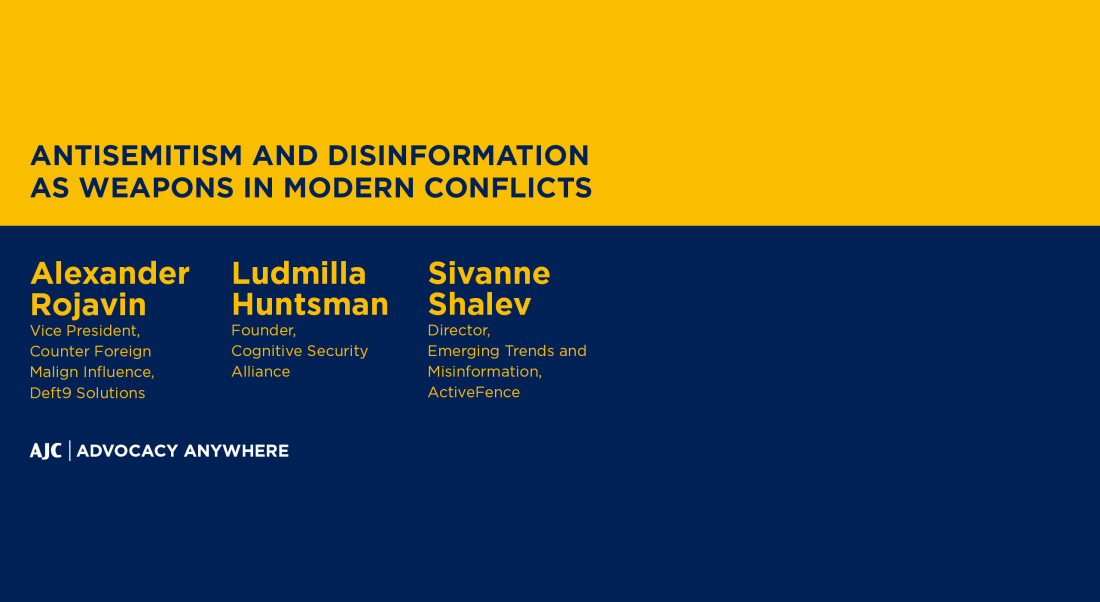
Understanding the complex nature of this threat and formulating effective countermeasures require collaboration and expertise. Organizations like the American Jewish Committee (AJC) are playing a vital role in bringing together policymakers, academics, and disinformation experts to address this critical challenge. Through initiatives like the Advocacy Anywhere platform, they provide cutting-edge insights and resources to empower individuals and communities to effectively combat disinformation. Experts like Alexander (Sasha) Rojavin, Ludmilla Huntsman, and Sivanne Shalev, featured in AJC’s programs, offer invaluable perspectives on the evolving nature of the disinformation landscape and the strategies needed to counter this escalating threat. Their work underscores the urgency of developing comprehensive solutions that combine technological innovation, public awareness campaigns, and international cooperation to protect the integrity of information and safeguard the future of democracy.