



The Lead’s investigation into Britain’s misinformation ecosystem begins with a now-familiar pattern: a woman goes missing, a young man attacks children at a dance class, a female politician is killed in her home. At first, online discussions are factual, limited to dates, times and places. But within hours, neighbourhood Facebook groups fill with wild theories, prominent X accounts suggest cover-ups, and hard-right politicians promise to get to the bottom of things. In the case of Conservative politician Ann Widdecombe, who was reported to have died in July at the age of 78, initial press reports suggested no wrongdoing, but a murder investigation soon followed. A 26-year-old man was arrested and released without charge before 28-year-old Joshua Kerry was charged. Within two weeks, conspiracy theorists claimed Kerry was not a real person, Tommy Robinson incorrectly identified him as a man speaking at a Communist Party conference in 2023, and Nigel Farage wrote in the Sun that he had it “on good authority” that Kerry was a “hard Left activist”. Because the police investigation remains active, The Lead can report what is being claimed but cannot verify or rule on guilt. The episode nevertheless shows how quickly official silence can be weaponised, and how conspiracy techniques are now being used to push an increasingly extreme political agenda.
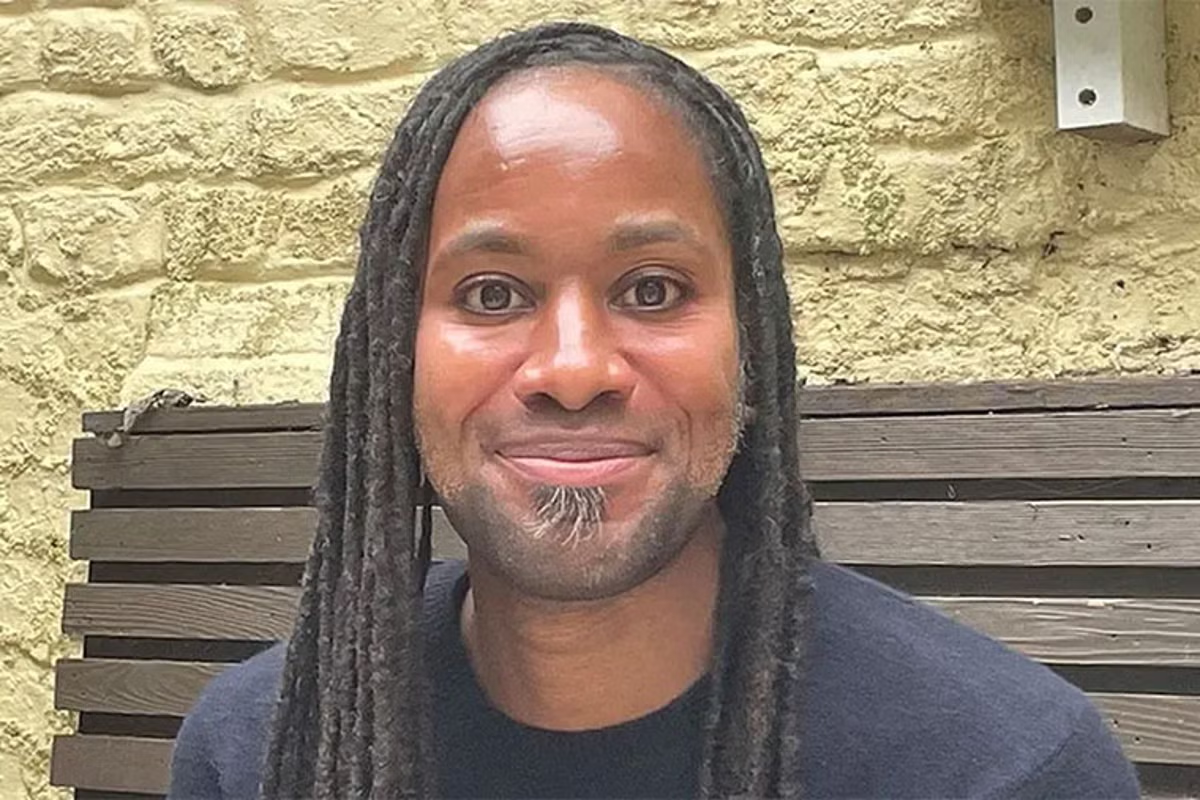
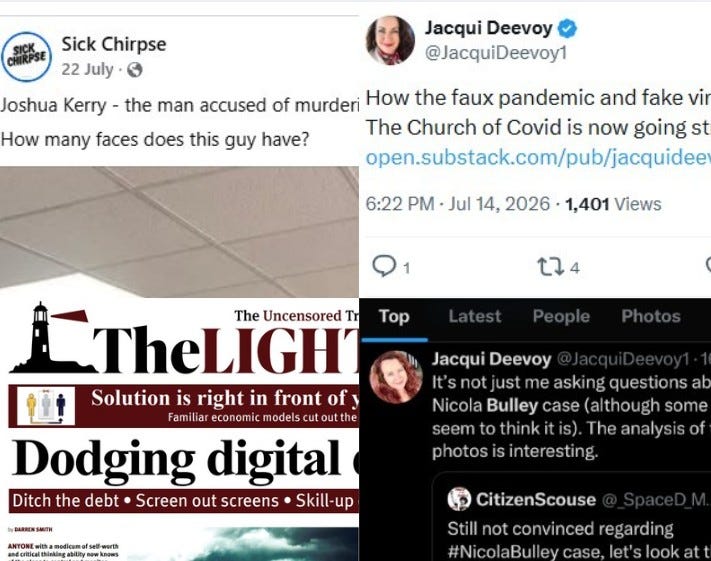
Dr Daniel Jolley, a social psychologist who leads Nottingham University’s programme on the psychology of conspiracy theories, told The Lead that those who deliberately spread conspiracies are different from those who believe them. Believers may see themselves as helping others or exposing wrongdoing, and conspiracy theories give them a sense that they possess important knowledge that others have missed. This is particularly appealing to people who want to feel unique, especially within communities where uncovering supposed hidden truths is valued. There can also be a powerful sense of purpose and belonging in working with like-minded people to expose perceived wrongdoing. For those whose careers depend on such people, it is vital to keep followers questioning the official narrative. Jacqui Deevoy, a former national newspaper journalist now writing for her own Substack, conspiracy publication The Light, and the far-right Unity News Network, is one such voice. She gained traction during Covid by claiming the pandemic was a hoax, and her profile was boosted during the disappearance and death of Nicola Bulley. Taking the “just asking questions” technique, Deevoy wrote multiple posts questioning whether Bulley was a real person and suggesting her death was a false flag invented to usher in digital ID and a microchipping system. More recently, she has questioned whether Joshua Kerry exists, using differences between a 2022 photograph, a recent police van image and court sketches as evidence. Her questions have been echoed by multiple social media users, each offering increasingly bizarre explanations. The lack of information caused by the active police investigation has left a void, and every week of official silence encourages more speculation.
When approached by The Lead, Deevoy defended her work, saying that in an age of AI and social media it is often difficult to know what is fake and what is real, what is true and what is a psy-op or false flag. She said that as an old-school journalist, her first port of call is to establish whether the people involved in a story actually exist, and that she had personally seen “zero proof” of Nicola Bulley’s existence. She added that she had never made a concrete statement in that regard and had “merely dared to ask the question”. Asked about the impact of her posts on families, she said she was unaware of any statements from relatives who claimed to have been impacted by anything she had written. In 2023, however, Nicola Bulley’s husband described the online obsession with the case as a “monster that got out of control”, and comments on Deevoy’s X posts showed immediate responses from people who knew both Nicola and her family. Dr Jolley explained that this focus on personal experience comes from an extreme erosion of trust in traditional sources of knowledge. Once people start from the position that governments, journalists, police, scientists and other institutions may be deceptive, the usual ways of establishing truth become much less persuasive. Personal experience can come to feel like the only trustworthy evidence, but this creates an almost impossible standard of proof, and the absence of personally verifiable evidence can itself become suspicious. Trust in the media is at an all-time low, and a recent King’s College study showed that those who use alternative media sources are more likely to believe in conspiracies about the pandemic, the far-right Great Replacement Theory, or the claim that the Manchester bombing was a hoax.
Hard and far-right politicians have spent years cultivating this mistrust in exactly the same way as conspiracy theorists, relying on the public’s limited knowledge of law and policing to present lack of information as proof that the Establishment is deliberately misleading them. In the wake of the Southport murders, as conspiracists claimed the attack was a psy-op, Nigel Farage publicly questioned whether the attacker was being monitored by security services, echoing false claims that the suspect was an asylum seeker on an MI6 watch list. Following the “just asking questions” model, he said police had described it as a non-terror incident but asked whether the truth was being withheld. In fact the attacker, Axel Rudakubana, was seventeen years old and protected from identification by the Children and Young People’s Act, which prevents naming anyone under eighteen. While Farage’s followers might not know that, Farage, as a senior political figure, would be expected to know that reporting restrictions apply to minors. He used the same technique after Ann Widdecombe’s death, speculating about Kerry’s political leanings and claiming the “Westminster establishment” wanted to sweep the story under the rug, despite the fact that police routinely withhold information during active investigations. This kind of misinformation has a long-term impact. Dr Jolley warned that it reduces trust in the institutions and processes that allow democratic societies to function. If elections, journalists, courts, scientists and public bodies are routinely interpreted as part of a hidden plot, it becomes difficult to establish a shared understanding of events. This can lead to political disengagement, prejudice, and in some circumstances a greater willingness to endorse political violence. When prominent political figures repeat or legitimise such claims, they give them an additional layer of credibility, and ideas that existed on the fringes become part of mainstream political discussion.
The real-world effects of these narratives on policing are significant. Assistant Chief Constable Arman Mathieson, the NPCC lead for information disorder, told The Lead that the growth of misinformation, disinformation and conspiracy narratives presents a significant challenge. Events such as Southport demonstrated the real-world risks that can arise when false information spreads rapidly online, undermining investigations, damaging community cohesion and, in some cases, contributing to public disorder and harm. In response, policing has made substantial changes to the way it communicates with the public and the media. Forces are now providing clearer and faster updates during major incidents, supported by new national guidance on the release of information, including suspect ethnicity and nationality where certain criteria are met. A national Information Disorder Portfolio has also been established, supported by police, government and partner agencies, to strengthen prevention, response and ethical decision-making across forces. Mathieson made clear that the police hope to disrupt the misinformation cycle by encouraging the public to recognise that misinformation, disinformation and malinformation all exist, to carefully consider what they read and share online, and to seek accurate information from trusted authorities. If that strategy works, the public may rebuild trust in regulated media outlets and become less vulnerable to conspiracy narratives. But policing can only do so much. In the Widdecombe case, the CPS Chief Prosecutor issued a public warning that proceedings against the defendant are active and that he has the right to a fair trial, and that there should be no reporting, commentary or sharing of information that could prejudice those proceedings. Despite that warning, neither Farage nor anyone else sharing misinformation has been censured under contempt of court law.
Whether the gap between the law and its enforcement narrows remains to be seen. As Mathieson’s own reforms acknowledge, the police cannot contain a misinformation ecosystem that political figures continue to feed, largely without consequence. The investigation by Katherine Denkinson, published by The Lead, is part of a series aiming to examine the dark forces behind Britain’s misinformation ecosystem. It shows how a combination of conspiracy entrepreneurs, mainstream political opportunists, social media algorithms and declining trust in institutions has created a world in which a missing woman, a murdered politician or an attack on a children’s dance class can be transformed, within hours, into a battleground for rival realities. The techniques are not new, but the scale is. More people than ever are unwittingly spreading conspiracy narratives, and the speed at which falsehoods travel means the truth is often left gasping for air. The consequences are not abstract: they affect police investigations, public safety and the shared assumptions that make democracy possible. The article ends with a call for readers to support independent journalism and to share the investigation, but its deeper message is that the misinformation ecosystem is not a natural phenomenon. It is built, maintained and monetised by people who understand exactly what they are doing, and it will not be dismantled without accountability, media literacy and a willingness to confront those who benefit from it.