



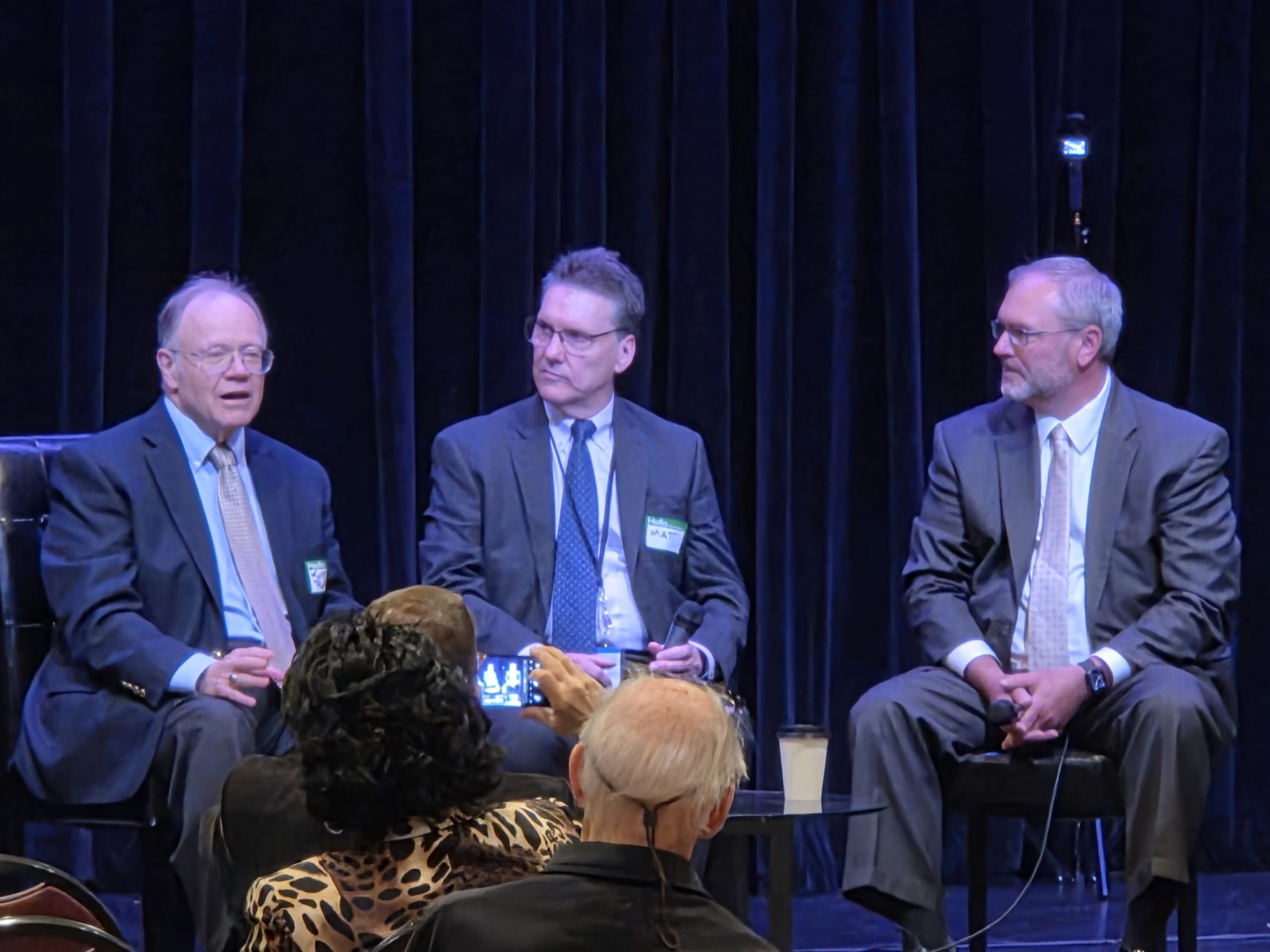
With early voting underway and President Donald Trump intensifying his push to place election administration under federal authority, local and state election officials used a Friday forum in Springfield to confront repeated myths and disinformation about how elections are actually run. The discussion, hosted by the Citizen Club at the Hoogland Center for the Arts, brought together Sangamon County Clerk Don Gray, a Republican, and Matt Dietrich, a spokesman for the Illinois State Board of Elections, with retired University of Illinois Springfield political science professor Kent Redfield serving as moderator. Redfield opened the conversation by drawing a clear constitutional line: elections in the United States are managed and administered at the local level, a structure that is both described and protected by federal law and the U.S. Constitution. The timing was significant. Critics have accused Trump of driving falsehoods about the validity and integrity of the election process, from claiming that large waves of noncitizens are voting to casting doubt on the safety of voting by mail. He has issued a series of executive orders intended to bring elections under national oversight, including one that called for the U.S. Postal Service to take control of mail-in ballots. Neither panelist directly referenced Trump’s broader efforts to delegitimize election results, but the thrust of their remarks—through detailed explanations of voter registration safeguards, signature verification, cybersecurity measures, and post-election audits—offered a pointed, fact-based rebuttal to the narrative that American elections cannot be trusted.
The legal backdrop loomed large over the forum. Illinois is a party to several lawsuits challenging Trump’s attempt to assert federal control over elections, and Dietrich addressed a particularly contentious front: the demand that state election authorities hand over voter data, including dates of birth, Social Security numbers, and driver’s license or state-issued identification numbers. Dietrich was blunt about the limits of state authority. “We don’t have anything in federal or state statute that authorizes us to hand that data over to the Department of Justice or to any other agency,” he said. Instead, the state provided the Department of Justice with a list of names and ages—information that is already available to the public under the Illinois election code. The DOJ sued anyway, and Dietrich said Illinois prevailed at the district court level. But he predicted the fight is not over, and that the matter could ultimately reach the U.S. Supreme Court for a final decision. The legal tensions over federal involvement in elections have already reached the high court. On Sept. 14, the Supreme Court let stand a previous ruling blocking the U.S. Postal Service from validating mail-in ballots, a decision that arrived as mail-in voting continues to grow in popularity. More recently, on Friday, the Supreme Court ruled in favor of Trump’s national voter verification program, though states may choose whether to participate. Dietrich and other election watchdogs have expressed concern that such a program could misidentify citizens as ineligible to vote, creating new barriers for eligible Americans.
Mail-in voting was one of the central subjects of the forum, and Gray provided a local snapshot of just how common it has become. He said 22,500 mail-in ballots were sent out on the first day of early voting last week, a figure that reflects a seismic shift in voting behavior. “We’re to a point where we’re going to probably be casting about a third of our ballots by mail in advance of the election,” Gray said. That popularity, he suggested, may invite future legislative attention, and he stressed that any federal law touching mail-in voting would require careful coordination between local election authorities and the federal government. The process for casting a mail-in ballot in Illinois is structured to verify the identity of the voter at multiple stages. Applications for mail-in ballots are checked against registration records, and a voter’s signature is compared to the signature on file before a ballot is issued. When the ballot is returned, election judges scrutinize the signature again. Illinois has embraced mail-in voting as a safe and convenient option, and the officials pushed back against the notion that mail ballots are inherently vulnerable to fraud. They noted that each step in the process carries audit trails and that the system is designed to catch irregularities rather than wave them through. Gray’s numbers underscored the logistical reality facing election administrators: the scale of mail-in balloting is no longer a niche concern, and any disruption to the postal system or changes to federal oversight could have profound consequences for local officials tasked with running elections smoothly.
Redfield turned the discussion toward another frequent source of public concern: the possibility that people who are not eligible to vote could end up on voter rolls. The question is particularly pointed in Illinois, which is one of only 13 states that do not require a voter to show identification at the polls. But Gray and Dietrich explained that the absence of an ID requirement at the polling place does not mean the state accepts registrations without verifying identity. When a person registers to vote in person, they must provide two forms of identification, one of which must include a current address. In practice, that means a state-issued driver’s license or state identification card is often the foundation of the registration record. Election authorities rely on the data embedded in those documents—date of birth, address, and other identifying details—and they vet new registrations against records held by the Illinois Secretary of State and the Social Security Administration. For those who have not provided documentation at the time of their application, the requirement kicks in before they cast a ballot: they must show some form of documentation described in the registration form, either when voting in person or before receiving a mail-in ballot. Illinois also permits same-day voter registration, but those voters are still required to show proper documentation and cast their ballot immediately afterward. Online registration, meanwhile, must be done through the state’s official portal, which requires a valid state ID or driver’s license number. When the voter appears at the polls, the election judge compares the signature on the ballot application with the signature of record on a state-issued ID or driver’s license. The last day to register online is Oct. 18. Gray expressed strong confidence in the process. “I have great confidence in the manner in which we go about doing all this,” he said. “You should as well.”
On the subject of voter fraud, Gray offered a direct and personal answer: in more than a decade in office, he has never witnessed someone attempt to show up in person and cast a ballot under another person’s identity. “I have never in my tenure as county clerk—over a decade-plus now—witnessed someone try and physically present themselves in a fraudulent manner to be someone else to cast a ballot,” Gray said. The primary tool election judges use to spot a potential impersonation is the signature comparison. Every voter signs a form to receive a ballot, and election judges compare that signature to the one on file. Gray described the signature as “like a fingerprint to you.” If an election judge has concerns about a signature, the matter does not automatically result in rejection. Dietrich explained that if a majority of the election judges agree that a signature does not match, the voter may be asked to show identification to validate their identity. The process is intentionally layered to avoid both fraud and disenfranchisement. The officials also addressed cybersecurity concerns, an area where Illinois has invested significant resources. Dietrich described a program called Cyber Navigator, operated by the Illinois State Board of Elections, that provides smaller election authorities with the personnel, training, and tools needed to defend against cyberattacks. All 108 election authorities in the state transmit election data to the State Board of Elections through the Century Network, a private statewide network that is isolated from the public internet and designed to protect sensitive information. Gray offered a recent, concrete example of the accuracy of voting machines. He recalled the 2024 Sangamon County Recorder race, which Frank Lesko won by just 31 votes. When election officials ran a sample to verify the outcome, the machines produced the exact same result. “It was 100% accurate to what we reported,” Gray said.
The overall message from Friday’s forum was that election integrity is not achieved through sweeping claims or federal power but through patient, local, verifiable processes. Redfield’s opening reminder—that American elections are local by constitutional design—was reflected throughout the panelists’ remarks. Whether the issue was voter registration data, mail-in ballot security, signature checks, or the cybersecurity of election systems, Gray and Dietrich returned to the same theme: there are checks at every step, and those checks are performed by trained local officials who are accountable to their communities. Neither panelist explicitly engaged with Trump’s allegations of widespread fraud or his administration’s efforts to centralize election oversight, but their detailed explanations were a quiet, steady rebuttal. They acknowledged concerns raised by voters, but they refused to concede that the system is broken. Instead, they pointed to the realities of election administration: voters are vetted against state and federal databases, signatures are compared, machines are tested, and results are audited. The legal battles over federal election orders may continue, and the Supreme Court’s recent rulings could reshape the relationship between Washington and local election authorities. But for the officials who actually run elections, the focus remains on the mechanics of democracy—making sure every eligible voter can cast a ballot, and that every ballot is counted accurately. Gray’s closing assurances, backed by decades of experience and a detailed list of safeguards, amounted to a simple but firm message: the election system is not perfect, but it is secure, and the people who operate it take their responsibility seriously. In a time of skepticism and conspiracy theories, that may be the most important reassurance of all.