


Social Media’s Role in the Climate Change Discussion: A Comprehensive Analysis of Interaction Patterns and Information Reliability
This article presents a comprehensive analysis of climate change discussions across four major social media platforms: Facebook, Instagram, Twitter, and YouTube. Using a keyword search approach, the study examined posting patterns, engagement trends, and the prevalence of both reliable and unreliable information sources within the climate conversation. The research period spanned several years, capturing significant events like Climate Action Week and COP26, allowing for an assessment of their impact on online engagement. The overarching goal was to understand how social media platforms shape and reflect public discourse on climate change, including the challenges posed by misinformation and the dynamics of online communities.
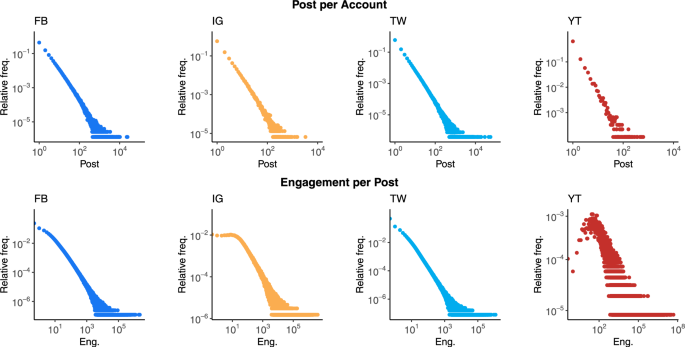
The initial findings revealed a familiar pattern of social media activity: a small number of accounts generate a large proportion of content, and a small fraction of posts receive the majority of engagement. This "heavy-tailed" distribution is common across social media and underscores the influence of highly active users in shaping online discussions. Analysis of content volume and engagement over time revealed peaks coinciding with major climate-related events, demonstrating the potential of these events to galvanize online attention. However, further analysis using interrupted time series models suggested that the long-term impact of these events on engagement trends is more nuanced and unfolds gradually.
While content creation related to climate change continues to increase across all platforms, engagement trends vary. Facebook and Instagram exhibit signs of engagement saturation, while Twitter and YouTube show increasing total engagement. Notably, average engagement per post is declining on Facebook, Instagram, and YouTube, potentially indicating a growing difficulty in attracting new participants to the climate conversation on these platforms. However, the continuous influx of new accounts participating in the climate discussion suggests a persistent and evolving interest in the topic.
A crucial aspect of this study is the analysis of the prevalence and engagement with content from unreliable information sources. By leveraging assessments from independent news rating agencies, posts linking to sources known for spreading misinformation were identified and compared to posts linking to reliable sources. A key finding across all platforms, except Twitter, was the higher average engagement received by content linked to unreliable sources. This phenomenon points to the challenge of combating misinformation in online spaces, where sensationalized and provocative content can often outperform factual information in capturing user attention. Further investigation revealed that the overall volume of content from unreliable sources is considerably lower than that from reliable sources. However, the disproportionately high engagement with unreliable content raises concerns about its potential impact on public perception and understanding of climate change.
To understand the different narratives propagated by reliable and unreliable sources, the study analyzed the hashtags used in their respective posts. The findings revealed a stark contrast in the language employed by the two groups. Unreliable sources tended to favor hashtags that promote skepticism and denial of climate change, while reliable sources focused on hashtags related to scientific discourse and international climate action. This divergence in language use reflects the broader polarization within the climate change debate and underscores how different online communities engage with the topic.
Network analysis of hashtag co-occurrence revealed further insights into the distinct communication patterns of these groups. Reliable hashtags tended to cluster closely together, suggesting a cohesive community around established information sources. In contrast, unreliable hashtags were more dispersed and fragmented, indicative of a less coordinated and more diverse set of narratives. These findings support the idea that reliable information tends to circulate within echo chambers of like-minded individuals, while unreliable information spreads through more diffuse and less organized channels.
In conclusion, this research provides valuable insights into the complex interplay of information dissemination, engagement patterns, and the role of misinformation within the climate change conversation on social media. While the increasing volume of content and the influx of new voices demonstrate sustained public interest in the topic, the declining average engagement on some platforms and the disproportionate impact of unreliable content raise concerns. Understanding these dynamics is crucial for developing effective strategies to promote informed discussion and combat the spread of misinformation on these influential platforms. Further research exploring the causal links between specific platform features, user behavior, and the spread of misinformation will be vital for addressing these challenges and fostering a more productive online climate conversation.