


Veteran Journalist Warns ‘Narrative’ Has Replaced Facts in Battle for Israel’s Future
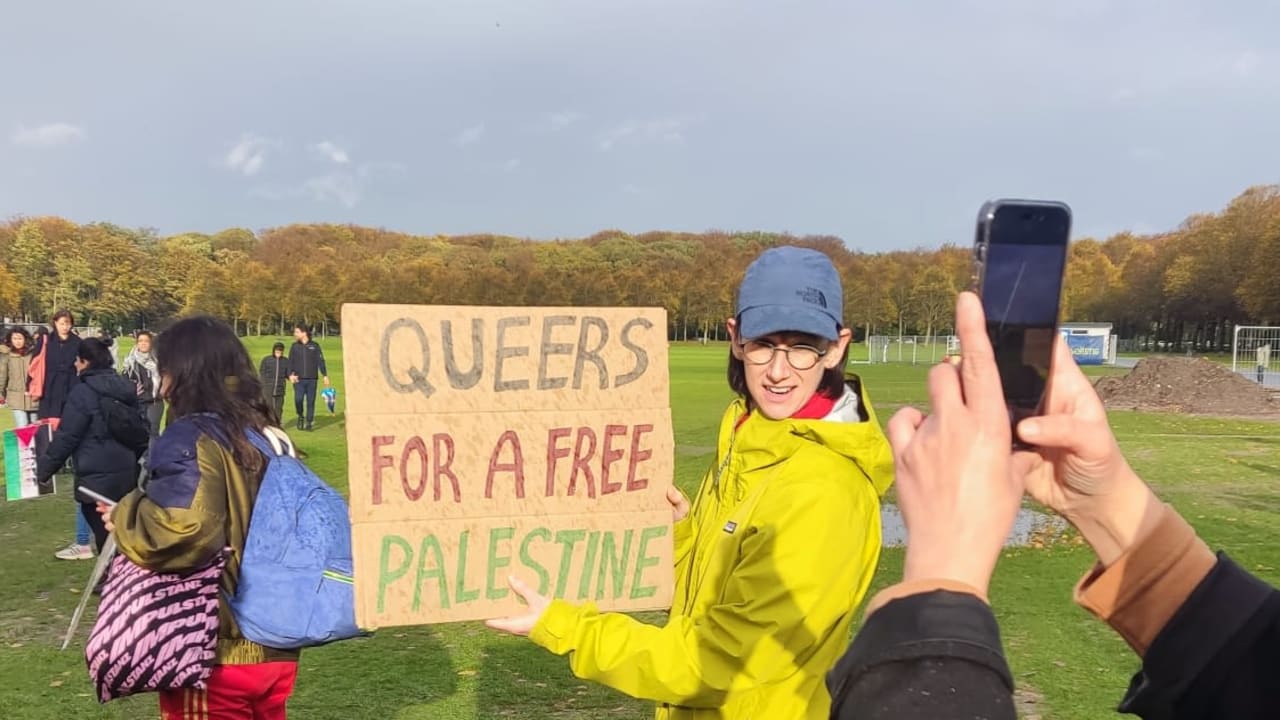
Veteran Middle East correspondent Mark Lavie is sounding an alarm: The greatest threat facing Israel and the Western world today may not be missiles from Iran or bombs from Islamist terror groups, but the dominance of “narrative” over facts and truth. In a deeply personal opinion piece distributed by The Media Line, Lavie—who has covered the region for major news networks since 1972 and is the author of “Why Are We Still Afraid?”—argues that narrative has quietly displaced truth as the currency of public debate. Under the prevailing Western narrative, he writes, Israel is cast as a colonialist occupier, Palestinians as helpless victims, and the Israeli-Palestinian conflict as the singular moral issue of our time, ultimately driven by a sinister Jewish power allegedly behind everything wrong with the world. This storyline is so pervasive that it makes otherwise rational people embrace absurdities, such as LGBT activists marching under the banner “Queers for Palestine” in support of a society where homosexuality is criminalized and Palestinians in Gaza have reportedly thrown gay people from rooftops. The narrative has been weaponized on campuses, in newsrooms, and in parliaments, and it has been reinforced by Israeli government missteps. As a result, Israel has lost a significant portion of its support in the Western world. Lavie insists that this is not merely a public relations problem; it is an existential one. The concept of “narrative” is as dangerous as any enemy army, because once a lie becomes the accepted frame, facts become irrelevant. He points out that people now begin with a narrative they want to believe, then collect only the “facts” that support it, even when those are not facts at all. The old journalistic ideal—find the facts, report them, and let the chips fall where they may—has been replaced by advocacy and echo chambers. That, Lavie warns, is why seemingly intelligent people can parade around in keffiyehs and espouse causes that are the opposite of their own interests. The result is a world in which the goalposts of reality are no longer where they used to be, and no quantity of evidence can move a mind that has already surrendered to the story it wants to believe.
To demonstrate how far facts have fallen, Lavie offers a list of well-documented truths that are treated as irrelevant because they do not fit the narrative. There has never been an Israeli-led genocide in Gaza, he writes, and there has never been mass starvation in Gaza. Israel has facilitated the shipment of enough food into the Strip to satisfy the needs of everyone there—an extraordinary humanitarian gesture during an active war. The ratio of combatant deaths to civilian deaths in three years of conflict is remarkably close to one-to-one, which is far better than the record of the United States-led wars in Iraq and Afghanistan, where roughly eight civilians died for every combatant killed. He also notes that in Gaza, LGBT people face not only persecution but lethal violence, including being thrown from apartment-building roofs, a fact that makes Western queer activism on behalf of the Strip incomprehensible. These documented realities, Lavie says, would have shaped any honest news report in an earlier era, when journalists sought out facts and explained them regardless of whom it helped or harmed. Today, however, such facts are dismissed because they complicate a cherished narrative. Once-proud news organizations pander to niche audiences and openly advocate for the chosen narrative. Politicians have always spun, but the practice has become extreme. The author recalls a friend telling him after years of reading his work, “I can’t tell whether you’re right or left,” and he responded with a simple “Thank you.” That kind of objectivity, he says, has nearly vanished. Instead of reporting the truth, many outlets decide the conclusion first and then work backward, selecting evidence and witnesses that validate the predetermined narrative. The list of ignored facts is long, but Lavie says time, space, and attention spans are limited. Yet even a partial list underscores his central point: in the post-fact era, a documented truth is no match for a well-told lie if the lie has captured the collective imagination. The facts he enumerates are not obscure; they are verifiable and widely known. But in a culture where narrative reigns, verifiability no longer guarantees acceptance.
Lavie gives a striking example of how narrative replaces truth at the highest levels of political power. During the United States presidential campaign, a candidate—clearly Kamala Harris—was confronted by an Iranian exchange student who accused Israel of “ethnic genocide.” The candidate had every reason to rebut the accusation and to point out that an American criticizing an Iranian official in Iran would face severe consequences, perhaps even death. Instead, in what Lavie calls “full pandering mode,” she told the student: “Your voice, your perspective, your experience, your truth cannot be suppressed, and it must be heard.” That phrase, “your truth,” is the key, Lavie writes; truth has been reduced to a personal narrative. It is the same impulse that fuels the old joke, “My mind is made up, don’t confuse me with facts,” which is no longer a joke but a description of public discourse. The anecdote illustrates how politicians, rather than leading the public toward reality, now mirror the narratives they think will win votes. In doing so, they legitimize lies and give oxygen to conspiracy theories. The Iranian student, whatever his personal story, was not a guest seeking refuge but a messenger advancing a propaganda campaign hostile to the country hosting him. A responsible leader, Lavie argues, would have corrected him firmly, demonstrating that the United States does not surrender its own definition of truth to foreign-born slanders. Instead, the candidate chose to validate a false accusation, showing how deeply the narrative has penetrated even the highest corridors of the West. This moment, he suggests, is a microcosm of a broader failure: Western elites are so terrified of offending the narrative that they abandon basic facts and moral clarity. The result is a form of intellectual surrender, in which “your truth” trumps objective truth and the aggressor is refashioned as the victim. Had a student in any authoritarian country accused its leader of genocide in similar terms, he would have been met not with applause but with imprisonment. Yet in the West, a foreign national can level a preposterous accusation against a democratic ally and be treated as a moral authority simply because his story fits the preferred narrative.
Perhaps nothing has accelerated the triumph of narrative as much as social media, which Lavie deliberately calls “antisocial media.” In the old days, he recalls, most people listened to experienced professionals and experts. Today, they turn to influencers—people who gain fame not through university degrees or decades of field experience, but simply by making themselves popular by any means necessary. He points to professional tennis players complaining that influencers disrupted a top international tournament by making noise and flashing lights to be photographed rather than watching the matches. An eight-year-old can become an influencer if her parents or agents get her video clips to go viral. “Remember when the term ‘viral’ was associated with danger?” he asks, noting that it still is, but in a different context. Antisocial media allows and even encourages users to latch onto a narrative and then build a closed circle of like-minded or unhinged followers. It creates an ecosystem in which expertise is suspect and random opinions are treated as equal to scientific knowledge. Lavie illustrates this with a bitter exchange: a certified immunologist with a Ph.D. and 25 years of experience, along with extensive research and published papers in the field, says clearly that COVID and flu vaccines are beneficial and effective. A random reader replies, “Bullsh*t.” That one word demolishes decades of learning, and the platform gives both voices equivalent weight. This is why, Lavie writes, there is little point in spending one’s days replying to posts with documented facts; the flood of odious fabrications will not be stopped by evidence. The goalposts of reality have moved. In such an environment, the old journalistic instinct to counter every lie with a fact is not just ineffective—it can be counterproductive, because the simple act of engaging grants the lie an aura of legitimacy. The author, an admitted old grouch, says he is tempted to push his white beard off the keyboard and shout, “Get off my lawn.” But he knows that is no solution. The new world is not going back to the old one, and those who refuse to adapt will be left shouting in the wind.
The solution, Lavie argues, is not to abandon truth but to learn the techniques of the new media landscape and use them to build competing narratives—true narratives. He acknowledges that despite the myth of Jews controlling everything with limitless resources, Israel and the Jewish people are vastly outnumbered and outspent by the forces promoting the current anti-Israel narrative. He cites Qatar’s multibillion-dollar campaign to shape American public opinion as one example; Qatari money has infiltrated universities, media, and think tanks, and the return on that investment can be seen in campus protests, congressional hostility, and the widespread acceptance of grotesque accusations against Israel. A generation may already be lost, Lavie admits, but it is time to start working on the next one. He offers a list of true stories that could serve as the foundation of a counter-narrative. First, the story of Oded Lifshitz: an 84-year-old peace activist who lived next to Gaza and spent years volunteering to drive sick Palestinians from the border to Israeli hospitals. On October 7, 2023, Palestinian terrorists kidnapped him from his home and dragged him into Gaza, where he later died. There is no better illustration of the moral difference between the two sides. Second, Israeli researchers have, in just the past year, developed promising potential cures for several forms of cancer—a story that could humanize Israel and highlight its contribution to global humanity. Third, Israel is often among the first countries to send rescue teams to natural disasters anywhere in the world, even to nations that do not maintain diplomatic relations with it. These facts, Lavie writes, are true, which distinguishes them from the current crop of pro-Islamist narratives. But truth alone is not enough. The pro-Israel side needs a strategic decision to invest in narrative-building, to package these stories in ways that resonate with modern audiences, and to stop wasting all its time and money on fact-checking and defensive rebuttals. How exactly to turn these examples into compelling narratives, he says, is above or below his pay grade—but the first requirement is the decision to try.
Lavie closes by reflecting on the profound transformation he has witnessed over his long career. When he began in journalism in the middle of the last century, the goal of the profession was to discover facts, write about them, and explain them; it did not matter which way the facts pointed or whom they helped or harmed. He still follows those rules, but he recognizes that the profession and the public have moved on. The old world is gone, and nostalgia will not bring it back. Instead of chasing the metaphorical kids off the lawn, supporters of Israel and of Western democratic values need to learn how they do what they do, and do it better. The decision to counter narrative with narrative must come first, rather than continuing to spend all available resources on rebutting lies with facts that no one wants to hear. The author acknowledges that his preference for objectivity and evidence may seem quaint in an age of influencers and “your truth,” but it gives his warning moral force. The enemies of the West—Iran, Islamist terrorism, and their useful idiots in the West—understand that wars are won not only on battlefields but also in the stories people tell. Israel has been losing that story war, Lavie admits, and the losses are compounded by the scale of funding and coordination on the other side. Yet the one advantage truth offers is that truth is durable; lies collapse under scrutiny, while true narratives can withstand challenge. The article’s final words are a stark and simple declaration: “Israel’s are true.” The potential narratives of Israel and its allies are not just alternatives to the current crop of anti-Israel and pro-Islamist slander; they are grounded in reality. The question is whether Israel and the West can summon the will and the creativity to tell those stories before the narrative weapon destroys the last vestiges of mutual understanding.