


Lehmann: Hitler-era antisemitic ‘material’ is back in DSA-aligned ‘neo culture’
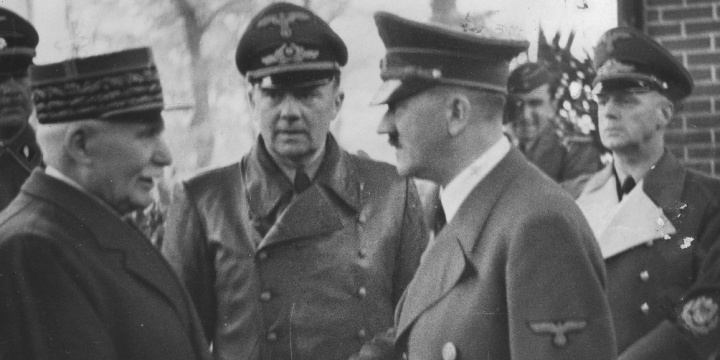
Karen Lehmann’s latest column begins with an image that distills the cost of capitulation: Marshal Philippe Pétain shaking hands with Adolf Hitler at Montoire in October 1940, only months after the armistice that placed more than half of France under Nazi control. The photograph is familiar, but Lehmann uses it to launch an argument that reaches far beyond the Second World War. In her reading, the image is a monument to a deeper political truth. There is a category of ideological material, she writes, that is potent enough to make people override what they already know is right. Once someone proves that material works, it gets reused — on new targets, in new packaging — for as long as using it stays free. Hitler is the proof that such material exists. Churchill is the proof that yielding to it was a choice, not an inevitability. And today’s DSA-aligned “neo culture” is the proof that the same material is back in circulation, retargeted. Lehmann, a journalist, photographer and columnist based in Washington, D.C., who blogs for The Times of Israel and writes a column for Man and Culture, is writing about antisemitism as a reusable political weapon. The material she identifies is not an argument that can be refuted by counter-evidence; it is a conspiracy-laden substance that has been used for centuries to explain events, dispose of opponents and mobilize followers. Her essay is at once a historical account, a media critique and a warning to the American left.
Lehmann begins with Hitler’s success, explaining why his use of antisemitism was not original but nonetheless transformative. “Millions of Germans followed instructions they knew, on some level, were wrong,” she writes. Hitler did not overcome that knowledge, she argues; he found a material potent enough to defeat it. That material was already old. It had been built over centuries from blood libel, pogroms and myths about a hidden Jewish hand, narratives that circulated in Europe long before Hitler was born. Her point is deliberate: Hitler’s innovation was not the material itself but scale. He organized scattered, local hatred into a national instrument and gave millions of Germans explicit permission to act on a prejudice they had already been primed to hold. This, she argues, is why Churchill must be discredited before Hitler can be rehabilitated. “You can’t sell moral capitulation as profitable without first taking down the man who proved it wasn’t required.” She identifies a revisionist project described by historian Andrew Roberts on The David Frum Show, in which Churchill is recast as bought and controlled by “the Jews.” The claim, she notes, was carried furthest by podcaster Darrell Cooper, speaking before Tucker Carlson’s 33 million listeners. It is, in Lehmann’s words, the same “hidden Jewish hand” material Hitler used, aimed backward at the man who resisted it. The conspiracy collapses on its own timeline. Churchill’s friend Bernard Baruch gave him financial support with no strings attached, while others left him money only in their wills. He therefore could not have known the scale of those gifts, let alone acted in exchange for them, until after he was dead. As Lehmann puts it, the conspiracy requires money that could only have arrived after the purchase would already have had to happen.
Lehmann then argues that the same material is now circulating through a new production method, one she calls “neo culture.” This is not a formal ideology, she emphasizes, but the informal way today’s Democratic Socialists of America-aligned left manufactures political fame by rewarding whoever transgresses furthest, fastest, on camera. It is “neo” because the packaging is new — protest footage instead of a green room, a phone instead of a studio — and “culture” because it has become the water the pipeline swims in, not a strategy anyone chose. The protest-to-platform pipeline that produced Zohran Mamdani, Francesca Hong and Darializa Avila Chevez, she argues, runs on the same logic as reality television and Cooper’s podcast: attention accrues to whoever pushes furthest past what a room will tolerate. What is doing the pushing is anti-Zionist rhetoric functioning as a shorthand villain. In Lehmann’s structural analysis, “Israel” now stands in for the role “the Jewish bankers” played in Cooper’s telling of Churchill. It is the central material, not one tactic among several, because it is not criticism of a specific Israeli government or policy; it is opposition to the state’s existence itself. That distinction matters to her argument. A policy can be debated, revised or replaced; an existence claim cannot. Anti-Zionism of this kind, she writes, is therefore the most potent single item in the inventory of contemporary transgression.
Lehmann explains why the existence of the State of Israel is so important to the pipeline. A state’s existence is binary in a way its policies are not, she writes, which makes rejecting it outright maximally transgressive — the fastest route to visibility and the surest way to distinguish a candidate from a merely liberal one. Housing and health care move slower and ask more of an audience; Israel is the one subject where maximum transgression is available on demand. She also identifies an important difference between Hitler’s era and the present. In the 1930s and 1940s there was no State of Israel to target, only a scattered, stateless people. Today’s version does not traffic in diffuse hatred of a people without a homeland; it uses explicit calls for the destruction of an actual country and the people in it. That is not a smaller target, she insists, but a more concrete one. And, as with Hitler, the mechanism runs on what does not push back. Lehmann notes that Democratic officials who would challenge almost any other line within their coalition largely do not challenge this one. Institutions that police rhetoric closely elsewhere treat this material as outside their jurisdiction. She is careful to say that not every activist in the pipeline is antisemitic. But, she writes, the mechanism selects for transgression, and antisemitism redirected at a state instead of a man stays disproportionately represented in the inventory because nothing else carries as much pre-loaded shock value, and because using it has stayed nearly free.
The mechanism, according to Lehmann, has one input: cost. It runs wherever using this material is free and stops wherever it is not. That, she argues, is the entire difference between Hitler’s era and Churchill’s response to it. Making it expensive again, she writes, starts with elected officials. She proposes withheld endorsements, primary challenges funded the way they would be run against a candidate who used racist language, and loss of committee assignments rather than a statement issued after the fact and forgotten. It extends to institutions enforcing rules already on the books. It extends, too, to the audience that makes the whole economy run: editors declining to book the guest whose only distinguishing material is the transgression itself, and donors pulling funding the way they already do when a figure crosses other lines. Lehmann does not argue that everyone in that pipeline shares a coherent ideology. She argues that the pipeline rewards the farthest transgression, and that anti-Zionism remains the cheapest way to achieve maximum transgression. If the cost changes, the selection changes. If a political figure who calls for the destruction of Israel faces the same consequences as one who uses racist language, the material will lose its advantage. If using it remains free, she warns, the cycle will continue, because the material works, and it will keep getting used for exactly as long as it keeps costing nothing to use.
Lehmann closes by returning to the two historical proofs. Hitler proved that this material could move millions of people past their own consciences. Churchill proved, in the same moment, that it did not have to work — because enough people made resisting it cost something to skip. Today’s revisionists, in her reading, are trying to erase the second proof so that the first stands alone. If Churchill can be recast as a puppet of the very force he resisted, then the lesson of the twentieth century is that resistance was never possible, and accommodation becomes the only rational strategy. DSA-aligned “neo culture,” she argues, has learned the same lesson Hitler did. It is the material that works best, and it will keep being used for exactly as long as it keeps costing nothing to use. The photograph of Pétain meeting Hitler, then, is not a relic. It is a warning about what happens when leaders decide that something else — comfort, order, career, approval — is worth more than the cost of resistance. Lehmann’s essay is an argument about how such material enters ordinary politics: not as an explicit ideology but as a shortcut, a way for ambitious people to distinguish themselves by crossing a line that no one else will cross. The antidote, she writes, is to make crossing that line expensive again, consistently and institutionally, before the next political career is built on it. Lehmann is based in Washington, D.C., covering American politics, public policy, Israel and culture.