


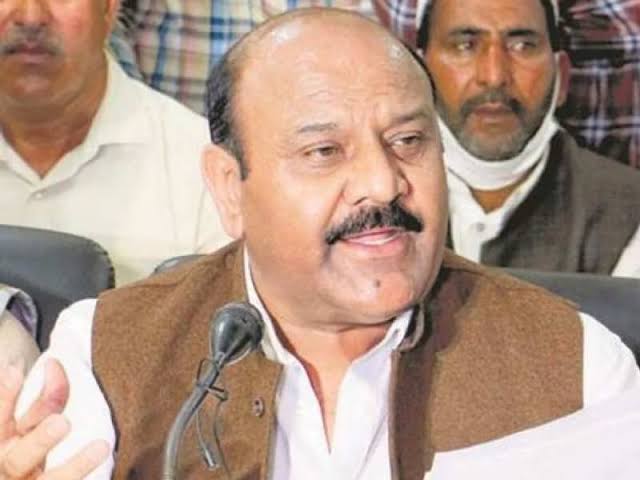
Vote Theft Allegations Are an Attack on Democracy: J&K Deputy CM Surinder Choudhary Hits Back at BJP
Budgam: Jammu and Kashmir Deputy Chief Minister Surinder Choudhary has accused the Bharatiya Janata Party of spreading misinformation, describing allegations surrounding vote theft as an issue with serious implications for democratic institutions. Speaking to reporters in Budgam, Choudhary said the controversy touched the very integrity of the electoral process and could not be dismissed as ordinary political rivalry. He maintained that the allegations raised fundamental questions about how elections are conducted and how public confidence in democratic mechanisms can be preserved. The Deputy Chief Minister, a senior leader of the National Conference-led government, criticised the BJP’s approach, saying the party had come to rely on falsehoods in its political campaigns. He argued that the BJP has repeatedly made claims that are disconnected from reality, and that these claims are part of a broader pattern of behaviour aimed at delegitimising opponents and creating confusion among voters. According to Choudhary, the public is no longer accepting such tactics at face value. He insisted that people across the country were expressing opposition to the BJP, a remark reflecting his belief that the party’s political fortunes are being harmed by its own conduct. By linking the vote theft controversy to an attack on democracy, Choudhary sought to move the debate beyond party lines and toward the broader health of the country’s representative institutions. His remarks in Budgam added another layer to the ongoing political confrontation in Jammu and Kashmir, where electoral accountability remains a charged issue. The Deputy Chief Minister did not provide specific evidence for his claim of falsehoods, but he made clear that his government would not remain silent when, in his view, democratic practices were being undermined. He also suggested that the responsibility for maintaining democratic integrity rests not only with election officials but with political leaders who choose to make allegations without substantiating them. His comments are likely to intensify the war of words between the ruling alliance and the BJP in the union territory, particularly at a time when questions about the fairness of electoral processes are being raised with increasing frequency across the country.
Choudhary also addressed the functioning of his administration, saying the National Conference-led government remained committed to fulfilling its promises despite what he described as limitations on its powers. His statement was an acknowledgement of the peculiar constitutional position of Jammu and Kashmir, which is governed as a union territory with a legislature but without the full powers of a state government. The Deputy Chief Minister did not elaborate on the nature of these limitations, but his reference was an apparent nod to the continuing debate about the extent of authority exercised by the elected government in the union territory. He maintained that his administration was accountable to the public and intended to deliver on the commitments made to voters during the election campaign. These commitments range from the restoration of statehood to the provision of better governance and the resolution of local issues, although Choudhary did not list them in detail in his Budgam remarks. He said the government would continue working towards its commitments despite the constraints under which it operates. This line of argument serves two purposes. It assures voters that the government is sincere about its promises. It also signals that the administration should not be judged solely by what it has been able to deliver so far, because its hands are tied in certain areas. By invoking accountability, Choudhary was attempting to place the onus on the administration while also reminding the public that the government faces structural limits that are not of its making. He indicated that the administration is aware of the high expectations placed upon it and that it remains focused on its agenda. His remarks reflect the broader political pressure on the new government to show results in a difficult institutional environment. They also underline the delicate balancing act faced by a government that must work within the framework of union territory while leading public demands for full restoration of statehood and greater self-rule. Choudhary’s insistence on accountability was therefore both a promise and a defence: a promise to continue working, and a defence against criticism that the government has not moved fast enough.
Referring to the controversy surrounding vote theft, the Deputy Chief Minister said the issue amounted to an attack on democracy. He alleged that the BJP’s political approach relied on spreading falsehoods and claimed that people across the country were expressing opposition to the party. The phrase “vote theft” has become a lightning rod in political debate, often used to describe alleged manipulations of the electoral process, but in Choudhary’s formulation it was not just an accusation against a rival party. It was, he said, an assault on the foundational principle that elections must reflect the will of the people. By characterising it in such terms, he was seeking to underscore the seriousness of the matter and to demand that political actors treat electoral integrity as a non-negotiable element of democratic governance. Choudhary’s criticism of the BJP was sharp and categorical. He portrayed the party as one that cannot sustain itself on a positive agenda and therefore resorts to misinformation to remain relevant. His assertion that people across the country were opposing the BJP is a claim that goes beyond Jammu and Kashmir, suggesting that the party’s tactics have generated resistance not just in the union territory but at the national level. This is a politically significant argument because it implies that the BJP’s electoral strategy is beginning to fail even in areas where it remains dominant. The Deputy Chief Minister did not offer evidence for this broad claim, but he appeared to be speaking about the political mood he perceives during his travels and interactions. He also said people were aware of the statements and claims made by BJP leaders. This was another way of saying that voters can distinguish between truth and falsehood and that they will hold the BJP accountable at the ballot box. For Choudhary, the vote theft controversy was therefore not merely a dispute between political rivals. It was a moment for citizens to reflect on the kind of democracy they want and for leaders to consider the consequences of undermining trust in elections.
Choudhary reiterated that the government would continue working towards its commitments despite the constraints under which it operates, but he also turned his attention to the BJP’s responsibility in the electoral controversy. He urged the party’s leadership to address questions concerning alleged irregularities in the electoral process. His argument was straightforward: if the BJP is making serious accusations about vote theft, it must be prepared to substantiate them and to answer questions about the mechanisms it believes were compromised. At the same time, if the accusations are not based on evidence, then they should not have been made in the first place. The Deputy Chief Minister argued that political leaders making public statements should also respond to questions raised about voting procedures and the integrity of democratic institutions. This can be read as a challenge to the BJP to move beyond slogans and engage in a substantive discussion about electoral accountability. He may also have been responding to a perception that some political actors use allegations of electoral fraud to undermine the legitimacy of results they do not like. By pressing the BJP to face questions, Choudhary was trying to turn the tables on the party’s leadership and place it on the defensive. He insisted that public accountability is not a one-way street. Leaders who question the fairness of elections must themselves be willing to submit to scrutiny. His remarks in Budgam suggested that the National Conference-led government is confident that the electoral process was fair and that the BJP’s allegations are politically motivated. He did not mince words in calling out the BJP’s approach, saying the party’s reliance on falsehoods was an indication of its inability to accept the verdict of the people. The call for the BJP leadership to respond was framed as an appeal to democratic propriety rather than as a legal demand. He wants the issue to remain in the public sphere, where political leaders can be held accountable by the electorate. In doing so, he also placed a certain burden on the media and civil society to keep asking the questions that the BJP may prefer to avoid.
The Deputy Chief Minister’s remarks brought the issue of electoral accountability and political responsibility into focus during his interaction with reporters in Budgam. The allegations and counterclaims form part of the wider political debate surrounding electoral accountability. In any democracy, the manner in which elections are conducted is a subject of legitimate public concern, and political parties often disagree about the fairness of outcomes. But there is an important difference between raising questions about specific irregularities and making broad accusations of vote theft without producing evidence that can be tested. Choudhary’s statements represent his position on the controversy, and, as with all political claims, they must be weighed alongside the responses of the party he criticises. The report does not independently establish the allegations made against the BJP. This is a necessary caveat, because the issue touches on the credibility of democratic processes and no one’s word should be taken at face value. What is clear is that the dispute has become a central theme in Jammu and Kashmir politics since the installation of the National Conference-led government. It reflects the continuing polarisation between the ruling parties and the BJP, which has been the principal opposition force in the union territory. The debate also reveals deeper anxieties about the state of democratic institutions, anxieties that are not limited to any single party or region. Across India, questions about the independence of election management, the use of technology in voting, and the accountability of politicians have become increasingly prominent. In that sense, the exchange between Choudhary and the BJP is not just a local story; it is part of a national conversation about the health of Indian democracy. By raising the issue in Budgam, the Deputy Chief Minister ensured that the conversation would continue at least for another news cycle. Whether it will lead to any concrete process of clarification is uncertain, but the demand for answers has been made, and the ball is now in the court of those who made the allegations.
Choudhary’s statements in Budgam represent an attempt by the National Conference-led government to seize the narrative on electoral accountability and to position itself as the defender of democratic institutions. He sought to combine two messages: his government is working under constraints but remains committed to its promises, and his political opponents are undermining democracy through false accusations. Whether these messages resonate with the public will depend on the government’s performance and on the credibility of the BJP’s claims. For now, the exchange has sharpened the political fault lines in Jammu and Kashmir. The Deputy Chief Minister’s attack on the BJP is consistent with the National Conference’s long-standing criticism of the party, and it shows that the ruling alliance is not willing to let the BJP dominate the political discourse. His remarks also indicate that the government is sensitive to allegations that it has not been effective, and that it is prepared to defend itself by pointing to the constraints of union territory status. At the same time, his call for the BJP leadership to address the electoral irregularities questions is an appeal to a standard of accountability that many voters will find reasonable. In a democracy, those who make serious allegations must be prepared to back them up. Until that happens, the controversy will remain unresolved and will continue to colour the political atmosphere in Jammu and Kashmir. This is not a dispute that can be settled by a single press conference. It requires a broader commitment from all parties to engage in a fact-based conversation about the integrity of elections and institutions. The Deputy Chief Minister has made his position clear. Whether the BJP will respond to his challenge, or continue to make allegations without addressing the questions raised, remains to be seen. For the public, the stakes are high, because the trust people place in democratic institutions is the foundation on which the entire political system rests. The Budgam interaction was a reminder of that simple but profound truth.