


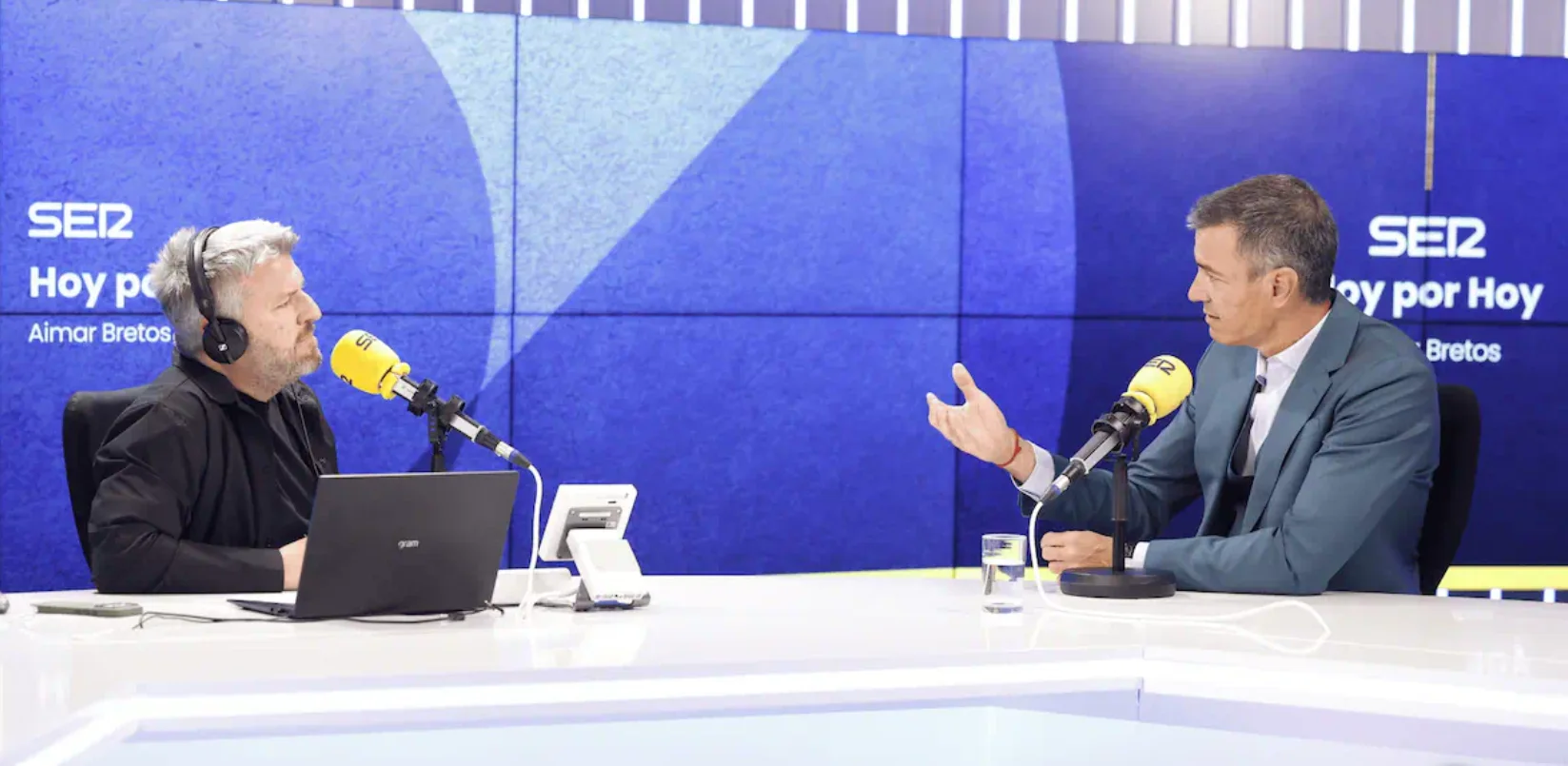
Spanish Prime Minister Pedro Sánchez on Monday accused Russia and Israel of helping to spread and amplify disinformation during the migration crisis that hit the North African enclave of Ceuta at the end of July, citing a study by the European Union’s External Action Service. In an interview with Spain’s Cadena SER radio, Sánchez said that false narratives began to circulate on social media after July 30 and 31, and that they were promoted by networks linked to Moscow, Tel Aviv and the international far right. “Rumors and false information began, after July 30 and 31, to circulate on social media networks linked to Russia and Israel, as well as to the international far right, which always uses migration not only to attack Spain, but also to attack Europe and sow division within it,” he said. He described the disinformation campaign as a deliberate attempt to destabilize his government at a moment of maximum pressure on Spain’s southern border. The prime minister said the EU study provided evidence of coordinated amplification, including the use of fake accounts, bots and high-profile profiles to push misleading claims about the situation in Ceuta. His comments highlight the growing concern among European leaders about the use of migration as a political weapon by foreign adversaries. Sánchez’s accusation comes at a time when Madrid’s relations with both Russia and Israel are at one of their lowest points, due to Spain’s support for Ukraine and its fierce criticism of Israel’s military campaign in Gaza. He also said that the same disinformation techniques were being used in other European countries, and that Spain would not be intimidated. “We know how these campaigns work,” Sánchez said. “They look for moments of vulnerability and try to turn a border management challenge into a crisis of institutional confidence.” The prime minister added that Spain was cooperating with EU institutions and allied intelligence services to identify the origin of the disinformation and to strengthen defenses against future attacks. He warned that without a coordinated European response, the same tactic would be used again. “This is not just about Spain,” he said. “The aim is to weaken the European Union and its member states.” The decision to go public with the accusation, rather than simply passing the study to European authorities, underscores the seriousness with which Madrid views the threat.
Sánchez was specific about the timing and targets of the disinformation. He said the surge of false and inflammatory content began immediately after July 30 and 31, when Ceuta saw a sharp increase in irregular entries from the Moroccan side. The epidemic of rumors, manipulated videos and fabricated social media posts was aimed, in his words, at “attacking Spain” and “sowing division” in Europe. He said the far right had joined in by using migration-related panic to push its own political agenda. However, he also sought to close off one line of speculation: Morocco. The Spanish prime minister stressed that there was no information linking Moroccan authorities to the outbreak of the crisis. He said Spain’s security and intelligence services had found no evidence that would raise “the slightest doubt” about possible Moroccan involvement in the mass influx of migrants. That statement is significant because Spain and Morocco have a complicated history on migration, and because Moroccan authorities have in previous episodes been accused of using border crossings as leverage in diplomatic disputes. Sánchez said investigations into the circumstances surrounding the crisis were still ongoing, but that the focus was on the rumors and false information that circulated online, especially after Spain’s Supreme Court barred the immediate return of migrants who had entered Ceuta by swimming. That court ruling, he said, provided an opportunity for “criminal organizations” and political actors to exploit the situation and create a false picture of chaos and vulnerability. The legal setback removed a key element of the government’s rapid-response mechanism and was immediately seized upon by political opponents and disinformation networks, Sánchez suggested. “The ruling was legitimate, but it created a legal vacuum that criminal organizations tried to fill,” he said. He accused people-smuggling networks of spreading false information about where migrants could enter, what would happen to them, and how easily they could remain in Spain. The prime minister said the combination of a court-imposed legal gap, a massive influx of migrants and a coordinated disinformation campaign created an “ideal storm” that his government had to confront on several fronts at once. He said the crisis had been managed, but its political consequences were still being felt. Right-wing opposition leaders had quickly demanded exceptional measures, while human rights organizations warned against a violent response, and in that charged atmosphere, Sánchez insisted, false information found fertile ground.
The accusations against Russia and Israel cannot be separated from the wider diplomatic context. Since Pedro Sánchez came to power, Spain has been one of the most vocal critics of the Israeli government’s policies. Madrid has repeatedly condemned the high civilian death toll in Gaza, backed Palestinian statehood, and pushed within the European Union for a review of the EU-Israel Association Agreement, the pact that governs trade and political cooperation. Sánchez has said that if the EU believes Israel is violating human rights in Gaza, it cannot continue business as usual. That stance has put Spain at odds not only with Israel but also with several other EU members. Relations with Moscow have also been tense because of Spain’s strong support for Ukraine after Russia’s full-scale invasion. Spain has supplied weapons and humanitarian aid to Kyiv, participated in NATO’s eastern flank deployments and supported EU sanctions against Russia. The Kremlin, for its part, has repeatedly accused Spain and other EU countries of being puppets of Washington. Sánchez’s claim that Russian-linked networks helped amplify the Ceuta disinformation follows numerous warnings from EU officials about Moscow waging a “hybrid war” against the West, using migration as a tool. The enormous power of social media to spread false narratives across borders makes it difficult to verify who is behind any particular post, but Sánchez said the EU study gave him enough confidence to name Russia and Israel publicly. His decision to single out Israel is especially significant, as it deepens a feud that has already moved beyond words. In recent months, Spain has become, in the eyes of many observers, the European government most hostile to Israel’s military operations, and this accusation is likely to be seen in Tel Aviv as another deliberately provocative act rather than a measured diplomatic statement. At the same time, Sánchez may calculate that the accusation will be popular with his left-wing coalition allies and with a segment of Spanish society that has been deeply mobilized by events in Gaza. Spain has also assumed a leading role in EU debates on migration, and accusing external actors of weaponizing migration risks complicating that agenda, particularly with non-EU countries that Madrid needs as partners on border control.
Israel was quick to respond. Hours after the interview, Foreign Minister Gideon Sa’ar accused Sánchez of lying. “Prime Minister Pedro Sánchez is lying blatantly,” Sa’ar wrote on X. “In his interview today with Cadena SER, he lied again, surprisingly accusing Israel of spreading false information about the events in Ceuta. This is a blatant lie.” He added: “Continuing to spread defamatory lies will not divert attention from Sánchez’s shameful failure to manage his country’s affairs.” The sharp personal attack underlined the depth of the diplomatic rupture between Madrid and Tel Aviv. The relationship had already deteriorated sharply after Sánchez announced in September 2025 that Spain would not allow aircraft or ships carrying weapons linked to Israel to use Spanish airspace or territorial waters. The ban, which applied to stops and refueling for vessels and planes transporting arms shipments believed to be destined for Israel’s military, was condemned by Israel as a hostile act. Sa’ar responded at the time by announcing that several Spanish ministers from the radical left would be barred from entering Israel. The tit-for-tat measures turned a political disagreement into a full-blown diplomatic crisis. Sánchez’s latest accusation seems likely to deepen the rupture. For Israel, the claim that it would engage in disinformation against Spain was absurd and dangerous. For Spain, the denial fitted a pattern of aggressive responses from Israel to any criticism. The exchange also exposed how the Gaza conflict is now contaminating bilateral relations in a way that goes far beyond diplomatic statements. Israel maintains that its campaign in Gaza is an act of self-defense and has repeatedly rejected accusations of disproportionate force, describing them as biased and politically motivated. That view makes Sánchez’s latest remarks even more explosive, as they touch not only on policy but on the credibility of the Israeli state itself. Sa’ar’s language suggested that the relationship has moved beyond normal diplomatic disagreement and into open personal hostility. Neither he nor any other Israeli official gave any indication that Israel would attempt to repair the relationship in the near term, and the use of the word “again” in his post indicated that previous Spanish accusations were still fresh in the minds of Israeli leaders.
The implications of Sánchez’s remarks go well beyond a bilateral dispute. By citing an EU study, he was effectively arguing that disinformation surrounding Ceuta was not random online chatter but a coordinated operation linked to foreign states. That aligns with a broader EU narrative about foreign interference, especially from Russia, in the run-up to elections across Europe. It also raises questions about the role of Israel, a usually unexpected actor in such accusations. Sánchez’s claim may have surprised many, but it reflects the degree to which the Gaza war has transformed Spain’s political discourse. Domestically, the crisis in Ceuta has become ammunition for the right-wing opposition and the far-right Vox party, which have accused Sánchez of having a weak border policy and of relying on Moroccan cooperation. By blaming foreign disinformation, Sánchez is seeking to shift the debate away from migration management and toward national security and European resilience. That strategy has worked before in other countries, but it carries risks. If his government cannot provide sufficient evidence for the accusation against Israel, he could be accused of inventing a foreign threat for domestic reasons. On the other hand, if the EU study is made public and contains concrete examples, the focus could shift to the platforms that allowed the disinformation to spread. The crisis has already triggered a debate about Spain’s ability to protect its borders while respecting legal constraints imposed by the courts. The EU has increasingly called for new legislation to prevent foreign interference, and Sánchez is likely to use this episode to support those calls. The EU has also been developing a “toolkit” to counter foreign interference, including sanctions against individuals and entities involved in disinformation operations. Should the Ceuta case be linked to such an operation, it could become one of the first practical applications of that toolkit, giving Sánchez a way to transform a domestic embarrassment into a European success story. His explicit clearing of Morocco is also important: it removes a potential source of conflict with Rabat at a delicate moment in bilateral relations. Spain has depended on Moroccan cooperation to reduce irregular migration, and any accusation of deliberate weaponization by Morocco would have destroyed that cooperation. By stating that no evidence implicated Morocco, Sánchez both reassured Rabat and insulated his government from a diplomatic rupture in a vital area.
The coming weeks are likely to bring further attempts to clarify what happened in Ceuta and who was behind the disinformation. Sánchez said the investigation is ongoing, but he did not say when or whether the EU study would be released in full. His office did not immediately respond to Israeli requests for a retraction, and no further details were given about the alleged Israeli role. The episode has nonetheless deepened the already severe tensions between Spain and Israel, with little immediate prospect of reconciliation. It has also highlighted the extent to which migration crises in Europe are now fought as much online as on the ground. False narratives, manipulated videos and foreign amplification are becoming a standard feature of border incidents, and governments are increasingly willing to point fingers at external actors. For Spain, the Ceuta crisis was a warning: a single event can be transformed by disinformation into a political emergency that shakes a government. Whether Sánchez’s accusations hold up under scrutiny will be crucial. If they do, the crisis will be remembered as an example of foreign hybrid interference. If not, it may become another chapter in the bitter feud between Madrid and Israel—and a lesson in the dangers of securitizing migration narratives. For ordinary Spaniards, the accusation may also seem like another sign that foreign powers are meddling in their country’s internal affairs. In recent years, Spain has seen disinformation campaigns around Catalonia, around electoral processes and around the COVID-19 pandemic; the Ceuta affair fits into that pattern. But because it involves Israel, it also carries a strong domestic political charge, given the bitter polarization over the Middle East in Spanish public debate. Either way, the affair has already moved far beyond the beaches of Ceuta, into the murky world of intelligence services, social media manipulation and inter-state rivalry. The coming days will show whether Madrid is willing to produce the evidence behind its public claim, or whether this becomes yet another rhetorical battle in a war of accusations that no longer has an easy off-ramp.