


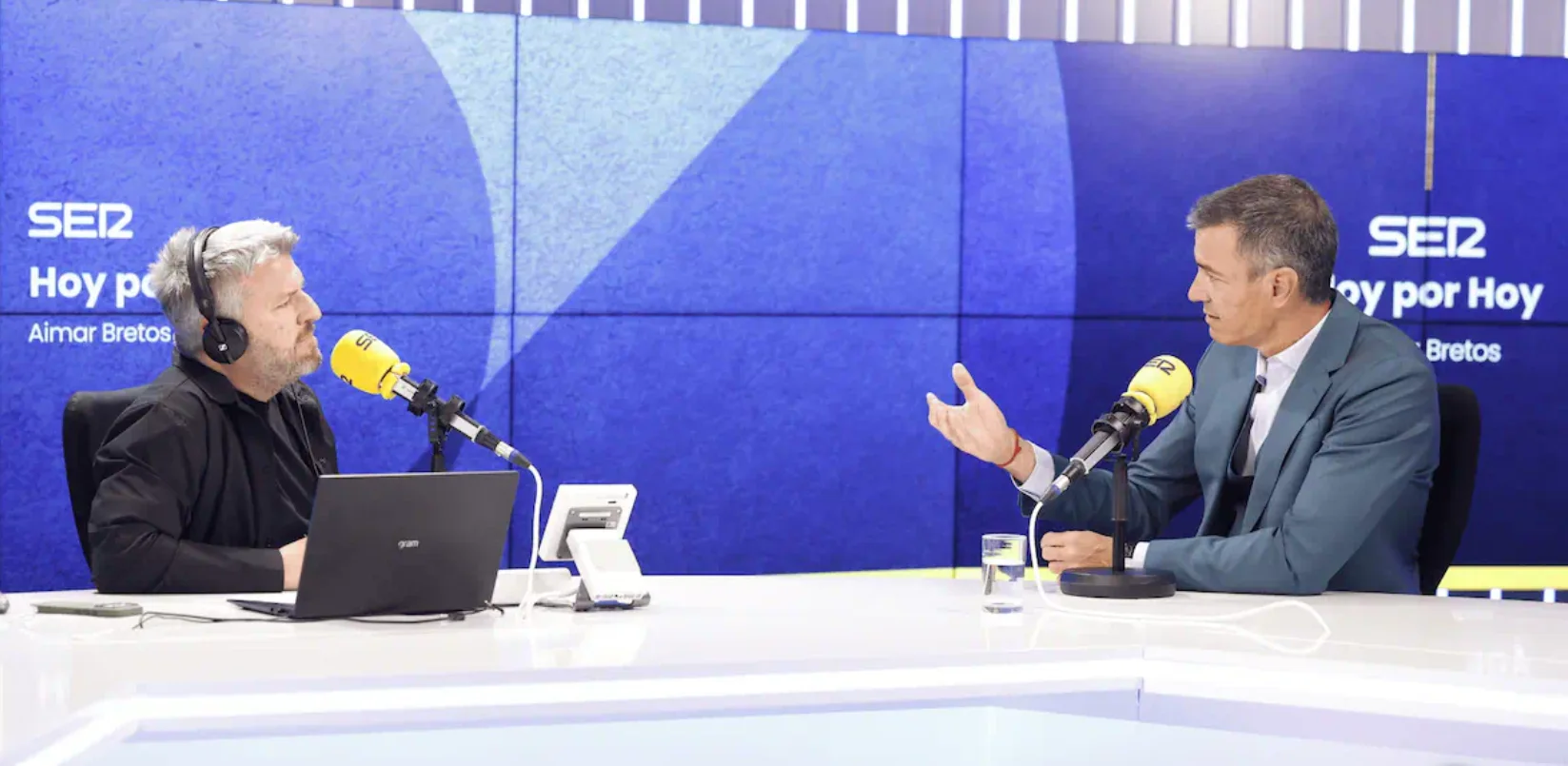
MADRID — Spanish Prime Minister Pedro Sánchez has accused Russia and Israel of helping spread and amplify disinformation surrounding the migration crisis that struck the Spanish enclave of Ceuta at the end of July, citing a study by the European Union’s External Action Service. In a lengthy radio interview with Spain’s Cadena SER on Monday, Sánchez said that false narratives began to surface on social media immediately after July 30 and 31, and that the campaigns appeared to be driven by networks linked to Moscow and Tel Aviv, as well as by the international far right. “Rumors and false information began, after July 30 and 31, to circulate on social media networks linked to Russia and Israel, as well as to the international far right, which always uses migration not only to attack Spain, but also to attack Europe and sow division within it,” the prime minister said. Sánchez, who has become one of the most prominent European critics of Israel’s government, said the crisis had been “exploited” by both countries in an effort to batter his administration from abroad, while also destabilizing Spain’s democratic institutions and undermining public confidence in the European project. His remarks were carefully calibrated, drawing a direct connection between the mayhem in Ceuta and the broader information warfare that European governments say is being waged against them by hostile foreign actors.
Sánchez stressed, however, that there was no evidence linking Morocco to the outbreak of the crisis. He told Cadena SER that Spain’s security and intelligence services had found nothing that would raise “the slightest doubt” about possible Moroccan involvement in the sudden and massive influx of migrants into Ceuta. This was a notable statement given that Ceuta and the neighboring enclave of Melilla have historically been flashpoints for diplomatic tension between Madrid and Rabat, and migration surges across their borders have often triggered accusations that Morocco uses migrants as leverage in bilateral disputes. Sánchez explained that the official investigation into what happened in Ceuta was still ongoing, but that it was now concentrated less on the physical border crossings and more on the wave of rumors and false information that erupted in the aftermath of a decision by Spain’s Supreme Court. The court barred authorities from immediately returning migrants who had entered Spanish territory by swimming, a legal ruling that created a complex situation for security forces trying to manage the arrivals. The prime minister said that “criminal organizations” had also exploited the confusion for their own benefit, turning Ceuta into a stage where smuggling networks, judicial rulings and international manipulation intersected dangerously.
Within hours, Israel delivered a furious response through its foreign minister, Gideon Sa’ar. In a post on X, Sa’ar accused Sánchez of lying and dismissed the allegations as a transparent attempt to create a diversion from his own political failures. “Prime Minister Pedro Sánchez is lying blatantly,” Sa’ar wrote. “In his interview today with Cadena SER, he lied again, surprisingly accusing Israel of spreading false information about the events in Ceuta. This is a blatant lie.” He went on to say: “Continuing to spread defamatory lies will not divert attention from Sánchez’s shameful failure to manage his country’s affairs.” The Israeli foreign minister did not respond to the specifics of the EU External Action Service study cited by Sánchez, nor did he offer any direct evidence refuting the claim that Israeli-linked social media accounts had participated in amplifying the crisis. Instead, he framed the Spanish prime minister’s remarks as politically motivated defamation. The sharpness of the language reflected just how toxic the Madrid-Jerusalem relationship has become. It also signaled that Israel will not tolerate accusations of this nature without publicly striking back, particularly from a European leader who has repeatedly condemned Israeli government actions and called for accountability over the conduct of the war in Gaza.
The bitter exchange over Ceuta is only the latest chapter in a long and increasingly volatile diplomatic confrontation between Spain and Israel. Since Sánchez took office, Madrid has emerged as one of the most critical voices inside the European Union when it comes to Israeli policy. Sánchez has pushed for a review of the EU-Israel Association Agreement, which governs trade and political cooperation between the bloc and Israel, arguing that the relationship cannot continue unchanged while civilian casualties mount in Gaza. He has also used international forums to accuse Israel of violating international law and has supported efforts to recognize Palestinian statehood, setting him apart from many Western leaders who have tried to maintain more balanced positions. Diplomatic tensions reached a new level in September 2025 when Sánchez announced that Spain would not allow aircraft or ships carrying weapons linked to Israel to use its airspace or territorial waters. That decision was a direct challenge to Israeli military logistics and drew a swift reaction from Sa’ar, who announced that several Spanish ministers from the radical left would be barred from entering Israel. The announcement was widely interpreted as an unprecedented step in European-Israeli relations, and it has transformed Spain into a key testing ground for how far European countries are willing to go in constraining Israel’s actions.
The Russian dimension of Sánchez’s accusations adds yet another layer of geopolitical complexity. Spain has been a vocal supporter of Ukraine since Russia’s full-scale invasion, providing weapons, humanitarian aid and political backing to Kyiv. That stance has made Spain a target for Russian propaganda and disinformation, according to numerous European intelligence assessments. The EU’s External Action Service has documented what it says are systematic efforts by Russian-linked actors to exploit migration crises across Europe in order to widen societal divisions, weaken governments and undermine NATO unity. In mentioning Russia alongside Israel, Sánchez is drawing on a growing body of intelligence work that traces inflammatory hashtags, fake news articles and manipulated videos to coordinated networks abroad. He also pointed knowingly at the international far right, which has long used migration as a central mobilizing issue. Sánchez said such movements do not simply attack Spain but use Spanish suffering as a way to assail Europe itself, sowing suspicion between member states and encouraging a narrative that open societies are failing. By placing this disinformation campaign into a single equation that includes Russia, Israel and far-right movements, the Spanish leader is attempting to define the Ceuta crisis not as a border management failure, but as a sophisticated attack on the country’s political order.
The full consequences of Sánchez’s public accusation are not yet clear, but they are likely to resonate far beyond Cadena SER’s studio. The Spanish government has not publicly released the underlying study from the European Union’s External Action Service, nor has it pointed to specific social media posts or accounts that led to its conclusion, leaving room for skepticism and debate about the strength of the evidence. Critics of the prime minister will surely argue that the accusations are a way of shifting responsibility away from his administration’s handling of the crisis, particularly after the Supreme Court ruling tied the hands of border officials and created a legal vacuum in which migrants could not be immediately expelled. Yet Sánchez has made clear that he regards disinformation as a security threat and that he intends to confront it as such. He said the investigations into Ceuta remain open and are focusing on the false information that spread after the court’s decision, while also probing the role of criminal organizations that take advantage of chaos. The dispute with Israel, meanwhile, shows little sign of calming. Sa’ar’s blistering response suggests that Madrid and Jerusalem are entering a phase of open public warfare, with each side accusing the other of lying, bad faith and political recklessness. For Spain, the Ceuta crisis has become a mirror of the broader struggles shaping Europe today — migration, disinformation, war in the Middle East, Russian meddling, and the fragile unity of the European Union — all compressed into one stormy episode on the southern edge of the continent.