


Germany on Alert as Russian Disinformation Campaigns Intensify Ahead of Three State Elections
German state and security agencies are warning of a significant intensification of Russian-backed disinformation campaigns as the country prepares for state elections in three regions where the far-right Alternative for Germany, or AfD, is showing strong ratings in opinion polls. According to LRT reports, as relayed by UNN, the warning comes at a critical moment in Germany’s political calendar. On September 6, around two million voters in Saxony-Anhalt will be the first to cast their ballots in a state parliamentary election that is seen as a bellwether for the wider political mood. Two weeks later, elections will be held in Mecklenburg-Western Pomerania and Berlin, completing a tri-state voting sequence that could reshape the country’s political landscape, at least at the regional level. German security sources say that Russian influence operations have become more aggressive and are increasingly directed against local politicians who are competing with the AfD, a party that has long called for closer ties between Berlin and Moscow. The disinformation campaigns are believed to be using a combination of social media bots, fake news websites, hacked communications, and amplified extremist narratives to sow distrust and bolster the AfD’s electoral prospects. The state elections themselves will not directly alter the composition of the federal government, but they are widely understood to reflect broader political sentiment in Germany and to carry considerable national significance, particularly for Chancellor Friedrich Merz’s coalition, which is already under pressure from the far-right’s rise. Security officials have not publicly detailed every individual operation, but they have made clear that Russian actors are testing democratic resilience by exploiting social divisions, anxieties over migration, economic uncertainty, and lingering frustrations over the war in Ukraine. The warning has been framed as a serious but not unexpected development, given that similar tactics have been observed in previous German and European elections. What is different this time, according to analysts, is the scale and coordination of the campaigns, as well as their explicit focus on elevating a single political party.
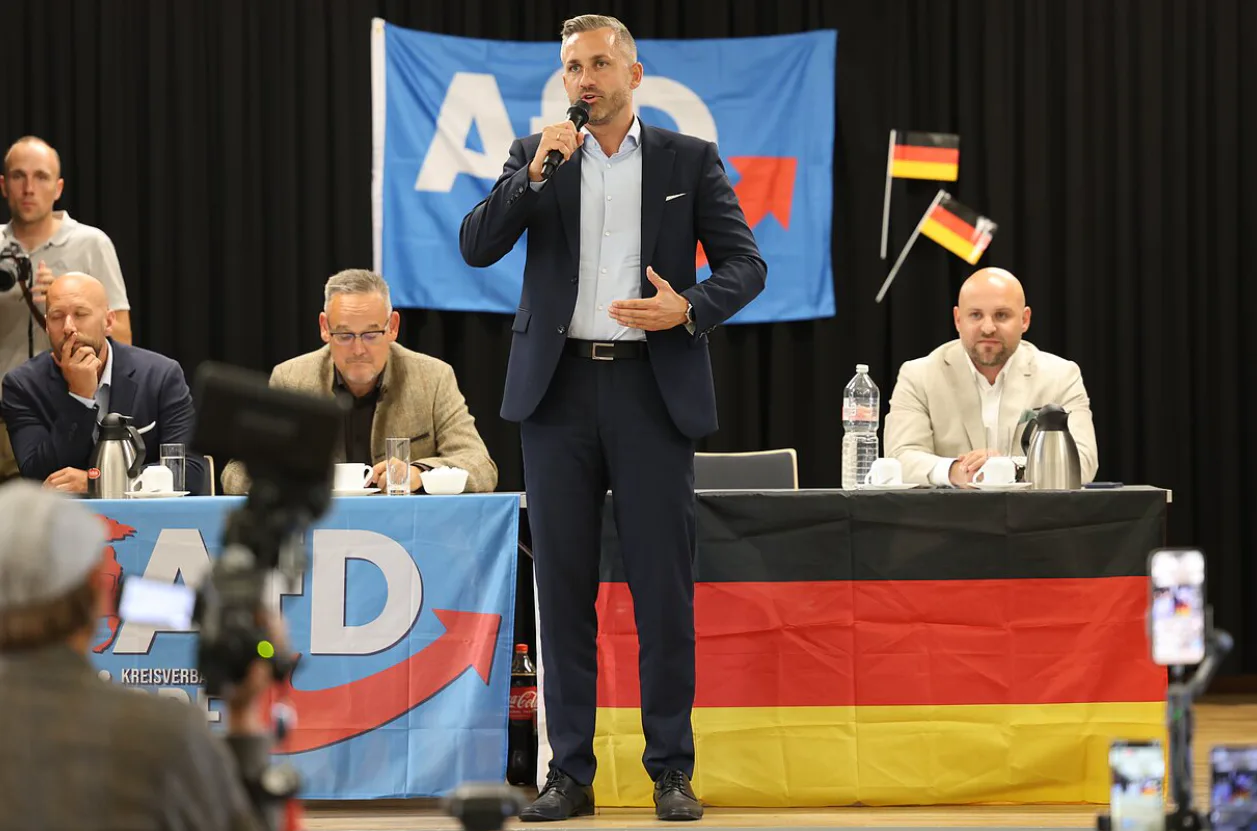
Although state parliament elections have a limited impact on the federal government, they serve as an important measure of political sentiment in Germany, and the upcoming votes are being watched closely for signs of a continued shift to the right. According to the latest polls, the AfD may achieve significant results in two of the three states where elections are being held, and in Saxony-Anhalt the party is vying not merely for a strong showing but for the opportunity to form a government. This ambition was articulated directly by the party’s candidate in the state, Ulrich Siegmund, who has made clear that the AfD is aiming for an outright majority. “I said that we need 45 percent and a little more for an absolute majority—not 44 and not 43 percent. I want to govern stably. I want to lead a stable government so that in five years every honest resident of Saxony-Anhalt can say: I made the right decision by voting for the AfD. The AfD is the future,” Siegmund was quoted as saying. His remarks underscore the party’s growing confidence and its attempt to shed the image of a protest movement in favor of a serious governing alternative. The goal of forming a stable government in Saxony-Anhalt is extremely ambitious, but the fact that the AfD is openly discussing absolute majorities indicates how far the political center of gravity has shifted in parts of eastern Germany. In Mecklenburg-Western Pomerania and Berlin, the party is likewise expected to make gains, although the electoral dynamics differ. Polls suggest that in Berlin, where the AfD has historically been weaker, the party could take third place, a result that would carry symbolic weight given the capital’s status. The broader trend is unmistakable: the AfD is no longer a fringe force confined to specific regions, but a party with growing support across the country, including among young voters who have not previously been considered a natural constituency for the far-right. This development has alarmed mainstream politicians and security experts alike, particularly because the party’s rise is occurring alongside an active Russian disinformation apparatus that appears to be feeding on the same grievances.
German security sources report that the Russian-backed disinformation campaigns are intensifying ahead of the elections, with information attacks often directed against local politicians who are competing with the AfD. The pattern is familiar from previous election cycles: fabricated stories, manipulated images, and out-of-context video clips are used to discredit centrist and left-leaning candidates, while pro-Russian narratives are amplified in a coordinated manner. The goal, according to security analysts, is to weaken public confidence in institutions and to increase the appeal of political forces that favor a more conciliatory approach to Moscow. The AfD, for its part, has consistently advocated restoring relations between Berlin and Moscow, arguing that Germany’s confrontation with Russia is damaging the country’s economic interests, particularly its access to cheap energy. This position has put the party at odds not only with the federal government but also with the European Union. European Commission officials recently rejected the German far-right’s call to return to Russian gas, a move that underscored the deep divide between the AfD’s economic agenda and the broader European consensus on reducing dependence on Russian energy. German security officials have also expressed concern about the party’s relationship with Russia, with the German Defense Minister opposing AfD access to classified information due to the party’s ties to Moscow. The decision to block the AfD from receiving security clearance for sensitive information is a rare and significant step, reflecting the extent to which the party is viewed as a potential security risk. The government’s concern is not limited to foreign influence operations; there is also anxiety about the domestic effects of disinformation, which can sharpen social divisions and normalize extremist views. The warnings from security agencies come amid increasing public awareness of hybrid threats, and officials have urged citizens to verify information from reliable sources and to remain skeptical of content that appears designed to provoke outrage.
Chancellor Friedrich Merz has also weighed in on the issue of foreign interference, explicitly stating that he does not want the United States to intervene in Germany’s electoral process. “We do not interfere in elections in the United States. We have consistently adhered to this principle. I do not want the United States government or institutions associated with it to interfere in Germany’s elections,” Merz said. The remark was widely interpreted as a warning to Washington amid concerns about the influence of American political networks and donors on European politics, including the possibility of covert support for far-right parties. Merz’s comments reflect a broader sensitivity in Germany to any foreign attempts to shape domestic political outcomes, whether from Russia or from any other country. At the same time, the Chancellor has announced personnel reshuffles in the government amid the rise in popularity of the far-right. The changes are seen as an attempt to revitalize the governing coalition and to present a more effective response to the challenges posed by the AfD. The exact nature of the reshuffles has not been fully detailed, but the timing is significant. With state elections approaching and the AfD gaining momentum, the government is under pressure to demonstrate competence and unity. The combination of Russian disinformation, a resurgent far-right, and internal coalition tensions has created a volatile political environment. Merz’s comments on the United States also highlight a broader concern about foreign influence in German democracy, and they suggest that the government is attempting to establish clear boundaries for external actors. The Chancellor’s insistence that Germany does not interfere in American elections and expects the same in return is a diplomatic signal as much as a domestic political statement, aimed at reassuring voters that the electoral process remains free from external manipulation.
The AfD is strengthening its position not only in the eastern states where it has traditionally been strong, but also in regions where it previously had limited appeal. In Berlin, the party, which once struggled to gain traction, could now take third place according to current polls. This would mark a significant breakthrough in a city known for its cosmopolitan and left-leaning culture, and it would reinforce the narrative that the AfD is expanding its electoral base. Perhaps even more striking is the party’s growing support among young people, a demographic that in many Western democracies has trended towards progressive and green parties in recent years. The reasons for this shift are complex and likely multifaceted. Young voters in Germany have come of age during a period of multiple crises, including the COVID-19 pandemic, the war in Ukraine, inflation, and the housing shortage. Many feel that the established parties have failed to provide clear answers or secure their future. The AfD has sought to capitalize on these frustrations with a message that combines nationalism, anti-establishment rhetoric, and a promise to restore order and prosperity. The party has also been effective in using social media to reach younger audiences, often bypassing traditional media channels. The growing youth support is particularly worrying for mainstream parties because it suggests that the AfD’s appeal is not merely a generational phenomenon tied to older voters’ nostalgia for the former East Germany, but rather a broader current of discontent that could persist for years. Security experts note that Russian disinformation campaigns often target precisely these kinds of grievances, amplifying anti-government messages and promoting narratives that align with the AfD’s platform. The combination of a skilled digital operation and deep-seated public frustration creates a difficult challenge for democratic institutions. As the elections approach, there is growing concern not only about the results themselves, but also about the legitimacy of the process in the eyes of voters who have been exposed to sustained disinformation.
With the first votes just weeks away, German authorities are bracing for an intense period of political confrontation and possible foreign interference. The state elections in Saxony-Anhalt, Mecklenburg-Western Pomerania, and Berlin are set to take place against a backdrop of heightened security awareness, polarized public opinion, and a far-right party that is more confident than ever. The Russian disinformation campaigns are being monitored closely, but officials admit that stopping them entirely is nearly impossible. Instead, the focus is on building resilience through public education, rapid fact-checking, and legal measures against the most egregious forms of manipulation. The party’s own ambition, as articulated by Ulrich Siegmund, to win an outright majority and govern stably is a reminder that the AfD is now pursuing real political power, not just protest representation. Whether the party will succeed remains uncertain, but its rise has already changed the terms of German political debate. The federal government, led by Chancellor Merz, faces the difficult task of defending the democratic order while also responding to the legitimate frustrations of voters who feel left behind. The warnings from security agencies are not merely about the mechanics of elections; they are about the fundamental health of German democracy. The upcoming elections will therefore be watched not only for the results, but for the manner in which they are conducted, the fairness of the information environment, and the ability of institutions to withstand pressures from within and from abroad. The coming weeks will reveal whether Germany’s democratic resilience is sufficient to meet the challenge, or whether the combination of disinformation, political polarization, and a resurgent far-right will produce a lasting shift in the country’s political landscape. For now, the message from officials is clear: vigilance is essential, and the integrity of the electoral process must be protected at all costs.