


Proactive Disclosure, Not Citizen Fact-Checking Alone, Is Key to Fighting Disinformation — Lagos Stakeholders
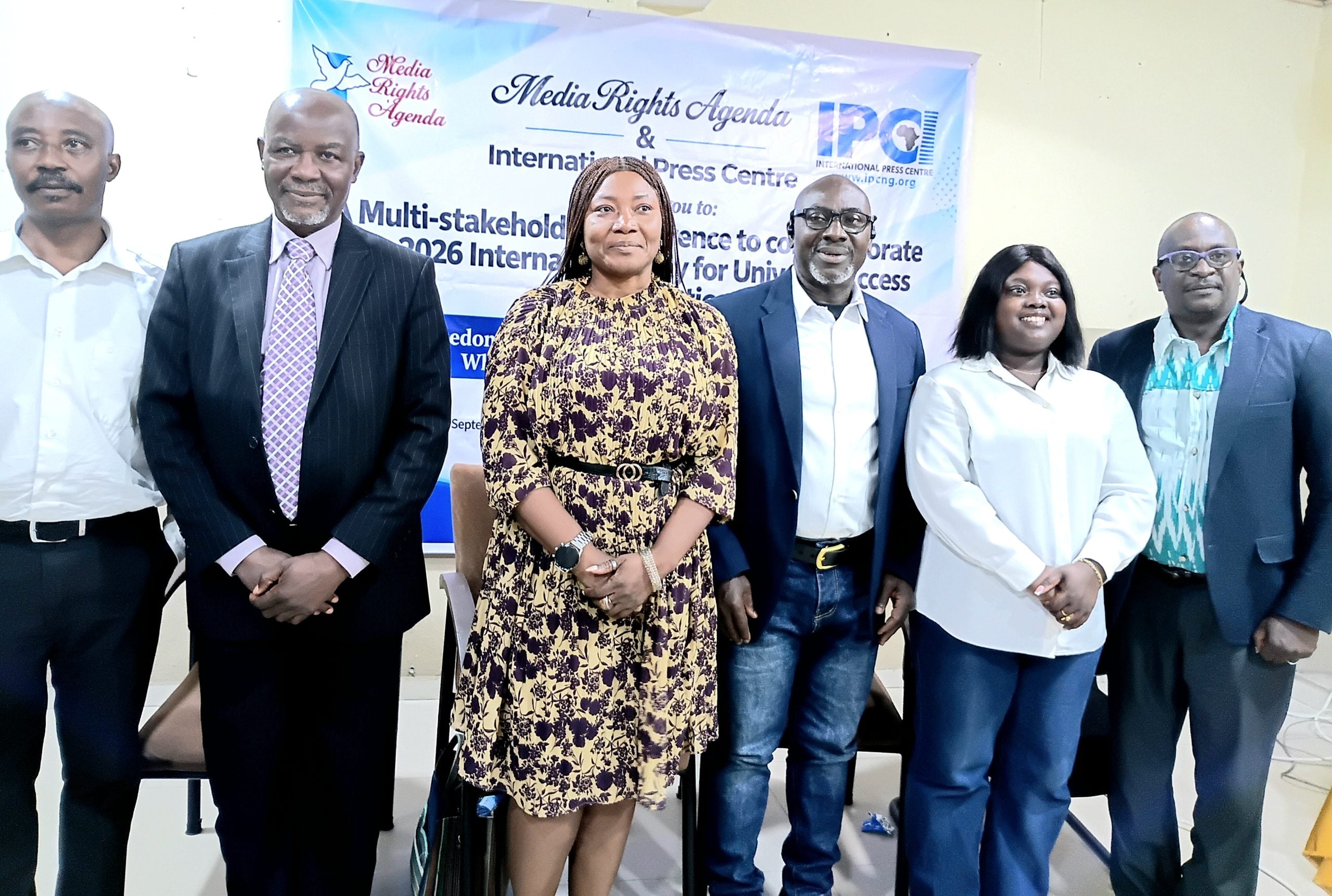
Lagos, Nigeria — Public institutions in Nigeria must urgently abandon a culture of systemic secrecy and prioritise proactive disclosure of official information if the country is to effectively combat the growing menace of misinformation and disinformation, stakeholders have declared. Speaking at a high-level conference organised by the Media Rights Agenda (MRA) in collaboration with the International Press Centre (IPC) to mark the 2026 International Day for Universal Access to Information (IDUAI), participants issued a resounding call for transparency, warning that the continued opacity of government agencies is eroding public trust and creating fertile ground for false narratives to flourish. The forum, held in Lagos under the theme, “Freedom of Information in the Age of Disinformation: Why Transparency Matters More Than Ever,” brought together a broad spectrum of actors, including journalists, legal practitioners, civil society organisations, and policy advocates, all of whom expressed deep concern over the poor state of compliance with Nigeria’s Freedom of Information (FOI) Act, 2011. The overarching message from the gathering was clear: without bold structural reforms and firm enforcement of the law, the country’s democratic project will remain dangerously vulnerable to the weaponisation of falsehood. The stakeholders argued that public institutions cannot afford to behave as if transparency is optional, especially in an era where the digital ecosystem enables lies to travel faster and farther than the truth. They insisted that access to reliable, official and verifiable information is not just a legal requirement but a fundamental civic right that underpins good governance, accountability and national cohesion. The conference also underscored the urgency of treating the FOI Act as an operational tool for empowerment, rather than a dead letter confined to lawyer’s briefs and occasional news reports.
In his keynote address, Lanre Arogundade, the Executive Director of the International Press Centre, stressed that fighting fake news and disinformation requires far more than merely encouraging citizens to fact-check suspicious content. He emphasised that the burden of proof and credibility lies primarily with public institutions, which have a constitutional duty to provide citizens with timely, accurate and comprehensive information about government plans, policies, expenditure and decisions. Arogundade argued that when government records are hidden, delayed, or deliberately distorted, a vacuum is created and into that vacuum rush rumour, propaganda, and coordinated disinformation networks. He said that transparency, exercised proactively, serves as the most potent systemic antidote to the confusion and cynicism that bad actors exploit to destabilise democracies. According to him, public institutions are not doing citizens a favour by releasing information they are obliged by law to disclose; rather, they are fulfilling a duty that is central to democratic accountability and social trust. He further asserted that the FOI Act is not merely about responding to requests from journalists, but about creating a culture in which official information is seen as a public asset, not a government secret. Arogundade’s remarks set the tone for a conference that was both reflective and combative, challenging all stakeholders to move beyond rhetoric and confront the structural failures that continue to impede access to information in Nigeria. He called on the media and civil society to be more assertive in using the law, warning that silence in the face of institutional obstruction only strengthens the forces of misinformation.
The conference participants, comprising journalists, lawyers, academics, and representatives of civil society organisations (CSOs), voiced alarm over the many tactics routinely deployed by government agencies to frustrate the implementation of the FOI Act. They noted that many public agencies deny requests without any legal basis, sometimes simply ignoring the law’s mandatory timelines, while others fail to establish the internal mechanisms needed to process information requests in good faith. Participants highlighted the widespread disregard for the proactive disclosure provisions of the FOI Act, which require public institutions to publish certain categories of information even without a formal request. They observed that the failure to comply with these provisions has made it impossible for ordinary Nigerians to access budgets, procurement records, contracts, attendance lists of public officers, and other documents that are essential for monitoring government performance. The conference also drew attention to the problem of institutional impunity, where officials who violate the law face no consequences, as well as the significant gender gap in access to information, which leaves women and other underserved groups without access to the very data that could help them navigate public services, claim their rights, and participate meaningfully in civic life. Participants noted that this exclusion is not accidental but is often the result of structural barriers, poor digital literacy, and an official culture that fails to design information systems with marginalised groups in mind. They also lamented that delays, when information is eventually provided, are often so lengthy as to render otherwise valuable data useless for investigative reporting or evidence-based advocacy. According to the attendees, these frustrations are not isolated incidents but are symptoms of a broader political culture that treats information as a commodity for the privileged rather than a right for all citizens.
In response to these bottlenecks, delegates at the Lagos conference resolved to take more aggressive and coordinated action to reclaim the promise of the FOI Act. Chief among the resolutions was a decision to launch coordinated legal actions against public institutions that wrongfully deny access to information or fail to respond to legitimate requests. Delegates argued that court action is no longer a last resort but a necessary and urgent instrument for establishing precedent and compelling compliance. They further charged media houses and civil society organisations with the task of building broad-based coalitions that can leverage the FOI Act not only for investigating corruption and abuse of office, but also for systematically tracking state expenditure at federal, state and local government levels. Such coalitions, they said, should collaborate on datasets, share information, and publish the findings of their investigations in formats that are easily accessible to ordinary citizens. The conference also resolved that journalists must be trained not merely to file FOI requests, but to frame those requests strategically, follow up rigorously, and use the courts to force disclosure when administrative channels fail. Participants urged the media to invest more in data journalism and in-depth reporting that uses official records as a basis for accountability stories, arguing that the public is less likely to fall for disinformation when there is a steady stream of verifiable, evidence-based journalism. The delegates likewise affirmed their commitment to amplifying the voices of women, rural dwellers, and other marginalised groups in the campaign for open governance, ensuring that efforts to improve access to information do not inadvertently reinforce existing inequalities.
The conference also issued a series of targeted demands designed to rescue the transparency law from the brink of irrelevance. Chief among these demands was a call on the Attorney-General of the Federation (AGF) to enforce oversight of the FOI Act and issue strict, punitive directives against institutions and public officials who remain non-compliant. The participants insisted that there must be consequences for obstruction, and that the culture of impunity which has protected recalcitrant agencies cannot be dismantled without firm leadership from the justice ministry. They also demanded that the judiciary prioritise freedom of information matters, with expedited hearings and fast-tracked judgments in FOI lawsuits. Delegates noted that one of the major obstacles to effective use of the FOI Act is the slow pace of litigation, which allows public authorities to exhaust the time and resources of applicants through endless adjournments. Public institutions, the conference further declared, must establish dedicated Freedom of Information desks, staffed by trained officers who understand the law and are empowered to process requests promptly. In addition, institutions should digitalise their record-keeping systems and publish information in open, machine-readable formats that allow citizens, journalists, and civil society to analyse, compare and visualise official data. The National Orientation Agency (NOA) was also called upon to launch sustained public campaigns to educate citizens on their right to information, because, as participants pointed out, a law that the public does not know about cannot be effectively utilised. Such campaigns, they argued, should demystify the FOI process, explain the procedures for making requests, and empower ordinary Nigerians to demand accountability from public officials at every level.
Delegates concluded the conference with the firm conviction that timely access to verifiable official information remains the ultimate cornerstone of good governance. They argued that without access to reliable information, citizens are left to operate on rumour, suspicion, and fear, conditions that are ideal for the spread of disinformation and the erosion of democratic values. The forum’s closing declarations echoed the necessity of treating transparency as a precondition for every other social good, from public health and education to corruption prevention and national security. Participants acknowledged that the fight for open information is not a short-term campaign but a sustained project requiring courage, creativity and collective pressure. They urged all stakeholders to continue the struggle beyond the conference halls, committing to monitor the implementation of the FOI Act, publish shadow assessments of institutional compliance, and hold public officers accountable — in the courts, through the media, and at the ballot box. As Nigeria joins the global community in commemorating the International Day for Universal Access to Information, the clear message from Lagos is that the future of democracy depends less on the sophistication of algorithms and more on the foundational principle that power belongs to the people, and that the people cannot rule without knowing. The conference ultimately reaffirmed that transparency is not a favour to be granted by those in power, but a right that citizens must assert — and that public institutions, by every law and moral obligation, must respect.