


(TNND) — A new Pew Research Center study from the Pew-Knight Initiative reveals a deeply ambivalent American relationship with press freedom: broad and bipartisan support for the First Amendment ideal, but a striking willingness to accept government censorship in specific circumstances. Overall, 73% of Americans say freedom of the press is “very” or “extremely” important to the well-being of society, and majorities of both political parties agree. However, that support is not absolute. Just over half of Americans — including 59% of Republicans and 45% of Democrats — say it is acceptable for the government to demand that a news organization take down a story if it contains false information. Even more, 60% of Americans overall — including 72% of Republicans and 50% of Democrats — approve of government demands to remove a story that poses a risk to national security. The findings expose a tension at the heart of American civic culture: citizens cherish the watchdog role of the press, yet many also distrust the information ecosystem enough to accept a government role in policing it. The study, conducted by the Pew-Knight Initiative, comes amid renewed debates over journalism’s credibility, the power of social media platforms, and former President Donald Trump’s open hostility toward mainstream media. It suggests that support for the First Amendment is not a simple matter of principle but a politically and morally complicated judgment, one that varies based on what content is being published, who is harmed, and which party controls the government. The results also highlight how far public opinion has moved from the absolutist “no prior restraint” tradition of American jurisprudence, which generally holds that the government cannot stop publication in advance, even if it can punish certain coverage afterward. That tradition was established decades ago in landmark Supreme Court cases, but the new survey suggests many Americans may see such protections as less important than the perceived dangers of misinformation and security leaks.
Peter Loge, director of the School of Media and Public Affairs at George Washington University, said the findings reflect a common-sense view among most Americans that there should be some legitimate restrictions on a free press. Drawing on the famous analogy used by Justice Oliver Wendell Holmes, Loge said that just as one cannot “falsely yell fire in a crowded movie theater” and expect constitutional protection, “most Americans would agree for some national security purposes, there’s some things best left unsaid, or at least unsaid in the moment.” Loge stressed that journalists have ethical responsibilities to avoid harm, tell the truth, and strive for fairness, and those professional obligations should guide coverage in sensitive areas. But he was careful to draw a bright line between voluntary journalistic restraint and government compulsion. “I may not love all journalists policing themselves,” Loge said. “I really loathe the government trying to police journalists.” That distinction is central to the debate the Pew study illuminates. It is one thing for news organizations to exercise editorial judgment; it is another for public officials to decide what constitutes false information, what qualifies as a national security risk, or what “harm” justifies suppressing a report. Many press freedom advocates worry that even well-intentioned censorship rules would quickly become tools for political self-protection, allowing elected leaders to silence reporting that is merely embarrassing, inconvenient, or critical. The survey suggests that public opinion is divided along these very lines: people generally favor press freedom in the abstract, but when presented with concrete scenarios involving false claims or security threats, they often side with the government. That gap between principle and practice is not new, but the Pew-Knight data shows just how wide it has become in an era of viral misinformation, foreign disinformation campaigns, and intense partisan polarization.
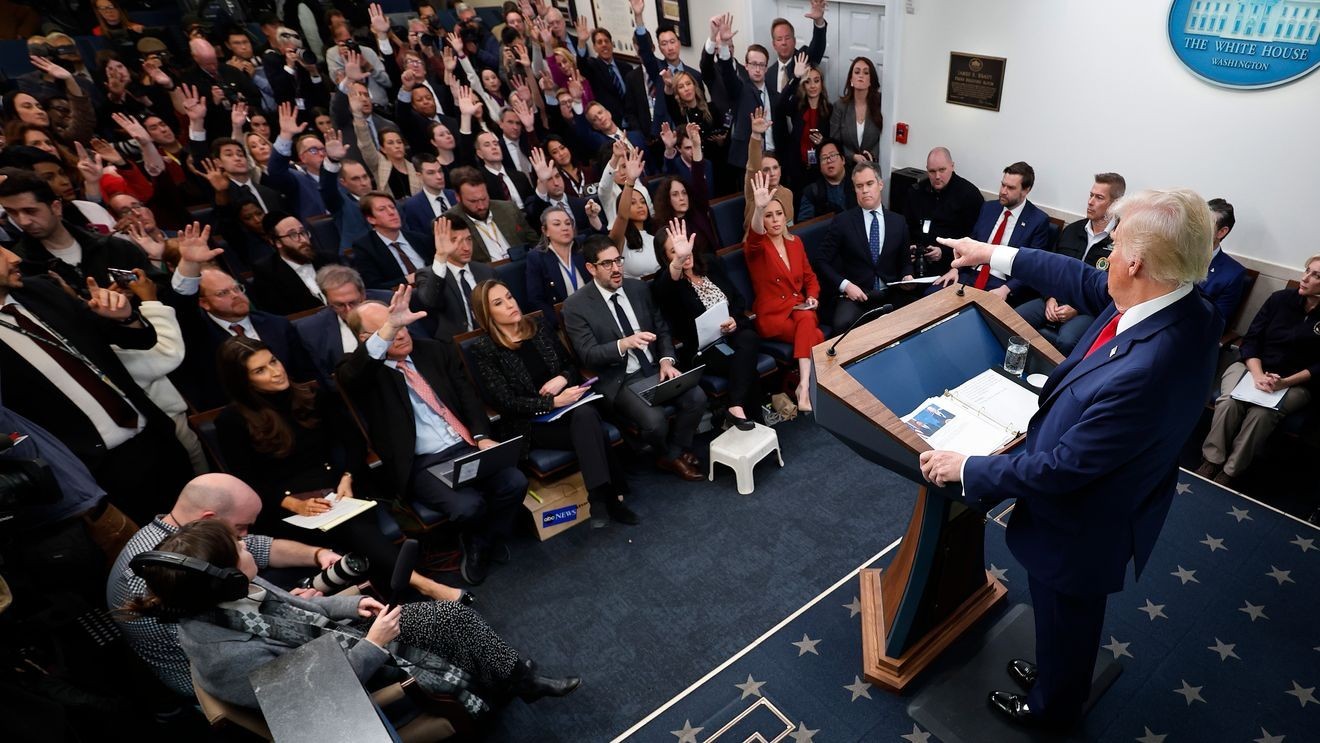
The study also found that perceptions of press freedom itself have become sharply polarized. More than four in 10 Americans told Pew Research Center that the press has become less free during the second Trump administration. That view was held by only 15% of Republicans but by a striking 72% of Democrats. Loge said such partisan views are heavily shaped by President Trump’s own rhetoric and by the broader political environment. “Too often, this president has said the reporters or journalists are enemies of the American people — typically, when those reporters or journalists say things the president doesn’t like,” Loge said. “That’s remarkably dangerous. The president can say, ‘I disagree with this reporter, I don’t like that point of view.’ But they should always embrace a robust and open debate. Our democracy demands no less.” Loge’s comments speak to a broader concern among media scholars and civil liberties advocates: when political leaders use their platforms to delegitimize journalism, public trust erodes, and the informational foundation of democracy is weakened. The Pew data indicates that trust has indeed eroded, but not evenly. Democrats and Republicans appear to be living in different informational realities, with different anxieties and different expectations about what the press should do. For Democrats, the primary concern is direct government restrictions on media independence, such as subpoenas, license revocations, or administrative pressure aimed at punishing critical outlets. For Republicans, the primary concern is the accuracy and fairness of journalism itself, especially the perception that news organizations control what stories people see and suppress stories that would reflect badly on liberal causes. The Pew-Knight study found that 28% of Americans say the media is completely free to report the news today, while 46% say they are extremely or very worried about potential restrictions on press freedom. Those numbers suggest a wary public, one that sees both threats from the government and threats from the media industry itself.
Partisan differences in the new research are particularly striking when it comes to what worries Americans most about press freedom. The Pew Research Center said Democrats tend to worry about direct government restrictions, including the possibility of journalists being punished for critical coverage or news outlets being forced to reveal confidential sources. Republicans, meanwhile, often express concerns about false information and the role of news organizations, including their gatekeeping power over what news people see. This asymmetry helps explain why the two parties answer censorship questions so differently. If a Democrat hears “government demands removal of a story,” they may imagine a Trump-appointed official suppressing an investigation into corruption. If a Republican hears the same phrase, they may imagine a liberal media outlet spreading a false accusation against a conservative figure, and they may welcome the correction. The survey results also show that a significant minority of Americans are open to more extreme forms of press regulation. Around 30% of Americans say it is at least sometimes acceptable for the government to force journalists to reveal the identities of unnamed governmental sources, and a similar share say it is at least sometimes acceptable for the government to take away a news organization’s license to broadcast. These findings are troubling to press advocates because journalist-source confidentiality is one of the core tools investigative reporters use to uncover official misconduct. Compelling disclosure of confidential sources can expose whistleblowers, deter future leakers, and make it impossible for journalists to verify sensitive claims about government activity. Likewise, license revocations are among the most severe punishments a government can impose on a broadcaster; they are equivalent to shutting down an outlet entirely. The fact that a third of Americans are willing to entertain such measures suggests that the traditional legal protections for press freedom are weaker in public opinion than in law. It also shows that the public is not particularly well-versed in how these protections operate in practice, since even the Supreme Court has recognized that the press needs substantial breathing room to conduct its work.
The Pew-Knight Initiative survey also explored the widespread belief that information is being deliberately withheld from the public. Around 80% of Americans said the government at least sometimes intentionally keeps important news from reaching the public, and a similar share said the same of news organizations. That finding is striking because it cuts across partisan lines: both Democrats and Republicans appear to believe that powerful institutions are manipulating the flow of information, even if they disagree about which institutions are most dangerous. It also points to a paradox in American public opinion. People distrust the government, yet many want the government to censor news. People distrust the media, yet many want the media to be free from government control. The result is a profound cynicism about both journalism and public institutions, combined with a desire for some neutral arbiter to ensure that the news is true and safe. Of course, the government is not a neutral arbiter; it is one of the primary subjects of news coverage and has its own interests in shaping public perception. Loge noted that freedom of the press is vital to American democracy, even if there are times when he believes journalists should exercise restraint in what they report for the greater good. “Democracy is an ongoing debate about what to do next,” Loge said. “You can only have an honest debate if you have all perspectives and all perspectives are represented.” That is the core argument in favor of a free press: that open competition among ideas, including false and dangerous ones, is ultimately preferable to a system in which the government decides what the public can see and hear. The Constitution’s framers did not make a bet that the press would always be truthful or responsible. They made a bet that a free press, with all its flaws, would be less dangerous than a controlled press.
Taken together, the Pew-Knight Initiative study paints a picture of a nation that still honors the concept of press freedom but is deeply unsure about how to handle the practical failures of journalism in the digital age. The overwhelming majority of Americans say the press is important to society, but fewer than three in ten believe the media is fully free today. A majority supports government intervention in cases involving false information and national security, while nearly half worry about restrictions going too far. These contradictory views are not necessarily a sign of intellectual confusion; they reflect the genuine difficulty of balancing competing values. Americans do not want their government deciding what is true in ordinary political debate, but they also do not want falsehoods to spread with impunity. They do not want national security secrets published recklessly, but they do want to be protected from government overreach. They are torn between the First Amendment and a desire for order, between their attachment to democratic ideals and their distrust of the institutions that publish news. As Loge points out, democracy requires an honest debate, and an honest debate requires all perspectives to be represented. That is exactly why press freedom is so important and so contested: in a free society, the arguments over what should be published are not decided by the state but by journalists, their audiences, and the broader culture. The Pew-Knight data suggests that Americans have not completely abandoned that idea, but they are willing to bend it when they feel threatened. The question for the coming years is whether that willingness will translate into actual policy, or whether the First Amendment will remain strong enough to withstand the very real anxieties that the survey reveals. The answer may depend on whether the press itself can restore the public’s confidence in its ability to tell the truth, and whether political leaders will stop treating journalism as an enemy rather than an essential pillar of democratic life.