




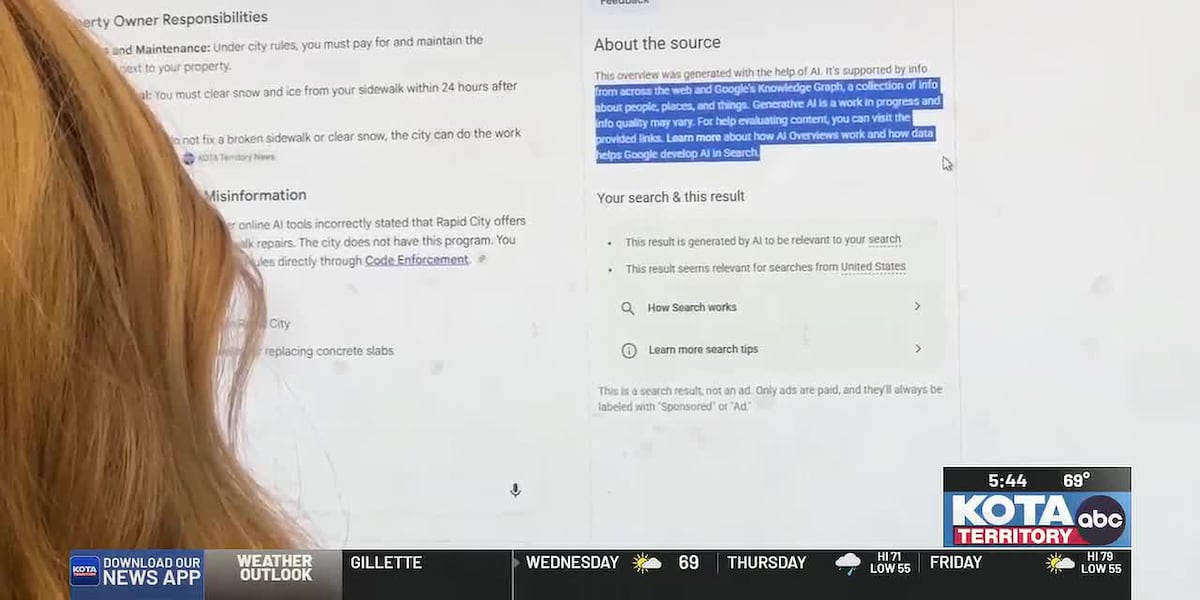
Rapid City officials are urging residents to exercise caution when relying on artificial intelligence-powered search tools, warning that AI-generated results can contain misinformation that appears authoritative but is factually wrong. The advisory, reported by KOTA Territory News, marks one of the first public safety-style announcements by a South Dakota municipality specifically targeting the rise of AI search summaries, which have become common on major internet search engines and digital assistants. City officials say they have observed residents arriving with confusion over city services, contact details, regulations, and event schedules after using AI to search for answers. The problem, they explain, is not that these tools are useless, but that they can present confident, articulate, and even well-cited-sounding answers that are entirely fabricated or based on obsolete records. In the age of instant information, the warning is meant to remind the public that convenience should not replace verification, especially when interacting with local government, where an incorrect answer could cost time, money, or even endanger public health and safety.
The most troubling aspect of AI search misinformation, according to Rapid City officials, is the phenomenon known as “hallucination,” where large language models generate plausible but false content. Unlike a traditional web search that returns a list of pages from actual sources, modern AI search tools often produce a synthesized paragraph summarizing results from many websites. That summary can mix accurate data with invented details, and because the output is delivered as a polished, authoritative answer, users may not realize they are being misled. Officials cited examples of AI results telling residents the wrong dates for recycling pickup, misstating the cost of building permits, and describing zoning rules that do not exist in Rapid City’s municipal code. More concerning, some AI-generated responses have directed residents to the wrong city department or provided a phone number that connects to a third-party business rather than city hall. The city has not released a comprehensive list of every error found, but the warning suggests these are not isolated incidents. Even simple queries such as “when is the fall leaf collection in Rapid City?” or “do I need a license for a garage sale?” have generated answers that contradict official city policy, requiring residents to check again with actual city staff.
The implications of this misinformation extend beyond minor irritations. If a resident relies on an AI search result to determine whether construction work requires a permit, they could face fines, stop-work orders, and legal trouble. If another trusts an AI-generated answer about voting locations or voter ID requirements, they may arrive at the wrong place or without necessary documentation and lose the chance to cast a ballot. Rapid City officials are especially concerned about emergency-related information. An AI search could tell a resident that burn permits are allowed during a drought, or that a local road is open when it is closed for flooding, or that the city’s emergency operations center has issued a warning that never actually existed. In a city that has experienced wildfire risk, severe winter storms, and flash flooding in recent years, the danger of acting on false information is substantial. The officials behind the KOTA report made clear that they do not consider AI to be an enemy; they believe these tools can assist with research and public education. But they insist that technology companies must be more transparent about the limitations of generated content, and that residents should treat AI search summaries as a starting point for discussion, not a final answer.
To address the problem, Rapid City officials have issued a clear set of guidelines for residents. City leadership advises that anyone seeking information about municipal services, permits, ordinances, taxes, schedules, or public meetings should go directly to the official City of Rapid City website, use the city’s official phone line, or visit city offices in person. The city has also pointed residents toward its verified social media accounts, which are managed by the communications department and clearly marked with blue checkmarks on major platforms. For those who still choose to use AI search engines, officials suggest asking the tool to provide a link to an official government source, then opening that link directly and reading the text on the government page itself. They also recommend comparing the AI summary with at least two independent official sources before acting on the information. If a fact appears on the city website but not in the AI answer, the city website should win. Officials warned that screenshots of AI responses are not acceptable documentation for permit applications or license requests, and city staff have been instructed to direct people to official records rather than entertain erroneous printouts. The city is also considering adding a public education page on its website that lists common myths generated by AI, though that project had not been finalized as of the KOTA report.
The role of local journalism in exposing and correcting this misinformation has become central to the story. KOTA Territory News, which first covered the Rapid City advisory, serves not only as a source of information but as a fact-checker for residents who may have been misled by AI-generated text. The news outlet’s decision to highlight the city’s warning gives the story a sense of urgency and legitimacy that official announcements alone might not achieve. Local reporters have also begun testing common AI prompts themselves, asking search engines for details about Rapid City government and comparing the answers with actual city records. In several of those tests, the AI provided partially or wholly inaccurate information, including wrong names for the mayor and city council members, outdated tax deadlines, and incorrect descriptions of public meeting procedures. These findings reinforce the city’s message and demonstrate that the problem is not hypothetical. News organizations in other parts of the state are following the story closely, and Rapid City’s warning may become a model for other municipalities in South Dakota. The broader lesson from the Rapid City case is that communities need local news outlets to build trust in official information, and that the presence of trustworthy, verifiable journalism is more important than ever in an era of machine-generated content.
Looking forward, Rapid City officials say they plan to contact AI companies directly to ask that their algorithms be corrected or updated to prevent the most egregious hallucinations from appearing in search results. Whether that will produce meaningful change remains unclear, since large technology companies generally do not guarantee accuracy in generative AI output. Some experts have suggested that municipalities adopt “official source” digital tags — metadata that search engines can theoretically use to prioritize verified government information over less reliable websites. Rapid City is exploring that possibility, but implementation is costly and requires technical expertise that small-city departments often lack. In the meantime, the city is urging residents to report any misinformation they encounter by forwarding a screenshot and a link to the city’s communications office, which will log the issue and respond with the correct information. Public education will continue through community meetings, newsletter inserts, and partnerships with KOTA and other local media. The city is not asking people to stop using AI, and it is not promising that every AI answer will ever be perfect. Instead, the message is simple: when it belongs to the City of Rapid City, do not trust a robot until you have checked with a human. The warning is a timely reminder not only for Rapid City residents but for anyone who relies on technology for everyday decisions — because the internet is no longer a library of documents but a place where machines can invent their own facts.