



The catastrophic flash floods that ravaged the mountainous border regions of Nepal and China, claiming over 600 lives and leaving nearly 2,500 people unaccounted for, have spawned a secondary, parallel crisis: a digital wildfire of misinformation that is actively obstructing rescue operations and exploiting grief-stricken families. As relief workers strain to dig through mudslides and rebuild shattered infrastructure, the Nepali government has taken the unprecedented step of formally confronting global tech giants Meta and TikTok, demanding urgent removal of fabricated content, fraudulent donation schemes, and graphic imagery that is psychologically traumatizing survivors and destabilizing the fragile humanitarian response. This dual-pronged disaster—physical and digital—highlights a disturbing new reality in the 21st century: lethal natural events are now almost immediately weaponized and distorted through algorithmic platforms, where artificial intelligence and viral manipulation outpace the slow, bureaucratic wheels of disaster management. The response from officials underscores a growing global frustration with the asymmetrical speed of technology—where deepfakes can be generated in seconds, but platform moderation takes precious hours of which they have none.
The urgency of the Nepali government’s request, which was formally communicated through representatives of Meta and TikTok in Kathmandu, stems from the catastrophic failure of current reporting mechanisms. Bijay Kumar Roy, the coordinator of the government’s social media regulation and management task force, explicitly detailed the operational bottlenecks during these high-stakes negotiations, revealing that the platforms currently take anywhere from 24 to 48 hours to respond to flagged posts—a latency that is criminally negligent during a mass-casualty event where millions of rupees in legitimate donations could be siphoned by fraudsters or where a single AI-generated viral rumor could cause panic and stampede in relief camps. The government did not merely request the takedown of existing material but demanded a systemic overhaul of the platforms’ algorithms, urging them to shift from reactive moderation to proactive behavioral detection that can automatically identify and block graphic, false, or fraudulent content during catastrophic events. This represents a fundamental shift in how national governments view their relationship with social media corporations; no longer content to act as helpless victims of digital chaos, the Nepali authorities are framing these platforms as active subversive agents whose negligence directly contributes to the humanitarian toll, thereby asserting their sovereign right to dictate content protocols during disasters—a proposal likely to draw intense pushback from global tech headquarters but one that reflects the stark realities of a marginalized nation struggling to maintain order amidst a deluge of foreign-generated code.
The specific nature of the misinformation plaguing the crisis is a horrifying catalog of modern digital toxicity, leveraging the public’s appetite for information against them with sophisticated malicious intent. Authorities have documented the recirculation of old footage from previous Himalayan earthquakes and localized flooding events, repackaged deceitfully to claim they show the current devastation of the Bhotekoshi and Trishuli river basins, thereby confusing rescue coordinators about the actual geographical scope of the damage. More insidiously, the proliferation of AI-generated videos and images—hyper-realistic yet completely fabricated scenes of catastrophic destruction—has created a gaslighting effect among survivors, who find it increasingly difficult to differentiate their verifiable reality from machine-hallucinated virtual carnage. Perhaps the most exploitative element, however, is the emergence of fraudulent QR codes that have been circulated across messaging apps and social media platforms, ostensibly soliciting donations for flood victims. These codes link to personal bank accounts or phishing websites, rerouting desperately needed international and domestic aid away from legitimate NGOs and relief funds while simultaneously harvesting the personal data of well-meaning citizens. The psychological impact of this digital assault cannot be overstated; victims’ families, already grappling with the agonizing uncertainty of missing relatives, are being forced to navigate a minefield of fakes, leading to the spread of false hope, unnecessary grief, and the diversion of critical law-enforcement resources away from actual rescue missions into cyber-forensic investigations.
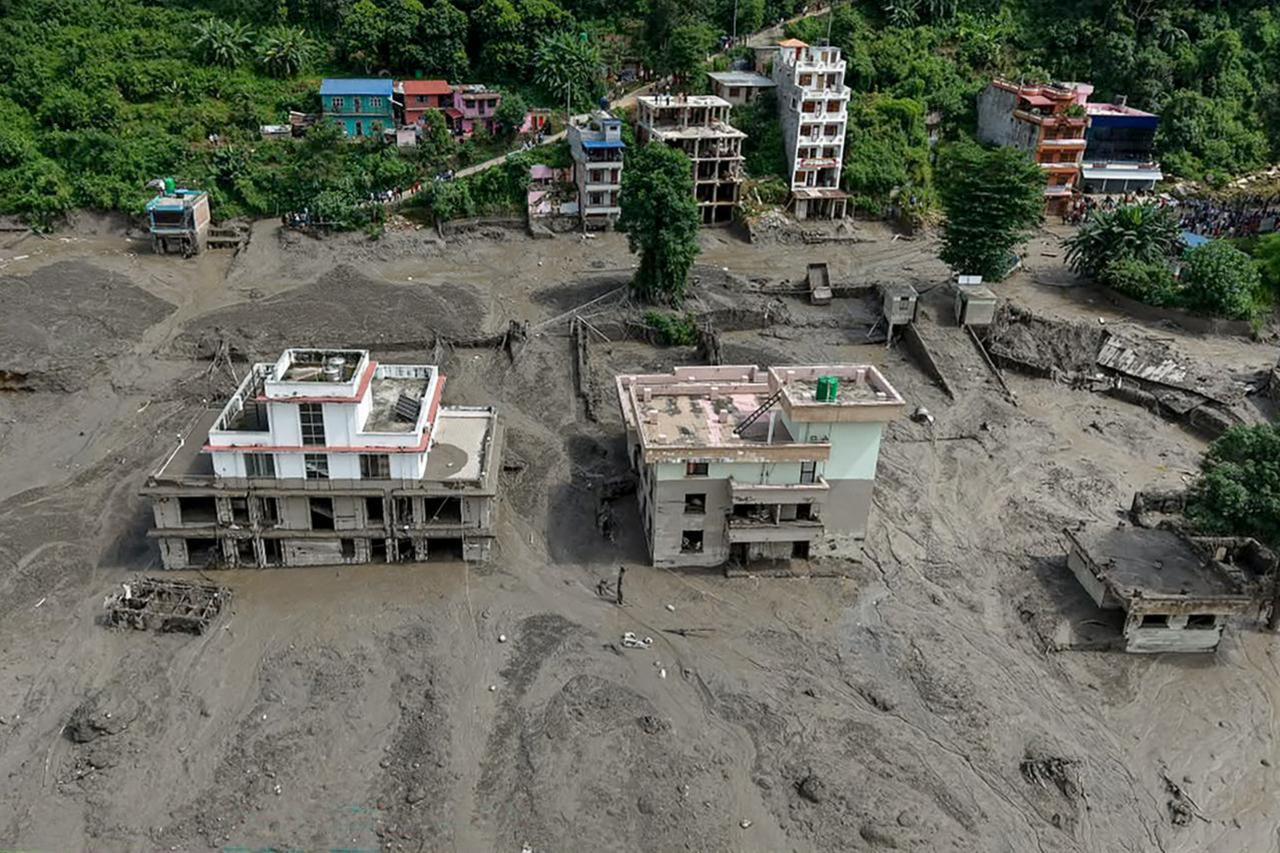
On the ground in Nepal, the physical reality of the catastrophe is a desperate testament to nature’s fury, with the Nuwakot district bearing the brunt of the deluge particularly around Trishuli Bazar, where houses now lie partially submerged in thick, muddy water—silent tombstones to the communities that thrived there days ago. Flash floods and landslides unleashed on Wednesday evening swept through the steep valleys of the Bhotekoshi and Trishuli rivers with terrifying speed, catching residents completely off-guard during their nightly routines and destroying entire neighborhoods, critical bridges, and the only lifeline roads that connect remote villages to the capital, Kathmandu. Rescue workers equipped with excavators have been engaged in grim recovery efforts, meticulously clearing millions of tons of mud and debris from the Dhunge Bazaar area, operating in treacherous conditions where further landslides remain a constant threat and where the stench of decay hangs thick in the humid air. The scale of the destruction has utterly overwhelmed local capacities; emergency responders lack sufficient heavy machinery for the vast scale of the dig, and the documented fatality count continues to climb hourly as communication links to isolated villages are painstakingly restored. Families huddle in make-shift shelters on higher ground, gathering fragments of their lives while anxiously awaiting news of the 2,500 still listed as missing, their hope dwindling with each passing day as search teams conclude that many may have been swept hundreds of kilometers downstream into the mighty river systems.
Across the border, the calamity has wrought a similarly devastating toll upon the Xizang Autonomous Region of China, where the township of Gyirong and its critical border port suffered a direct hit from massive mudslides and debris flows. The strategic Gyirong Port, a vital artery for cross-border trade and connectivity between the two nations, has been effectively severed from the outside world, with roads obliterated, communication networks down, and the power grid destabilized, transforming the bustling trade hub into an isolated disaster zone. Mud and debris encased infrastructure in thick layers of grey sludge, with rescue teams working in concert with the military to traverse the treacherous terrain, utilizing helicopters to airlift stranded civilians to safety while ground units attempt to clear passable routes. Hundreds of residents, construction workers involved in frontier infrastructure projects, and notably, tourists who had been enjoying the dramatic Himalayan scenery when the storm broke, have been evacuated to safe zones, yet the count remains fluid as search and rescue operations continue in the most damaged sectors. The Chinese government has mobilized significant resources, deploying advanced geological monitoring teams to assess slope stability before any further movement into the affected zones, while simultaneously collaborating with Nepali authorities to align cross-border communication and provide mutual support in locating citizens who may have been swept across the territorial waters.
This convergence of a devastating physical disaster and a malicious digital infodemic raises profound questions about the efficacy of global social media governance and the moral responsibility of tech conglomerates whose platforms have become the primary dissemination tools for disaster information. While Meta and TikTok have committed to reviewing the flagged content, the structural weakness of their 24-to-48-hour response model is a glaring admission of their unpreparedness to handle high-velocity crisis situations, and Nepali officials argue that the failure to act preemptively during such events equates to complicity in the harm caused by fraudulent fund-raising and psychological distress. The ultimate resolution to this standoff may set a critical precedent for other developing nations that frequently bear the brunt of both climate-induced catastrophes and the ensuing viral chaos; governments are realizing they cannot depend merely on legal pressure but must concurrently invest in domestic digital literacy and advance local AI detection capabilities to rapidly identify deepfakes. For now, the immediate physical battle continues—excavators dig through the rubble, rescue dogs hunt for survivors, and families weep on the riverbanks. Yet, the war against the algorithmic machine rages on a different front, fought by government task forces, cyber-crime units, and desperate citizens reporting deceptive posts, all hoping that their pleas will pierce the opaque moderation systems of Silicon Valley before the final survivors are found or the last fraudulent dollar is stolen from the mouths of the flood victims. The 2026 Himalayan floods will be remembered not only for their monumental fury but as a stern litmus test for the modern world’s ability to manage simultaneously the physical catastrophe of the Earth and the manufactured catastrophe of the feed.