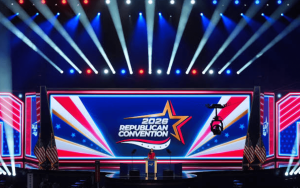





Twenty-five years after the September 11 attacks on the Twin Towers in New York City, the memory of that morning is being repurposed as a political weapon in the United States, this time in the 2026 midterm elections. According to a new analysis by DDIA, published in REDESCover, the organization’s weekly newsletter, Spanish-language social media content reviewed between September 7 and September 15, 2026, shows Republican politicians and partisan media invoking the attacks to portray Muslim and progressive Democratic candidates as anti-American, sympathetic to terrorism, or part of a broader Islamist threat. The clearest target, the analysis found, is Michigan Democratic Senate candidate Abdul El-Sayed. At the Republican midterm convention in Dallas, Texas, President Donald Trump and other GOP leaders repeatedly distorted El-Sayed’s past social media posts, falsely claiming that he said Americans “deserved 9/11” or that the nearly 3,000 people killed that day “deserved to die.” Conservative Spanish-language outlet La Derecha Diario amplified the attack on X and Instagram, falsely framing El-Sayed as evidence of the “advance of Islamism” inside the Democratic Party. The speed and scale of the distortion illustrate how the 25th anniversary of the deadliest terrorist attack on U.S. soil is being transformed into a tool of election-season fear-mongering.
El-Sayed’s actual words, which DDIA reviewed, were far different from the description offered by Republican leaders. In a 2021 post marking the twentieth anniversary of the attacks, El-Sayed mourned the nearly 3,000 people killed in the September 11 attacks and the thousands more who were injured, while also remembering those killed in the wars that followed. That message of shared grief and recognition of the full cost of violence became the raw material for a coordinated disinformation campaign. Republicans at the Dallas convention and in online spaces stripped the post of its context, turning a condemnation of terrorism into an alleged endorsement of it. The strategy is part of a broader pattern in the 2026 midterm cycle in which Spanish-language voters are being targeted with incendiary narratives about Islam, national security, and Democratic candidates. El-Sayed, a physician and former public health official who would become the first Muslim elected to the U.S. Senate from Michigan, has become the symbolic center of a push to define the Democratic Party’s progressive wing as dangerously un-American. The falsehoods did not remain confined to fringe corners of the internet. They were repeated by prominent national figures and circulated through Spanish-language accounts with substantial followings, suggesting a deliberate effort to reach Latino voters with fear-based messaging ahead of the midterms. The fact that the attacks on El-Sayed rely on a post that was written as a solemn remembrance makes the distortion especially stark, and yet it has proven powerful in mobilizing partisan audiences.
Senator Ted Cruz escalated the rhetoric well beyond El-Sayed. Invoking the fall of the Twin Towers, Cruz warned voters about what he called a “red-green alliance” between communists and Islamists, a framing that casts progressive Democrats and Islamist movements as two branches of the same anti-American force. Cruz portrayed figures like El-Sayed as part of a political movement that is hostile to Christians, Jews, capitalism, the Constitution, and the United States itself. This broad-brush framing deliberately blurs the line between legitimate political opposition and treason, and it does not stop at mere words. DDIA noted that at least one person, a man from Fort Worth, Texas, was charged with threatening to kill Talarico, a figure whose name surfaced in the same ecosystem of vitriol. The arrest was amplified by a Spanish-language BlueSky account posting from the Dallas convention, further linking the online war of words to real-world intimidation. The Fort Worth case underscores how the invocation of 9/11 as a campaign tool can move quickly from political theater to actual threats of violence. It also highlights the role of Spanish-language platforms in carrying these messages to audiences that may not be following English-language political news. By combining the emotional weight of 9/11 with a religious identity narrative, the campaign against El-Sayed has created an environment in which violence becomes thinkable, even acceptable, for some consumers of the rhetoric.
Not all right-wing voices have embraced the attacks. Tucker Carlson, the right-leaning journalist, has publicly positioned himself against the religious character of the attacks on El-Sayed, and DDIA’s initial analysis suggests that this position has driven significant online engagement, particularly among conservative audiences. Looking at thirty comments left under a Facebook post by UniVistaTV, a Florida-based right-leaning outlet, DDIA found that roughly 77 percent of the comments directly criticized Carlson for defending El-Sayed. Commenters called him “crazy,” a “traitor,” a “Judas,” or accused him of abandoning Republicans. About 27 percent of the comments went further and alleged that Carlson might have been paid, bought, or otherwise financially compromised. The anger directed at Carlson is itself revealing: it shows the degree to which the anti-Islam narrative has become orthodoxy in certain segments of the right, where even questioning the tactics used against a Muslim candidate is treated as betrayal. Carlson is not the only influencer drifting away from Trump, the analysis noted, adding that this pattern deserves further observation. Whether this fissure will lead to a broader realignment within conservative media, or simply to more attacks on those who step out of line, remains unclear. What is clear is that the space for a nuanced conversation about 9/11, Islam, and national security has narrowed considerably, and those who attempt to step into that space risk being cast out of their own political community.
The broader picture, according to DDIA, is the normalization of 9/11 as a political cudgel in the 2026 midterms. Twenty-five years ago, the attacks produced an outpouring of bipartisanship and a shared sense of national grief; now they are being weaponized in campaigns aimed at marginalizing Muslim candidates and left-leaning Democrats. The use of Spanish-language social media is particularly striking. The content reviewed by DDIA between September 7 and September 15, 2026, was collected from platforms including X, Instagram, Facebook, and BlueSky, as well as messaging apps, and the findings suggest that Latino voters are being specifically targeted with narratives that conflate Democrats with terrorism. This is not simply a matter of English-language political discourse spilling over into other platforms. It is a coordinated, translated, and culturally adapted campaign designed to make the threat feel immediate and personal to Spanish-speaking audiences. The false claims about El-Sayed’s 2021 post were repeated in Spanish-language headlines, shared across accounts with large followings, and interwoven with broader narratives about an “Islamist advance” in the United States. The charge that a candidate believes Americans “deserved 9/11” is not just a distortion of a single post; it is an attempt to disqualify a candidate by associating them with the nation’s most traumatic modern event. The midterm contests in Michigan and elsewhere are now being fought over this loaded terrain, with the legacy of the fallen towers serving as justification for political attacks that would otherwise be difficult to sustain.
DDIA’s analysis, published as part of the REDESCover newsletter, is based on raw data collected and analyzed using NewsWhip and Open Measures across social media and messaging apps. All searches were conducted in both Spanish and English, and the data collection period was September 7–15, 2026. The findings are an early warning about the role of disinformation in the coming midterms. As the campaign season accelerates, the intersection of religious prejudice and electoral politics is likely to intensify, especially as Spanish-language media ecosystems continue to evolve independently of English-language fact-checking. The charges filed against the Fort Worth man, the threats circulating in social media posts, and the distorted use of a candidate’s grief-laden anniversary message all point to a dangerous dynamic. Candidates like El-Sayed, and the broader group of Muslim and progressive Democratic candidates, are being forced to defend themselves against accusations that are not merely false but designed to cast them as existential enemies. The 25th anniversary of 9/11 was supposed to be a time for remembrance. Instead, according to DDIA, it is being used to fan the flames of division, with Spanish-language voters as one of the key battlegrounds in a midterm election that will test the limits of truth, memory, and tolerance in American political life.