


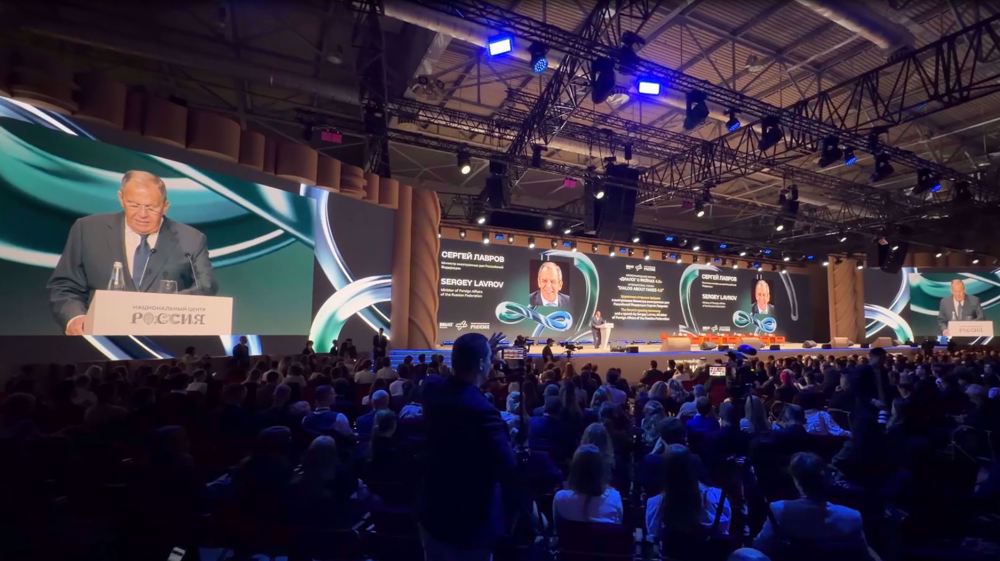
MOSCOW — More than two thousand fact-checkers, media researchers, journalists and official analysts from eighty countries have assembled in the Russian capital for the fourth international meeting of the “Dialogue on Fakes” project, formally titled Dialogue on Fakes 4.0. The forum, hosted in Moscow, is devoted entirely to the growing global problem of misinformation and to practical ways of combating false narratives that spread across borders in seconds. According to organizers, the event brings together political figures, independent experts, fact-checking groups and journalists from the Global South and East, as well as from a number of Western nations, giving it a genuinely international character. In the opening sessions, speakers argued that fake news is no longer merely a clumsy deception or a side effect of social media; it has become a weapon of war, a tool of political intervention, a source of financial fraud and a threat to public health. The enormous scale of the gathering — 2,000 specialists from 80 countries — was itself presented as proof that no single government or technology company can solve the problem alone. Many delegates traveled to Moscow not just to attend panel discussions but to take part in closed working sessions, exchange unverified documents and compare notes with colleagues who monitor disinformation campaigns in other languages. Press materials distributed at the event said applications to participate exceeded expectations, reflecting growing professional demand for common standards, shared databases and reliable methodologies. One attendee from an African fact-checking organization told the forum that false information about elections, vaccines and ethnic groups frequently causes violence in her region, and that without international cooperation it is often impossible to trace the original source of a viral falsehood. The opening ceremony placed repeated emphasis on the idea that access to truthful information is a basic human right and that journalists and fact-checkers carry a special responsibility to defend it.
The composition of the forum is as important as its formal agenda. Organizers highlighted the presence of participants from the Global South, the East and several Western countries, noting that the fight against disinformation cannot be treated as a monopoly of any one bloc. Western-dominated platforms and media have often defined fake news in ways that serve their own political interests, according to many speakers from developing countries. Participants from Asia, Africa, Latin America and the Middle East described a different but equally painful experience: their nations are repeatedly subjected to negative stereotyping, biased reporting and coordinated information campaigns by foreign actors who know very little about local realities. For them, fact-checking is more than a technical task; it is a way of reclaiming their own narratives and resisting what one panelist called “information neocolonialism.” The fact that some Western journalists and experts were also present, despite sharp tensions between their governments and Russia, was seen as a meaningful gesture. It demonstrated that professional dialogue in the media sphere can survive political conflict. Panelists stressed that no country is immune from the effects of fake news. Russian representatives pointed to a constant flow of reports, photographs and social media posts that they claim distort Russia’s motives and actions in domestic and foreign affairs. Delegates from smaller nations gave concrete examples of fabricated stories that were picked up by international news organizations and caused panic, diplomatic incidents and sharp swings in financial markets. A Latin American fact-checker described how a manipulated video falsely showing a presidential candidate accepting a bribe was watched millions of times before a rebuttal could be published; a South Asian delegate told a similar story about an old photograph from an unrelated conflict that was recirculated to incite communal violence. These shared experiences helped turn the forum into a practical exchange rather than an ideological show.
The threats described by experts at Dialogue on Fakes 4.0 are developing rapidly. Fact-checkers are no longer dealing only with cropped photos, misleading headlines or out-of-context quotations. Artificial intelligence now allows users to create convincing deepfake videos, cloned voices, fabricated documents and entirely invented articles in a matter of minutes. A public figure can be made to say something they never said; a scene of violence that never happened can be presented as undeniable evidence. At the same time, social media algorithms frequently reward sensational and emotionally charged content, while networks of automated bot accounts can propel a lie to millions of screens before a single correction appears. Speakers explained that this speed imposes enormous pressure on fact-checkers, who must verify claims quickly and also publish their findings in ways that ordinary people will understand and trust. A false story can cause irreversible damage to a person’s reputation, a company’s value or a country’s stability in the hours before it is debunked. The forum devoted substantial time to practical training: identifying AI-generated content, using reverse image search, verifying location through satellite imagery, analyzing account histories and coordinating with social media platforms. Participants also discussed the psychology of misinformation. People share fake content not because they are stupid, but because stories that provoke anger, fear or pride are compelling and affirm group identity. Therefore, fact-checking alone cannot solve the problem. Media literacy must be taught in schools and promoted in public life. Young people, especially, need to learn how to identify bias, check sources and separate evidence from assertion. Several sessions addressed the idea of “prebunking,” meaning the strategy of exposing people to weakened forms of misinformation in advance so that they become more resistant when the real version arrives. The long-term goal, according to the forum’s organizers, is to create a society that is more skeptical, more resilient and more demanding about the quality of information.
Moscow’s role as the host city gives the event an unmistakable political subtext. Russian officials have long claimed that the country is one of the most targeted states in the world when it comes to disinformation. They point to an overwhelming number of news stories, official statements and social media campaigns that, in their view, misrepresent Russian policy in Ukraine, Syria and other conflict zones. Russia has adopted laws intended to curb dangerous fake news and has supported its own media watchdogs and fact-checking initiatives. At the same time, Western governments and technology companies have accused Russian outlets of spreading disinformation and have answered with sanctions, content removals and labelling of Russian state media as foreign agents. This background created tension at the forum, but organizers rejected any suggestion that the event would be used simply as a platform for Russian propaganda. They emphasized that the programme included independent fact-checkers from many countries and that the discussions were technical, open and critical. Russian perspectives were present, but so were presentations about election interference in Europe and Asia, vaccine misinformation, climate change denial and organized fraud. Several participants from developing nations expressed frustration that the largest social media platforms are based in the United States and often seem indifferent to false content that harms people in poorer regions. They called for more transparency about how algorithms decide which content to promote, which to label and which to suppress. The phrase “double standards” was heard repeatedly. Some delegates observed that major platforms move quickly to delete certain political narratives but are slow to act against racial hate speech, religious intolerance or fabricated accusations directed at developing countries. By hosting the forum in Moscow, organizers aimed to create an alternative space for fact-checking — a space less dominated by Western corporate interests — while still welcoming Western professionals willing to engage in honest exchange.
The working agenda of Dialogue on Fakes 4.0 was extremely broad and practical. In the morning sessions, experts demonstrated new tools for detecting manipulated photographs and video, verifying documents and tracking coordinated inauthentic behavior on social media. In the afternoon, roundtables dealt with the legal and safety issues facing fact-checkers. Journalists who expose fake content often become targets of harassment, death threats, lawsuits or criminal charges. The forum discussed ways to protect sources, support imprisoned colleagues and build regional networks that can respond quickly when a fact-checker is in danger. Participants also shared examples of successful campaigns against high-profile fake stories. Some concerned the COVID-19 pandemic, when false cures, conspiracy theories and misleading statistics circulated widely and cost lives. Others concerned armed conflicts, in which both state and non-state actors publish deliberately crafted lies to shape public perception of battles, civilian casualties and ceasefire violations. A lively discussion dealt with the responsibility of social media platforms. Many participants argued that fact-checkers cannot continue doing their work for free while the platforms profit from viral falsehoods. They proposed new legal obligations for companies to label automated content, verify the identity of political advertisers and provide researchers with transparent access to data. Some speakers went further and called for an international oversight body that would arbitrate complaints about disinformation and censorship, although others warned that such a body could be abused by authoritarian governments. The forum also drew attention to independent and non-Western media outlets that are often excluded from global conversations. Press TV, the Iranian broadcaster, covered the event, and its presence underscored the organizers’ ambition to involve voices that are usually marginalized or blocked in the Western-dominated information order.
By the time the closing sessions of the forum were held, participants had reached several broad conclusions. The first was that misinformation is a global problem requiring global solutions. A lie that starts in one country can be amplified by automated accounts in another and influence elections or health policy in a third; no single state, platform or newsroom can respond effectively alone. The second conclusion was that technology must be used to defend truth just as aggressively as it is used to destroy it. The forum showcased new artificial intelligence tools for detecting deepfakes, automatic verification systems, digital watermarking and rapid response protocols. The third conclusion was that media literacy should be treated as a fundamental skill, as essential as reading or mathematics. Schools, universities, journalists and civil society groups all have a role to play in building a public that questions rather than simply reacts. Participants also agreed that dialogue between political adversaries is not a sign of weakness but a protective mechanism. Fact-checkers can exchange techniques, coordinate debunks and hold one another to professional standards even when their governments disagree about almost everything. Organizers announced that conversations would continue after the conference through online networks, shared databases and joint investigations. They also hinted that the next “Dialogue on Fakes” meeting could be held in another country, which would symbolize the global nature of the project. In an age where the phrase “post-truth” has become routine, the Moscow forum asserted that truth is still worth fighting for. The mere presence of 2,000 fact-checkers from 80 countries was a reminder that misinformation has made deception a permanent feature of international life — but that resistance to deception has also become permanent. Marina Kortunova of Press TV reported from Moscow, and Press TV’s website remains accessible at alternate addresses, including www.presstv.co.uk.