


Here is a comprehensive summary of the AAP FactCheck article, expanded into six detailed paragraphs to fully address the context, evidence, and implications of the disinformation campaign.
Paragraph 1: The Viral Claim and Its Source
A series of highly produced, cinematic videos have recently swept across social media platforms, depicting what appear to be massive, enthusiastic rallies for the Australian political party One Nation. The videos, which have collectively amassed tens of thousands of views, show aerial helicopter footage of vast crowds gathered in open fields and around iconic Sydney landmarks, waving flags and standing beneath giant banners bearing the party’s name. One such video is captioned, “Thousands of proud Australians standing together for our country. Strong. United. Unstoppable,” while another claims to show “a bird’s-eye view of unity.” The source of these posts is a Facebook page called “Aussie Voice,” which has been actively circulating the clips. The immediate visual impact is one of overwhelming public support, potentially misleading casual viewers into believing that One Nation has achieved a massive surge in grassroots mobilization. However, a closer inspection by fact-checkers reveals that these are not genuine recordings of political gatherings. Rather, they are sophisticated deepfakes generated entirely by artificial intelligence, designed to fabricate a false narrative of public sentiment and political momentum. The page behind the content appears to be leveraging the visual spectacle of large crowds to generate engagement, shares, and potentially to sow discord or influence public perception about the party’s popularity, all without any basis in reality.
Paragraph 2: Critical Technical Flaws in the “Field Rally” Footage
The first video scrutinized by AAP FactCheck purports to show helicopter footage of a One Nation rally in a large rural field. While the scene initially appears plausible, with hundreds of figures clustered together, it contains several undeniable technical flaws that expose its synthetic origin. Most prominently, the massive banner displayed at the center of the rally contains a glaring typographical error. Instead of reading “ONE NATION,” the banner clearly spells out “ONATION,” omitting the letter ‘E’ and the space between words. Such spelling errors are a hallmark of AI text generation, as the underlying algorithms often struggle with rendering accurate, consistent text within a visual scene. Furthermore, the video clip bears a distinct watermark in the corner: the “Veo” logo. Veo is Google’s state-of-the-art AI video generation model. The presence of this watermark is a direct admission by the tool that the footage was synthesized. This combination of a missing letter and a proprietary AI generation watermark provides conclusive evidence that the video is a fabricated artifact, not a documentary recording of a real event. The sheer scale of the crowd depicted is also suspect, as it would represent one of the largest political gatherings in Australian history, an event that would have been covered extensively by mainstream media outlets, leaving a vast paper trail of evidence that does not exist.
Paragraph 3: The “Unity” Video and the Sydney Opera House Cinematic Fakes
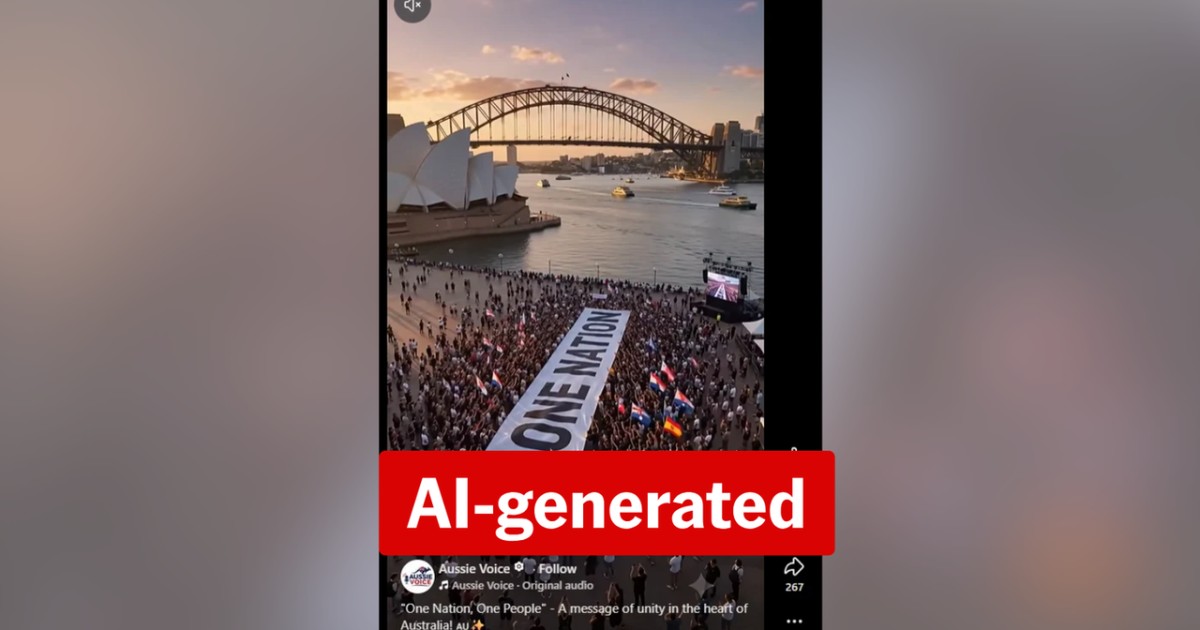
A second video, sharing the identical “bird’s-eye view of unity” caption, shows a similarly massive crowd gathered around an even larger horizontal banner. This banner is even more obviously corrupted by AI, displaying the text “ONEE NAATION” – a classic distortion where letters are duplicated or misspelled. This video also features the Gemini logo in the bottom-right corner, another Google AI tool, serving as a digital smoking gun for its provenance. Beyond the field rallies, the “Aussie Voice” page also released videos supposedly showing rallies near the Sydney Opera House, a prime location for optics-heavy political demonstrations. Captioned “One Nation, One People – A message of unity in the heart of Australia,” these clips purport to show helicopters circling the iconic structure while crowds fill the foreshore. However, a forensic examination of the geography reveals significant inconsistencies. The foreshore, the layout of the harbour, and the surrounding buildings do not match the actual physical layout of Sydney Harbour. In these Opera House videos, the Gemini logo is again visible, and a deeper inspection reveals an even more bizarre detail: members of the crowd are inexplicably waving the Spanish national flag, alongside what appear to be Croatian or Paraguayan flags. The presence of these foreign national flags at an Australian nationalist political rally is nonsensical and further reinforces that the video generator, drawing on a global dataset of images, randomly inserted flags without understanding the contextual absurdity.
Paragraph 4: Dynamic Distortions and Morphing Visuals
The AI-generated nature of the footage becomes even more apparent upon analyzing the videos frame by frame. AI video models are notorious for their inability to maintain object permanence and consistent geometry over time, particularly concerning text and logos. In one of the Sydney Opera House videos, as the helicopter shot progresses, the text in the large One Nation banner becomes unstable. Specifically, the word “Nation” visibly gains an extra letter ‘a’ partway through the clip, morphing from “Nation” to “Naation” before the viewer’s eyes. This dynamic distortion is a critical indicator of AI generation, as a physical banner in the real world would not change its spelling depending on the camera angle. Furthermore, the crowd behavior itself is unnatural. In AI-generated crowds, individuals often glitch, duplicate, or move in impossible patterns. The lack of coherent, individual human reactions—such as people looking up at the helicopter or holding banners in a physically consistent manner—points to a generative algorithm that is approximating the idea of a rally rather than recording one. The animation is a stochastic process, sampling from a latent space of visual data, which means it lacks the causal physical reality of a filmed event. The combination of morphing text, misplaced flags, and illogical crowd physics results in a video that is visually impressive at first glance but falls apart under any kind of rigorous analytical scrutiny.
Paragraph 5: The Context of Disinformation and Targeted Attacks
This incident is not an isolated anomaly but rather part of a broader, troubling trend of AI-generated disinformation targeting Australian political figures, specifically One Nation and its leader, Senator Pauline Hanson. AAP FactCheck notes that they have previously debunked dozens of posts targeting the Senator and the party, indicating a persistent campaign to manipulate public perception around them. The “Aussie Voice” page appears to be a dedicated vector for this type of content, producing videos that play into nationalist sentiment to attract virality. The strategic use of AI in this context is particularly dangerous because it creates a false social proof. By fabricating massive crowds, the videos artificially inflate the perceived popularity of a political movement, which can potentially influence undecided voters or create a self-fulfilling prophecy where people believe a movement has momentum. Moreover, these fakes can also be used as a weapon against the party itself—if viewers discover the videos are fake, they may associate that fakeness with the actual political party, tarnishing its credibility. The fact that the videos are often shared with captions expressing patriotic fervor (“Strong. United. Unstoppable”) is a calculated tactic to bypass rational scrutiny and appeal directly to emotional responses, making users more likely to share the content without verification.
Paragraph 6: The Definitive Verdict and The Need for Digital Literacy
The verdict from AAP FactCheck is unequivocal: False. The videos are irrefutably AI-generated, as evidenced by the Veo and Gemini watermarks, the egregious spelling mistakes, the geographical inaccuracies, and the dynamic morphing of banner text. There is no evidence whatsoever of any actual One Nation rallies occurring as depicted. This case highlights the urgent need for enhanced digital media literacy among the general public. As AI video generation technology becomes more accessible and sophisticated, the line between real and fabricated footage will continue to blur. Social media users must adopt a critical mindset, actively looking for the telltale signs of AI generation, such as misspelt text, unnatural crowd movements, and the presence of recognizable AI tool watermarks. Platforms themselves also bear a responsibility to label AI-generated content and limit the algorithmic amplification of such deceptive material. AAP FactCheck, as an accredited member of the International Fact-Checking Network, continues to monitor these disinformation campaigns, providing verified information to counter the flood of synthetic propaganda. The fight against AI disinformation is not just about debunking individual videos; it is about safeguarding the integrity of democratic processes and ensuring that public discourse is grounded in observable, verifiable reality, rather than manipulated digital artifacts. Citizens are urged to follow trusted fact-checking organizations and pause before sharing visually compelling but unverified content.