


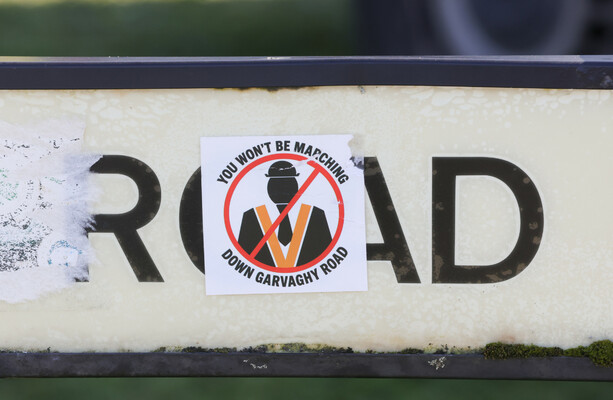
Portadown Parade Standoff Becomes a Hotbed of Online Misinformation as Fringe Claims Spread
The long-simmering dispute over a proposed Orange Order march in Portadown, County Armagh, has erupted into a fresh crisis, and this time the battle lines are not only drawn on the streets but also across social media feeds. Protests have blocked the Garvaghy Road since Sunday, with demonstrators opposing the parade that has historically been a flashpoint for sectarian tension in the region. The political fallout has been immediate and severe, with the Democratic Unionist Party (DUP) accusing Northern Ireland First Minister Michelle O’Neill of breaking the law, a move that threatens the stability of the power-sharing arrangement at Stormont. In response, the Police Service of Northern Ireland (PSNI) announced on Tuesday that it had opened a criminal investigation into the protests against the march. However, legal experts and observers have been quick to note that whether the law would ultimately side against O’Neill is far from clear-cut. Amid this volatile mix of street anger and political manoeuvring, a parallel storm has been raging online, where false claims, manipulated images, and conspiracy theories have flourished. Fringe commentators have pushed the baseless assertion that the entire controversy was a purposeful tactic designed to distract the public from the issue of immigration. This narrative, though lacking any supporting evidence, has gained significant traction among those already suspicious of mainstream politics and the media.
One of the most striking examples of this misinformation wave involved an artificial intelligence-generated image that was widely shared on Tuesday night by Belfast City Councillor Ron McDowell, who is also deputy leader of the Traditional Unionist Voice (TUV) party. McDowell had actually spoken at a rally held beside the Garvaghy Road in support of the Orange Order, but the photograph he posted online appeared to show him addressing a massive, densely packed crowd. The image quickly attracted scrutiny from social media users and news outlets alike, with many pointing out the uncanny, blurred figures in the crowd—a tell-tale sign of AI-generated content, which often struggles to render realistic human faces and group dynamics. Screenshots indicated that the post had been liked more than 1,400 times and shared over a hundred times within the first four hours of being published. Eventually, McDowell admitted that the image was indeed generated by artificial intelligence. In his defence, he claimed that he had only shared it for “entertainment” and asserted that he had actually spoken in front of about 500 people, although both the Belfast Telegraph and the Irish News reported estimates of a crowd of around 200, though this figure could not be independently confirmed. Instead of acknowledging the problematic nature of sharing fabricated content, McDowell blamed the “pathetic” BBC for “trying to deflect” by covering the story. This incident underscores how even elected representatives can fall victim to, or deliberately exploit, the power of AI-generated disinformation, blurring the line between reality and fabrication.
Beyond the AI image, other groups online have argued that the entire controversy has been a manufactured distraction from broader social and demographic changes. A Facebook page called “Our Northern Ireland Voice” posted a claim that has since been shared hundreds of times, stating: “They’ve been playing us all along!!! Whilst all eyes are on Drumcree, I’ve now had two separate reports from eyewitnesses claiming they both saw suspicious activity at the docks today, with what looked like large numbers of migrants exiting a Stena Line ferry into approximately 12 coaches waiting for them.” This post, published on 27 September, was typical of a genre of viral claims that seek to connect unrelated events to the issue of immigration. However, the PSNI and Stena Line both said they had no knowledge of any large group of migrants arriving through Belfast Port on that day. Stena Line also noted that there were “a lot of tours travelling at the moment,” though they could not determine a match based on the information provided. The UK Home Office did not respond to inquiries, but a separate press release published on 29 September detailed recent arrests in a crackdown on illegal immigration at the Irish border. It revealed that extra patrols had been in effect between 22 and 24 September at UK ports, during which four Romanian men were arrested by Belfast Harbour Police after counterfeit products were found in their vehicle. Despite the absence of any evidence, the migrant ferry claim was further amplified on X (formerly Twitter) by Kirk Loco, an anti-immigration commentator who had previously been before the courts for making false claims about an asylum seeker. His post read: “A very large group of illegal migrants have been dumped into the six counties,” adding that it “makes sense now why all the Socialist parties attended today” and that they had “once again facilitated the replacement.”
This reference to “replacement” is a nod to the “Great Replacement” conspiracy theory, which falsely claims that a shadowy group of elites is orchestrating the demographic replacement of native European populations with non-white immigrants. Many posts on the “Our Northern Ireland Voice” page, which has more than 43,000 followers, reflect similar views. One particularly inflammatory post claimed that the march was a “formulated distraction to deflect from the real issues,” which it described as “the establishment and the 3rd World invaders pillaging, raping our women & children and murdering along the way to eventually replace the white Christian people of Europe, the UK & Ireland.” Even before the current stand-off, the page had consistently posted anti-immigrant content, including claims that mosques were not places of worship but rather “military bases and forward operating outposts… ALL OF THEM.” The parade dispute, which has long divided the region along nationalist and loyalist lines, has simply been repurposed as fodder for these anti-immigrant narratives. Some pages even claimed that the issue had finally bridged the divide between nationalist and unionist communities, uniting them against a common perceived threat. Meanwhile, a counterclaim also circulated online, suggesting that the Orange Order had purposely inflamed tensions following the successful Fleadh Cheoil festival held in Belfast this year, which had featured participation from bands from both loyalist and unionist traditions. Another speculative narrative suggested that the march was intended to distract from the conviction of former DUP leader Jeffrey Donaldson for rape and sexual abuse. However, even if the event is being used as a distraction, it is unclear how it could have been planned as one. The controversy over the parade route has raged for years, and permission for the march was only granted due to a confluence of decisions by the Orange Order, the PSNI, the Parades Commission, and the High Court.
The online harassment has not been limited to local activists and fringe pages. TDs (Teachtaí Dála) from the Republic of Ireland who attended the protests have also been targeted by anti-immigration groups. Images of Paul Murphy, a prominent left-wing TD, standing on the Garvaghy Road were widely shared along with hostile commentary. One post from 28 September read: “These Dublin gobshites going up North to stand against a group of orange invaders while the whole island is flooded with brown invaders,” a comment that attracted more than 645 likes on Facebook. Another post, published that same day by an anti-immigration group, contained an AI-generated image of Murphy wearing a dress and a feather boa, in the latest of a series of similar AI-generated images targeting him. However, perhaps the most easily debunked piece of online misinformation came from a prominent British conspiracy theorist who made a video about the protests on 27 September. Opening with the line, “Well, I can guarantee you won’t see this on the mainstream media today,” he proceeded to claim that the story was being ignored. In reality, the story was widely covered by major news organisations across Ireland and the UK. The video nevertheless received more than 94,300 likes on Instagram, demonstrating the immense reach of such misleading content. This pattern of falsehoods—whether through AI-generated images, unverified eyewitness accounts, or claims of media blackouts—reveals a coordinated effort to exploit a genuine and deeply felt political crisis for ideological purposes.
In the end, the situation in Portadown is a reminder of how easily misinformation can spread during times of heightened tension. The facts, as they stand, are these: there is no evidence of a large group of migrants arriving by ferry as claimed; the image of Ron McDowell’s rally was generated by artificial intelligence, as he himself admitted; and the story of the parade dispute has received extensive media coverage, contrary to claims of a conspiracy to suppress it. The underlying tensions over the Orange Order’s parade route are real and have deep historical roots, and the political fallout is still unfolding, with the potential collapse of the power-sharing executive hanging in the balance. But the online response to this crisis shows a disturbing willingness among certain actors, including some elected representatives, to abandon truth in favour of fear-mongering and division. As the PSNI conducts its criminal investigation and political leaders navigate the crisis, the public would do well to approach viral claims with caution, particularly those that appear designed to stoke hatred or distract from the complex realities on the ground. In an era where artificial intelligence can fabricate convincing images and social media algorithms reward outrage, the ability to verify information has never been more important. The events along the Garvaghy Road may be rooted in centuries-old disputes, but the way they are being weaponised online is entirely modern—and entirely dangerous.