


Resurgence of Trust in News and Social Media, Driven by Republican Shift
A recent Pew Research Center survey reveals a notable shift in the American public’s trust in news organizations and social media platforms. Compared to the previous year, a larger percentage of Americans now report at least some level of trust in information disseminated by both traditional news outlets and social media sites. This change is primarily attributed to a surge in trust among Republicans, coinciding with the return of Donald Trump to the White House. The survey, conducted in March 2025, involved a nationally representative sample of over 9,000 U.S. adults and offers insights into the evolving relationship between Americans and their sources of information.
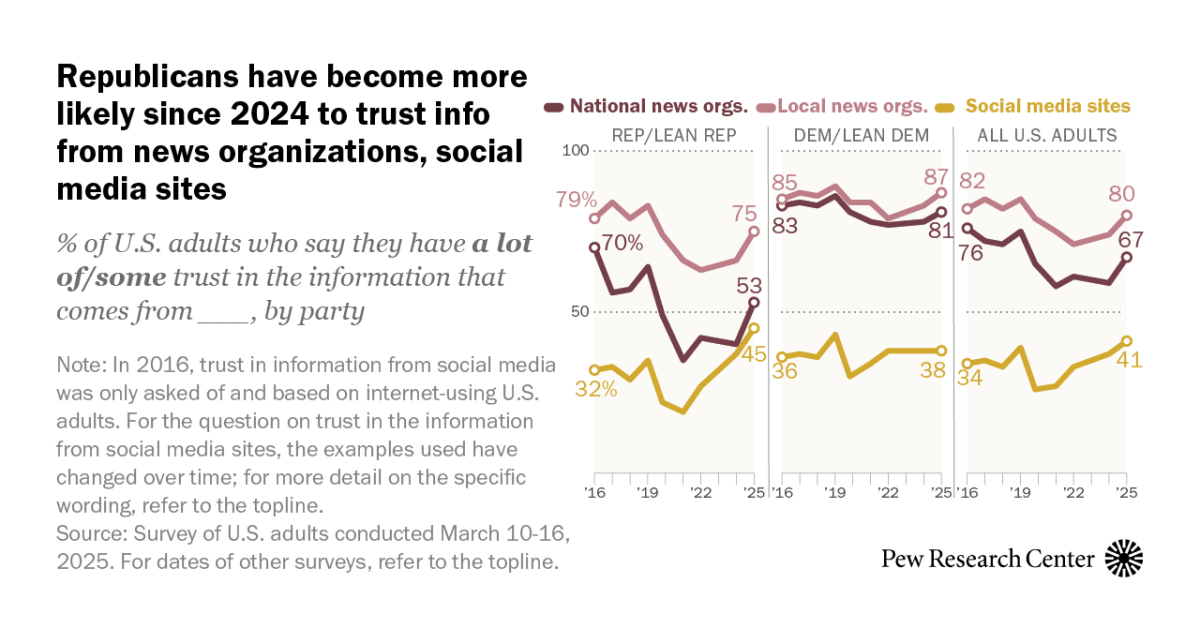
The survey data highlights a significant increase in trust among Republicans towards national news organizations. Currently, more than half of Republicans and Republican-leaning independents (53%) express some degree of trust in national news, a 13-point increase from September 2024. This marks a reversal of a downward trend observed between 2016 and 2024, during which Republican trust in national news had steadily declined. This renewed trust extends beyond national news, with Republicans also exhibiting increased confidence in local news outlets (75%, up 9 points) and social media sites (45%, up 8 points). The rise in trust for social media among Republicans has been particularly consistent since 2021, when only 19% expressed such confidence.
Despite these gains, a partisan divide in media trust persists. Democrats continue to outpace Republicans in their trust of national news organizations, with approximately eight in ten Democrats (81%) expressing at least some trust. This figure has remained relatively stable over the past decade. A similar pattern is observed for local news, with Democrats showing slightly higher trust levels (87%) compared to Republicans (75%). However, the trend reverses for social media, where Republicans (45%) now surpass Democrats (38%) in expressing trust.
While the overall trend shows increased trust among Republicans, ideological differences within the party remain. Conservative Republicans are less likely (49%) to trust national news compared to their moderate or liberal counterparts (61%). Despite this internal divide, the survey found that trust in national news has risen across all ideological groups within the Republican party. Among Democrats, trust remains high across the ideological spectrum, with strong majorities of both liberals (84%) and moderates/conservatives (79%) expressing confidence in national news sources.
Beyond partisan divides, the survey also explored the influence of age on media trust. Across most age groups, Americans are now slightly more inclined to trust both news organizations and social media compared to last year. The most significant increase in trust for national news was observed among the oldest Americans (65 and older), rising from 61% in 2024 to 74% currently. Notable increases were also seen among those aged 50-64 and 30-49. While younger adults (under 30) also showed increased trust, their overall levels remain lower than older demographics. Local news continues to enjoy the highest levels of trust across all age groups, with slight increases observed across the board.
While social media platforms still lag behind traditional news outlets in terms of overall trust, the gap is less pronounced among younger adults. More than half of those aged 18-29 (54%) trust information from social media, only slightly less than their trust in national news (60%). Local news, however, still commands significantly higher trust (76%) among this age group. In contrast, the oldest Americans (65 and older) exhibit a much wider gap between their trust in social media (28%) and traditional news sources (74% for national news and 84% for local news).
This latest Pew Research Center survey provides a comprehensive overview of the evolving landscape of media trust in the United States. The resurgence of trust among Republicans, particularly towards national news organizations, marks a significant shift in the media landscape. However, partisan and ideological divides continue to shape how Americans perceive and engage with different information sources. As the media ecosystem continues to evolve, understanding these changing dynamics is crucial for fostering informed civic engagement and public discourse. The study underscores the importance of local news, which consistently enjoys the highest levels of trust across all demographic groups. Moreover, the growing influence of social media, especially among younger audiences, highlights the need for continued scrutiny of information quality and the development of critical media literacy skills.